I wasn't even aware of Facebook until it had (apparently) taken over the world. People had tried to get me to join My Space and I think I did create a profile once, but didn't do much with it. Same with Twitter. I tweeted up a storm for a few weeks or so, but never understood what the use was. Still don't, frankly. I don't find others' tweets very interesting. I don't think mine are all that interesting, either.
I was told "everybody" was on Facebook, and only losers weren't on it. I heard friends talking about statuses and walls, friends and likes, but it was all Greek to me. I finally joined due to advice that it was a fantastic marketing tool, and I had just published a book.
From a marketing perspective, Facebook has been a bust for me. But I did play some lame-but-addictive Facebook games for a minute when I first started. I made hundreds of new "friends," was found by relatives I didn't remember...I even found a couple guys from units I served in.
Joining Facebook was like opening a floodgate. Since then I've been inundated with invitations to join more social networks--of which the variety seems to be infinite.
Are you kidding me? I can't even keep up with Facebook! (And Twitter, and my blog, and the Kindle Boards, and Goodreads, and Shelfari, and Library Thing, and VPP, etc. etc. etc...much less my writing.)
I've got some quality pals on Facebook, but probably less than 5% of them like to read. (Read anything besides Facebook posts, that is.) That's how Genrebuds offers a significant advantage for booklovers. It's meant to be a network for literate people. Instead of compiling lists of activities and interests, favorite songs, movies, etc. (which will be obliterated during the next Facebook "upgrade"), you choose what genres you like to read when setting up your profile. There are freebies, different ways to earn points, ribbons and such if you're into all that.
The list of genres reflects the market shares of the publishing industry, so far as I can tell. Hence the sort of fiction I prefer will likely be under-represented. Even so, the chance to connect with potential readers there should still be far greater than on Facebook.
If it had been around when I first entered the social networksphere, I probably would have concentrated my efforts there.
If you like to read, and would like to network with others who do, this might be the site for you.
The Cyber-Man-Cave For Literate Action Junkies
Thursday, October 20, 2011


Friday, October 7, 2011
Louis L'Amour...Need I Say More?
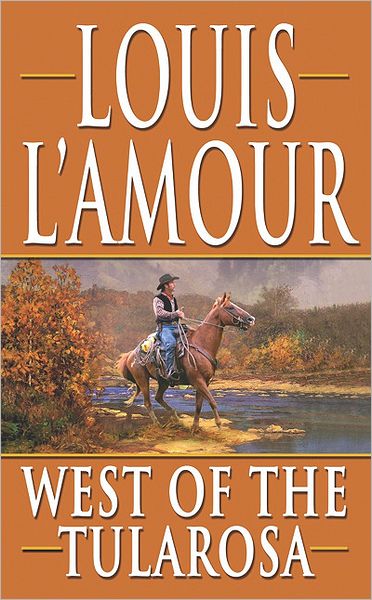
This incredibly prolific author is to westerns what Stephen King is to horror and Agatha Christie is to mysteries. Modern critics who insist all heroes be flawed despise writers like the old merchant marine (that's right--he spent more time asea than he ever did on horseback--as you'll learn in the interesting introduction/L'Amour biography). And yes, his books do tend to be formulaic. But hey--he developed his own formula. He didn't copy Zane Gray, Max Brand or anyone else.
In West of the Tularosa, a compilation of some shorter fiction from his early career (most of it written for western pulps), the legendary author is a bit more versatile than most of us have gotten used to. Oh, sure: The hero of each story is pretty much the same guy with a different name and a different gun (once in a while a different occupation--like an hombre who traps mountain lions for circuses). OK. And the leading ladies are all the same fetching western lass, as well. Granted. And big surprise: aforementioned hero always beats the bad guys and wins the heart of aforementioned fetching western lass. But don't assume L'Amour was just conforming to the times he grew up in. Watch a boxing movie from the time period in these tales were written (late '40s-early '50s), or some film noir, or read some of the crime fiction of the period. Pop culture had its share of squeaky-clean, handsome, G-rated good guys up to this point, to be certain; but to stick with that ran against the artistic zeitgeist.
L'Amour's protagonists weren't just handsome good guys--they were good good guys. Clean, honorable and honest. This reflected the sentimentality he and his readers felt about the frontier stage of American history. As Gene Autry sang in "Back in the Saddle Again":
...Out where a friend is a friend
Where you sleep out every night
And the only law is right
The "wild west" is frequently characterized as lawless. Well, they certainly didn't have all the police and jack-booted federal agents harassing the citizenry that we do now. Or lawyers, either. Yet society as a whole functioned much better then, despite the respective technology (women and children were safer, statistically, in the very worst frontier towns than they are today in our cities, for instance). Why? Most of the citizens didn't know much about the law, but they sure knew right from wrong.
Can't really say that today, can we?
We could sure use the kind of men L'Amour wrote about in our country now. It would be nice if everyone could brag that their "friends" were truly friends, too.
There were some good yarns in this anthology. Some felt cut a little short, probably due to their original pulp-bound purpose. A few could (should?) have been expanded to novel-length. It's easy to see why so many readers relate to this author's protagonists--they're young, strong, brave, good-looking and honest to a fault. Oh yeah, and almost always a phenomenal gunfighter, even if they punch cattle for a living. As Jeff Cooper might say, "They ride (hard), shoot straight, and speak the truth."
My favorite yarn in the batch was the last, the longest, and the one from which the title of this anthology was taken: West of the Tularosa. It's on the complex side for a L'Amour tale, some whodunnit mystery mixed in with the familiar range conflict.
R.I.P. Louis, we miss you. And your heroes.
Thursday, September 29, 2011
Robert E. Howard's Map

I'm far from an expert on Tolkien, but the fact that his most famous fictional setting was a place called "Middle Earth" suggests that he intended some sort of connection with historic reality.
When introduced to Robert E. Howard's fantasy, I first assumed the Conan character's home world had been built from scratch, so foreign were most of the geographic and ethnic terms to me at the time. But as I delved deeper, I discovered clues now and then (some subtle, some huge) that Conan's world was Earth...maybe just in some sort of alternate history. (A whopper of a clue happened in the John Millius film when the Cimmerians are called "Northmen".)
In time, I came to understand that Conan did, indeed, live on Earth--but during the "Hyborian Age." From then on, I couldn't read a Conan story without trying to figure out how his geography fit into the maps I was familiar with. Some of it was determinable by logical means, like the Land of Shem and the Pictish Wilderness. But much of it left me scratching my head.
That's why I was delighted to discover a reproduction of this map, sketched by Howard himself, in which you can easily discern Europe, the Middle East and North Africa underneath his Hyborian boundaries. Now I (and you) have this handy reference to help us trace the barbarian's footsteps.
Monday, September 19, 2011
Celebrate Cheap Kindle Books!
Hello 2-Fisted Blogees. Just a quick note to tell you about Daily Cheap Reads--a site where all books are $5 or less.
You may think I'm crazy for plugging the competition like this. Well, selling books is not a zero-sum game, as others have pointed out. People who like to read don't stop after the first book they buy, then never read again. Plus, the focus of Daily Cheap Reads is different from Virtual Pulp Press. There is some overlap in our target demographics, but I can live with that.
Most of the books featured at Daily Cheap Reads have at least 5 reviews on Amazon, so vetting is fairly easy. I hope you'll go check their site out. With all the changes happening in the publishing industry, this may be the best book lovers have ever had it.
You may think I'm crazy for plugging the competition like this. Well, selling books is not a zero-sum game, as others have pointed out. People who like to read don't stop after the first book they buy, then never read again. Plus, the focus of Daily Cheap Reads is different from Virtual Pulp Press. There is some overlap in our target demographics, but I can live with that.
Most of the books featured at Daily Cheap Reads have at least 5 reviews on Amazon, so vetting is fairly easy. I hope you'll go check their site out. With all the changes happening in the publishing industry, this may be the best book lovers have ever had it.
Thursday, September 8, 2011
Good News For Pulpy Action Adventure Fans Part 2

Ever since Quentin Tarantino's film, just about everyone is familiar with the term "pulp fiction." But do you know where he got that title?
Unlike highbrow literature from the 19th and 20th Century, pulp fiction was written entertainment for the regular guy, printed on the cheap paper from which it got its name.
Writers in pulp fiction gave the world escape from the dreary and mundane with heroes like Conan, Tarzan, Sam Spade and Buck Rogers. Over time, the pulps evolved into the action-adventure paperbacks of the 1960s-80s, as documented in Jack Badelaire's first issue of Hatchet Force. Characters like the Executioner, Nick Carter and Remo Williams inspired legions of imitators, as well as blazing a trail for other "men's fiction" authors to tittilate us with action adventure series set in WWII, the Wild West, the Banana Wars or outer space. Some of it was bad. Some of it was good. Most of it was great fun, giving us something to chuckle or smile about (however guiltily) for far longer than a feature-length film could entertain us.
Unfortunately, "men's fiction" had all but disappeared by the 1990s. Many avid readers quit visiting the book store over the succeeding years, since there were fewer and fewer books that appealed to them. Sure, some of the gutsy, testosterone-charged titles could still be found at used book stores, or thanks to online sellers, but either venue required hours of browsing to find the desired book among the multitudes of romances, chick-lit, horror and political or techno-"thrillers."
The good news is, there are developments coalescing to benefit those who enjoy reading pulp or pulpesque fiction. One such development is a renewed interest in the genre, represented in several blogs and Facebook pages/groups dedicated to the subject matter. Another promising trend is some great new fiction by talented authors inspired by the classics--some of which is arguably even better written than the inspirational source material.
Another significant victory for the genre is the opening of Virtual Pulp Press.
Unlike other online bookstores, Virtual Pulp Press is dedicated to a certain flavor of entertainment, and is focused on that whether the format is book or e-book; non-fiction, fiction, or film.
In days to come, I'll be working on making Virtual Pulp Press even better. For right now, I think it's pretty cool and worth all the work I put into it. I hope you will check it out, and tell somebody about it.
Sunday, September 4, 2011
Feel Guilty, But Enjoy Plenty Gruesome Violence First

Somebody lent me the Condemned DVD and, with no internet connection at the crib, I burned up a couple hours watching it recently.
It's a scenario I've seen before: evil rich guy throws a bunch of desperate cutthroats into an elaborately controlled environment and has them fight to the death (Similar to The Running Man, in a way). The "twist" this time is that they're all death row prisoners from around the world. Evil Rich Dude's logic is, "They're gonna die anyway, so why can't I make a buck off it?"
OK--sounds logical, I guess. And there were some nice touches throughout the flick. But amidst all the splattering blood, the film makers kept going back to the theme of how inhuman the spectators can become in spectator sports. Sort of like the original Rollerball, only subtle.
As subtle as a 12-pound sledgehammer.
There were some real douche-bag characters in this flick, and the director employed all the usual tactics to make us want to see them suffer the same kind of torture and horrific deaths that they inflicted. And then we were supposed to feel guilty about it. "OMG! We're just as bad as the 40 million people paying to see this snuff circus on the internet! Maybe we're almost as bad as the eeveel capitalist scum that's getting rich off the whole thing!"
Yawn. OK, whatever. Let's get to the fighting, since that's really the appeal of this kind of film, ironic guilt messages notwithstanding.
Steve Austin...wasn't he an astronaut who suffered a terrible accident, then wound up with bionic legs, arm and eye?
I like old western movies, alright? But even so, I admit they had some of the most ridiculous fight scenes ever filmed: 20-minute bare-knuckle brawls. Punches telegraphed from two miles away. Men on the receiving end of those dramatic haymakers standing around waiting to get hit (when it was their turn). Heros flooring villains with said haymakers, then stooping down to pull the villain to his feet in order to hit him again.
Well, the fight coreography in this flick was that bad. Not just with fists, either. The sadistic, murderous ex-SAS dude was given a bow with arrows. Twice he had our hero dead to rights, but didn't take a shot. One of those times, rather than launch an arrow into Austin's considerable target area from his protected position on high ground, he jumps down to Austin's level to menace him with the bow at melee range.
I guess classic westerns have some stiff competition for Most Ridiculous Fight Scenes in "professional wrestling." That's where I think Austin came from and probably what influenced the stupid fighting.
Movies like this are hard to pull off, I guess. Especially when they take their hackneyed message too seriously.
Sunday, August 28, 2011
Where There Were No Innocents by Thomas Drinkard


This novel offers an officer's perspective on SOG during US involvement in Vietnam. I understand this is a prequel to another book, but this was my introduction to the author and character.
Mack Brinson is the type of officer every good soldier wishes was in charge. Though his duties in MACV-SOG seem rather nebulous, he voluntarily tags along with SOG teams that go behind the fence, and earns enough respect to be invited to the one-zero table more than once after a mission.
No Innocents provides a fascinating glimpse into the pseudo-secret SOG command structure, administration, and even some operations. It overlaps nicely with Jack Murphy's PROMIS Vietnam, which was written from the perspective of a one-zero, or SOG team leader.
After his tour begins, Brinson is targeted almost immediately by VC assassins, and has numerous close calls. The reason for his targeting really struck me as plausible, too. In fact, though I'm at least a generation too young to have ever been to Vietnam, most of this book smacked of authenticacy, thanks to the author's experience in-country. Especially the geography and character interaction...with one exception.
That exception is Brinson's whirlwind relationship with the beautiful Song. I know love-at-first-sight does happen, so it's not that that bothers me, really. But these two decide to get married after one date. I know that happens, too, especially during wartime. I just think, story-wise, it could have been milked for a lot more suspense/conflict. Some suspense did get added to the mix by way of Song's father--an influential man in South Vietnam's intelligence organization, though.
In any event, the guts of this novel is SOG's part in the war up to and including the Tet Offensive, and it was presented so well as to outweigh my issues with the romantic subplot.
Monday, August 22, 2011
Survivor #2: The Nightmare Begins by Jerry Ahern
I admit this at the expense of dating myself badly, but I grew up during the end of the Cold War. From the age of seven or so, when a sibling informed me that the world could be annihilated at the push of a button, I lived with the threat of nuclear holocaust looming in the back of my mind. In fact, the very first time I heard the beeping of a phone left off the hook too long (I think I was 12 or 13), my very first thought was, "Oh, no. This is it!" Not having seen the previous generation's "Duck and Cover" films, I just assumed there was no possibility of surviving such a conflict.
A few years later, I saw The Road Warrior. That film influenced me in a few different ways. I'll mention two of those ways: 1) It caused me to consider the possibility that a nuclear exchange did not necessarily guarantee the obliteration of all human life on the planet. 2) Despite my fear of a nuclear war that could set the skies on fire at any moment, I really enjoyed it. I enjoyed it so much that I've had an affinity for the post-apocalypse genre ever since. Back in the day, I couldn't wait for the next Doomsday Warrior or Last Ranger to be published. Yet somehow, I missed Jerry Ahern's Survivalist series.*
I've recently corrected that oversight. I now have one Survivalist under my belt* and am hungry for more.
The series' title character is John Rourke, a former CIA operative who was on a civilian flight at the hour the missiles struck. His sidekick in this book was Paul Rubenstein, a former white collar geek type with a good heart, and a mental toughness allowing him to cope and adapt well to the new world, under Rourke's hands-on tutelage. Rubenstein was on the same flight, which crashed out West. The story picks up as the pair are making their way through Texas for the eastern seaboard, where Rourke hopes to find his wife and kids still alive somehow, and Rubenstein plans to turn south into Florida to look for his parents. They're traveling on motorcycles (Rourke in style--his is a Harly).
This series has most of what you would hope to find in a post-apocalyptic yarn: A smart, skilled, resourceful hero who is up to the extraordinary task of surviving in such a world; a wide-open Wild-West type landscape of dangerous wilderness and ghost towns; and a rogue's gallery of brigands and Soviets to ensure Rourke's quest is no radioactive milk run. And yet Ahern avoided some of the cliches...er, conventions I've come to expect in the genre. There were no human mutants, for instance. Our heroes did encounter a group of infected teenagers, but the author made it clear they were living on borrowed time--not transforming into vampires or Marvel supervillains. And though there was some sexual tension here and there, there was no prose-porn.
What about gun porn? From what I've read, Ahern has a reputation for this. Maybe I still don't understand where the threshold is defined between describing a weapon/its use and descending into "gun porn," but in my opinion the author's treatment of firearms in this book was the former, and not the latter. Rubenstein's primary weapon (a WWII German submachinegun, MP40) is so interesting that I now am tempted to seek out the first issue just to find out how it was acquired. Rourke's signature side armament are twin Detonics Combat Masters, and his use of them at one point (though nothing flamboyant enough for a John Woo movie) actually had me break reading silence and sound off with a hearty "ooh-rah!" For long range, he carries a CAR-15, arguably the father of the M-4 carbine in such wide use today in US troop deployments.
I have a prejudice against the entire M16/AR15 family of weapons. The 82nd Airborne Division was usually one of the first units to get new toys (the Kevlar helmet, the M249 SAW, etc.), and I did get to plink with some M16A2s when they were still brand new. Their accuracy was pretty good, I'll admit, and they were far more dependable than the A1s I had used in OSUT. Yet I was apalled by their tendency to malfunction in spite of diligent cleaning. Especially in sandy environments. Yet the AR15 and its derivatives are still the most popular assault/battle rifle with the Pentagon and in men's fiction. There's a chance I may be able to present an interview with Jerry Ahern here on the 2-Fisted Blog soon, and this is one of the details I'm hoping he'll share his thoughts on. There are some other choices he made I'm curious about, too, so I'm hoping this interview deal pans out.
OK-moving on.
The bad guys in Nightmare Begins were also a breath of fresh air. No "B" movie Nazis here--even the KGB honcho. And his wife/agent Natalia is surprisingly complex. (Rourke recognizes her, BTW, from one of his spook missions in Central America.) In addition to the knowledgeable depictions of weaponcraft, I appreciated thoughtful details like the difficulty of finding gasoline after a nuclear war. A very popular author in the genre fails to address this issue honestly. Another author in the genre, many of whose books I personally like, had his protagonist once use Federal Reserve notes to pay for something in the post-nuke economy...and they were accepted! Rourke and Rubenstein find it necessary to forage (though they make an effort to deal fairly and honestly with others). This is a far more sober speculation, IMO.
Nightmare Begins has left me with the impression that at this point in the continuity, the series is just hitting its stride. I certainly plan to read the other Survivalist book I picked up, and will be on the lookout for others. Based on this reading, I recommend The Survivalist as an intelligent, well-written TEOTWAWKI series with plenty of action to keep us turning pages.

*From what I've read about the series, I remember reading a book many years ago that may have been a much later installment in this series. But I can't swear yes or no.
Tuesday, August 16, 2011
Captain America and Art Deco-Punk

Meanwhile, I'd like to comment on the high point of Hollywood's summer.
Ever since learning Joe Johnstone was the director, I felt confident that the character was in safe hands. And he was. Other critics are kvetching about the "safe" screenplay, but aside from the obligatory irritation of one of my personal pet peeves, I think Johnstone did a fantastic job. Rather than a typical review, I'm gonna focus on a challenge or 2 Johnstone met with aplomb.
In the Golden Age of comics (coincident with the halcyon days of pulp fiction and cliffhanger serials), when Captain America was first created, people couldn't have guessed half of the technology we take for granted today. And yet, creative types imagined some technology that has yet to be achieved in reality.
Like practical rocket packs and a super-soldier serum.
(Individual jet packs were developed during the Vietnam War, and demonstrated at one of the first Superbowls, but consumed too much fuel for more than one short flight and were abandoned as impractical for transport of troops by the US Army. They were never more than an expensive and dangerous novelty.)
So one of the challenges Johnstone faced was presenting still-futuristic (?) gadgets during an historic setting. Not that this hasn't been done before. One of my favorite reruns to watch, growing up, was The Wild, Wild West, which did just this. And there is an entire genre called "steampunk" which features this anachronistic premise as a primary ingredient. In The Rocketeer and Captain America, Johnstone pulls off the anachronisms so masterfully, I think it deserves it's own phrase. I'll call it "art deco-punk."
Howard Hughs' rocket pack looks like it could actually work. And yet it also looks like something designed and built in the 1930s. Same for the helmet Cliff Secord wears. Of course the Rocketeer props were based on the drawings from the comic source material, but kudos to the film makers for not attempting to "fix" something unbroken.
In First Avenger, the same imaginative skills are in evidence in the Red Skull's fortress and aircraft, as well as the secret lab where Steve Rogers is transformed into Captain America. But the art deco-punk was carried out well in the costume, also. The original Captain America costume from the comics (with the triangular shield) is cleverly incorporated into the flick as what Rogers wears for USO and War Bond appearances. But when he hits his stride as "the bona fide article," Cap wears an outfit a little less outlandish. Johnstone and his crew rose to the challenge of finding a "realistic" excuse to have an operative in the ETO fighting the Nazis in a red, white and blue costume.

In comic books, readers have apparently never had a problem with flamboyant costumes in robust hues. But in real life, people are offended by bright colors. So with the exception of the Superman and Spiderman films, and one particular campy TV series from the 1960s, every successful comic book adaptation for the screen has either replaced the superhero's costume or modified it with bland, muted colors. Johnstone's costumer did mute the Star-Spangled Avenger's colors, but it's also noteworthy that they conceived his headgear more as a helmet than a mask, but didn't take the cheap, ridiculous route the makers of the '70s TV pilot did (in photo below):

In the medium close-ups of Cap in his costume, you can see material and stitching consistent with that issued to American troops during WWII.
Did the screenwriter also modify the origin story from the comic book canon? Yes, but not in the disrespectful, ham-fisted manner of so many other adaptations. Bucky and other stock characters were worked into this cinematic tale, re-conceived to be more believable, and even my own purist/stickler-for-accuracy self was pleased with how it was handled.
There are two other things I'll mention about this movie. In the political sense, they disprove the contention that Johnstone "played it safe" in the making of this film.
For whatever reason (verisimilitude, probably), Johnstone chose to show Captain America bearing arms--something I've never seen in the comics (most superheros have some sort of "code against guns"). Johnstone's leftist contemporaries in Hollywood will only show firearms responsibly used by cops, government agents, Communist revolutionaries or soldiers in wars they grudgingly approve of. I guess Cap falls into this latter category, but it's still a departure for a big-screen superhero.
After Watergate, the writers at Marvel found sufficient excuse to reveal their scorn for a "patriotic superhero" by turning Captain America into Nomad. That didn't go over so well. But now that the mass media has redefined patriotism to justify their lionization of politicians who commit treason, a supposed form of patriotism is considered acceptable again. It's okay to pay tribute to our flag as long as you pervert what it stands for. It's okay to pay lip service to our Constitution as long as you subvert its actual meaning and intent with globalist or Marxist plattitudes. The "safe" road for Johnstone to take would be to present Captain America as "a citizen of the world" who just happened to be born in the USA (remember when the Justice League of America became the "Justice League, America"? Or Bill Pulman's Independence Day speech, in the movie of the same name, that was really a globalist soundbite for interdependence?) And yet during Captain America and the Red Skull's climactic confrontation, it is clear from a short exchange about flags that the Skull is the globalist and Cap is rather proud of the exceptionality of his country.
Not to take anything from the other great superhero adaptations (of which Batman Begins might be the best), Joe Johnstone, along with his cast and crew, really did a bang-up job on this movie IMO. If Marvel Films can harness the swag of this one and the first Iron Man flick, then The Avengers should turn out to be something truly spectacular.
Monday, August 8, 2011
New Pulp is Spearheading the Revival

In an earlier post, I pontificated on pulp authors coming together and creating a brand for quality fiction that readers could grow to trust over time. Well, that is exactly what Mike Bullock, Tommy Hancock and others plan to do via New Pulp. And "others" includes me. I couldn't commit to a regular column of my own, but I am the columns editor now and will be contributing some of my own occasionally, starting with some interviews of movers and shakers in the Pulp Renaissance.


New Pulp is really a cool development on the one-year anniversary of the 2-Fisted Blog. Y'all may not be hearing from me much, these days, but I assure you I am working my tail off every chance I get. I've got several projects in the works right now that I'm stoked about and should prove to be something to be proud of if I execute well.
I'll be keeping you posted.
Hank
Tuesday, August 2, 2011
Terminal Departure by Joe Crubaugh
When agent Cleo Matts boards an airliner to defuse a false flag operation, things don't go as planned. He didn't count on the CIA planting a pound of C-4 in the cargo bay. He didn't count on being seated next to a gorgeous runaway Hollywood superstar. He didn't count on the ancient Watchers intruding in the flight path. And he didn't count on a U.S. President gone rogue who can't bowl worth a crap.Instead of business as usual, Matts embarks on a balls-to-the-wall adventure that takes him from 35,000 feet in the sky to the back streets of the Big Easy, from the halls of NASA to the corridors of Washington, DC, to a final bloody showdown with the Ministry of Streunberg in a raging ice storm.
This espionage action thriller is a plunging, twisting roller coaster ride that serves up a heaping helping of political satire, aliens, secret agents, scientists, beautiful women, a genetically-modified super virus, a CIA false flag operation, men in black, a jetliner that isn't going to make it to the ground in one piece, and many eccentric characters driving the plot.
Crubaugh has written a page-turning gigglefest involving competing secret and pseudo-secret government agencies, germ warfare conspiracies and alien abduction. This is one of those indie books that overcomes the stigma of poor editing, amateurish prose, etc. It's quirky and laugh-out-loud funny as Crubaugh weaves his eclectic tale, with a political outlook in synch with the entertainment industry as a whole. Were the publishing industry not in such a crisis now, I can easily imagine this being published conventionally and placed beside the latest from Hiassen or Coben.
Cleo Matts is sometimes on the loopy side of eccentric, which makes him all the more appealing as a hero. Movie star Julia is unique for Hollywood in that she's pretty down-to-earth; but typical in that her Hollywood marriage is going down in flames when we meet her. Perhaps my favorite character was Stormi--a girl with a great attitude even when she's verbally tearing somebody a new hole. Airline pilot Dallas is the lucky guy who fate throws together with Stormi, and though complete with human weaknesses, he's still a guy you want to root for.
Terminal Departure is certainly entertaining. I would have liked just a bit more exposition about the CIA-vs.-Trapdoor conflict, and maybe how Roman knew about Cleo but not vice-versa. I felt a little off-balance, too, that the aliens play such a major role during the first act, but aside from some telepathic advice, go MIA for the rest of the novel.
Depending on your sense of humor, this book is well worth your time for the laughs alone.
Saturday, July 23, 2011
From Writer's Purgatory to the American Dream
In the late 1990s I did not envision the revolution in publishing that is taking place before our eyes. But I wanted to write. The only respectable route to publishing for a non-celebrity who had no contacts in the biz then was the traditional method: send out hundreds of queries, receive hundreds of rejections and maybe, if the stars were aligned just right, somebody who mattered would read your query and sample chapters. If it was great stuff, and it just happened to be read by someone who liked it, and they just happened to push it up the food chain when the suit above them was having a good day, and a bazillion other variables all clicked in your favor, you just might wind up, a few years down the line, getting a book published by one of the Big (insert number here) of the New York Publishing Cartel.
"Tradpub", or traditional publishing, was the only game in town. So I prepared to play the game. Having learned in college the value of having others read and critique my written work (ripping it, and my ego, to shreds if necessary), I joined a writer's group.
I suppose all writer's groups consider themselves the best, most talented collection of literary geniuses the world over, but the group I was fortunate enough to be accepted into did have plenty of bragging rights. Several of the members achieved tradpubhood, accruing accolades from hoity-toity authorities like Kirkus; and the founder of the group attracted Hollywood interest with one of her books. I mention this not so much to boast, but more to provide perspective on some of the experiences I intend to share. And one reason I intend to share is that I'm convinced that the attitudes encountered in that writing group are very similar to some of the attitudes prevalent in the big publishing houses.
The first attitude I'll mention has to do with trust in the author.
Not everyone who reads fiction about cops and crime are themselves cops or criminals, and yet we know a lot of police jargon and procedures. Terms like "rap sheet" and "APB" were not always universally understood. How did we learn it? Not because we went to a police academy, or took a class about it, or read expository paragraphs in which the author spoon-fed us the information up front in most cases. Most likely we learned it from context--whether in a book, a movie or a TV cop show.
I've never been a medical professional, but I know what "scrub in" means. Not because anyone overtly taught me, but because the missus likes medical shows and I've watched enough of them with her to pick it up via context.
For those familiar with Star Trek, you didn't come to understand "beam me up" or "set for stun" or photon torpedoes or dilithium crystals because Kirk, Spock, Picard, Ryker or Gene Roddenberry lectured you on what it all meant. You picked it up by context. And if you're like me, you can learn stuff like this about subcultures that are new to you simply by reading a book set in that subculture by an author who will reveal these tidbits by context.
If the author's name is Stephen King, Tom Clancy, J.K. Rowling, etc., members of a writer's group will also learn this way. If the author is unknown, no matter how competent a writer, typical writer's group members will not trust them, and will demand the explanation of this new term, procedure, technology, whatever, be spoon-fed in full to the reader up front. (If the unknown author follows their advice, the red ink will fly again for insulting the reader's intelligence. But that's another story.) Ever notice how some people won't believe you, until they hear or read the same thing you said from some "expert?" Same principle in effect, here.
The next attitude I'll call "finding excuses to reject." I was accepted into the aforementioned group because the founder loved my prose (in a manuscript I as yet haven't published, BTW). There were no membership dues at the time, so I didn't doubt her sincerity. Plus, it was pretty doggone good, if I do say so myself. Ahem. Anyway, when I submitted that very same manuscript for a critique session, the critiquer I was assigned was all over me from the first sentence. (I could say quite a bit about this individual, and probably will one day, but don't want to get off-track here.) My competence came into question because I made a time reference, and the person assumed I meant pm when I meant am. Indeed, assuming pm made my introductory passage ludicrous; am was the only way it made sense. Now me, as a reader, I would have simply accepted the passage in the way that it made sense and read on. I tend to give people (politicians excepted) the benefit of the doubt, and there really wasn't much doubt to be found there.
Well, therein lies the distinction: They weren't reading it--they were searching for faults to criticize. This was a mild omen of things to come during this critique of a manuscript which did, honestly, have problems in need of correction. Unfortunately the actual problems, as I see them now in retrospect, went largely unaddressed by this person so intent on nitpicking everything they possibly could.
I once had an otherwise great, helpful critiquer in this group take issue with my use, without explanation, of the acronym "GPS". Correct me if I'm wrong, somebody, but GPS is a household term that civilians and everyone else is familiar with. (In case I am wrong, it stands for Global Positioning System, though the term is routinely misused, referring instead to a device that accesses the GPS. OK?)
When a member of this same group looked at my first draft of Hell and Gone, they raised the red flag when I wrote that one of my characters dove "to the prone." Granted, that's not Oxford-approved English, but it is exactly how that term is used in the military. She must have caught me during an insecure moment, because I wound up changing it to "the prone firing position."
Ah, insecure moments. I've had plenty, as a writer. In another manuscript, I mentioned that my protagonist sat down to breakfast. One group member, who undoubtedly read one of those "how to write fiction" manuals, thought I should reveal what he ate. I changed it so that the reader knew he was eating biscuits and gravy. The next person who gave me feedback wanted to know why he ate biscuits and gravy. Well, what he ate and why he ate it was not crucial to the chapter or the overall plot, but in another insecure moment I revised, figuring I could use it to work in some character background (after all, that's why those "how to write" manuals drill these things into critiquer's heads) and decided that biscuits and gravy was a habitual breakfast choice from when the character was going through financial difficulties, since the meal is both cheap and filling. The next person who gave me feedback thought, by reflecting on this, my character was wallowing in self-pity. At this point I considered omitting any mention of breakfast or any other meal altogether.
This maddening, time-consuming process was probably an effective orientation for the publishing biz at that time. Agents, editors and assistants don't read manuscripts; they search for excuses to reject them. Pick any 50 of them and each one will find a whole different set of excuses to reject Gone With the Wind. That's not entirely a sarcastic exaggeration--experiments like that have been conducted by frustrated writers, illustrating the mercurial subjectivity in the tradpub lottery.
There are reasons why the suits in New York have this attitude: They are buried under tons of manuscripts (most of which are garbage), they have very little time, and they're under constant pressure to pick only winners. Stamp your approval on too many books that don't sell enough to cover expenses and you're out of a job.
Valid reasons to be picky, right? So then, even with their Remorseless Rejection Machine set to Maximum Filtration, why do they still wind up publishing so much crap? Including crap that doesn't even sell? And non-crap that doesn't sell, despite all their marketing clairvoyance and gatekeeping wisdom?
I once had a publishing insider explain something about the selection process to me. I can't remember all the percentages she gave, but the gist of it is educational. This was a minority woman, BTW, who had worked for a major publishing house, and a major literary agency.
During a given fiscal year, a tradpub house only has so many books it can publish. First dibs go to the proven heavy hitters like Stephen King, whose grocery list would become a New York Times Bestseller as long as his name is on it. Next in line (and this is nauseating, if not surprising) are the writers who "know people" inside the industry. There is a little more scrutiny/quality control here than for the big name authors, but this is where a lot of the worthless drivel comes from. Next on the pecking order are female minorities. Then male minorities. (Homosexuals have been given quota parity with racial minorities for quite a while. Now they are one of the most powerful special interest groups in existence and I have no doubt this is reflected in the current pecking order.) Then women in general (which sometimes includes men who write for female audiences and/or who write female protagonists, plus men who use female pseudonyms). Everyone not heretofore mentioned is at the bottom of the slush pile, competing for the very smallest portion of the publishing pie.
And for those fortunate few whose manuscripts are actually opened by somebody with a modicum of decision-making authority, the axe chops something like this: First to get the axe are those manuscripts that fail qualitative inspection. Fair enough. Next are those with a low Crystal Ball Factor ("This is about a rogue submarine captain. It's never been done before. There's no market for it." "Rogue submarine captain stories have had a good run, but the market is now saturated with such fare. I sense the popularity of this genre will wane by the estimated print date." "Mysteries concerning racehorses aren't trending well right now." "A school for witches and warlocks is just plain silly." And so on.) Somewhere in there (unless the author is a celebrity with clout), the book must pass the ideology test--the politics must resonate with that of the New York Publishing Cartel, and any characters in the book who believe differently had better be either from the Archie Bunker/Frank Burns/Denny Crane cookie cutter or, better yet, the next Hitler or Darth Vader. Next on the chopping block are the books that offend the personal tastes of the gatekeeper ( "I don't like the main character's name." "This character reminds me of my ex-husband." "The hero drives a car that I hate." "Happy endings are stupid." "Sad endings are depressing.").
Yech. I just depressed myself. Enough about the old regime.
That's one of many fantastic aspects of the indie author/POD/E-Book revolution: none of that can keep a book from being published anymore! It's all up to the reader now. If the book is gonna be rejected for some unfair, subjective reason, it will be case-by-case. If it's rejected for political reasons, same deal. The reader gets to decide, instead of some suit in New York deciding whether or not the reader should even have the opportunity to decide. Now there is a big step toward true democracy!
Yeah, there's a whole lot more literary garbage available to readers now, just like there's a whole lot more video garbage on the internet. It's a trade-off I and most readers will gladly take. With free sampling, we have as much chance of avoiding purchase regret as we did before. And there are refunds. I've bought some horrible tradpubbed books over the years, but I never, ever, asked for a refund of a book purchase until a couple nights ago, when I realized I could get a better E-Book value from a different edition. My refund was granted promptly, with no fuss at all.
So far, reactions to my own books have been overwhelmingly positive. That's because (as an example) readers who buy Hell and Gone actually want to read a paramilitary adventure. They're not looking at it because it's their job or because they're fellow members of a writer's group (but would rather be promoting their own erotic lesbian vampire coming-of-age diary).
I'm idiosyncratic in many ways, but in one aspect I believe I'm in synch with book lovers everywhere: I would much rather enjoy a book than find reasons not to enjoy it. Readers would prefer to read than nitpick line-by-line.
BTW, I quit the writing group earlier this year, mostly due to my schedule and an inability to keep up with group email, exercises, etc. I left on good terms, and was assured I would be welcome back. Maybe I will re-join some day if time permits. I did learn some important things there. But at this stage of my life/fledgling career in fiction, I believe I'm learning more by being a published author than trying to get New York's blessing to become one. I hear from readers, listen to their opinions (on my books and others), likes and dislikes, plus what interests them outside of fiction.
I have no interest in even attempting to be tradpubbed anymore. I could spend the rest of my life trying to win that lottery. And if I did, I'd lose the rights to my own creative work indefinitely, and, statistics suggest, be making less money than I am now. That ship is sinking, anyway. What's happening to Borders Books is a harbinger of what's coming to the industry as a whole. Maybe the New York Publishing Cartel will adapt and survive in some form (I hope not via more criminal misuse of my tax dollars), but certainly not as we have known it.
It's hard to believe how close I came to never taking the indie route, but my eyes are open now. I don't plan on closing them again.
Subscribe to:
Posts (Atom)