Search This Blog

Friday, August 31, 2012

War Story by Jim Morris

"Ever since Robin Moore wrote that book, we'd been green-bereting up a storm." --Jim Morris, War Story


Vietnam.

Just the mention of that geographic term is enough to spark controversy among  people my age and older. Pretty much every adult I knew growing up had some sort of strong emotion attached to it. My teachers had protested the American deployment there; my parents had feared it; and once in a while I ran into someone who had been directly involved in it.

I think most people would agree the whole mess we call Vietnam was tragic (though my teachers/professors undoubtedly believed it had a happy ending since the Communists conquered the South and Vietnam has joined the number of Socialist dictatorships that American jobs are being outsourced to).

American veterans of the conflict certainly suffered, whether from combat wounds, Agent Orange, being spit on when they returned home and called baby-killers. But nobody suffered as much as the natives of Vietnam. I mean the Vietnamese, of course; but also the Montagnards and Nungs.

Jim Morris was in-country from early on, before the first conventional troops were deployed, until after the Tet Offensive (more on that later). As an officer in Special Forces, he bounced around quite a bit in South Vietnam, able to put both the forest and the trees of that conflict into a perspective that  your average lowly grunt (or a REMF in Saigon, for that matter) could not--at least without years of investigative journalism afterwards, I'd bet.


From Lyndon Johnson on down, the prosecution of the Vietnam War was a confusing, convoluted, self-defeating debacle. But no more confusing or convoluted than politics, or life in general, for the people of Vietnam. In this autobiographical work, we get just enough of a snapshot of the situation over there to appreciate just how complex it was.

More than anything, though, War Story is about a man whose chief aspiration in life was to be a soldier. While other young men were dragged to Vietnam kicking and screaming, or dodged the draft altogether, Jim Morris and other members of the Special Forces volunteered for Vietnam. Against his wishes, Morris was assigned jobs either in the rear or on Okinawa--jobs other men would have killed for. Still, he clawed and scratched his way back to the periphery of the conflict. Sometimes right into the hot thick of it--you can be certain that, unlike some who've attempted to parlay their service into political success, Morris earned his Purple Hearts. In fact, Morris actually feared promotion beyond 0-3 (Captain), because it would nix his chances to command an A-Team.

In the author's own words: "I do not recall a moment in my life when I was not bored, before I got to Vietnam; very few since leaving there. Going to Nam was like trying on my first pair of glasses. Before the glasses I didn't know that other people could see clearly. Before going to Nam I didn't know that everyone wasn't paralyzed by boredom all the time. I suppose that in any well-ordered society people like us would be locked up or shot. But then you would have to get people like us to do the locking up and shooting."


Had there been more officers like this in my time, I might have held to my original plan of being a 30-Year-Man. Or at least 20. Morris was a soldier who cared about the mission, and wanted to make a difference, armed with ideas which could have done so. He worked within the system, but (and this is one thing I love about SF) wasn't obsessed with following counterproductive protocols, or eating cheese. He wanted to fight, and to win, while the average career officer just wants to kiss ass, shuffle paperwork, and admire rows of spit-shined boots and starched uniforms all perfectly dress-right-dressed.

But not only was victory not an objective for the US chain-of-command, the South Vietnamese weren't much interested in it, either. The ARVN (Army of the Republic of Vietnam) was infamous for its corruption and incompetence. It would be hard to name a military organization more rife with cowards, crooks, traitors and fools. Whatever good soldiers fought for the South were buried under bureaucratic BS.

Morris relates the story of how some loyal villagers reported six VC (Viet Cong) sighted in a certain ARVN officer's district. "Only one weapon between them." That ARVN commander could have captured them quickly and easily, possibly getting some valuable intelligence into the bargain. Instead, he sent the report up his ponderous chain of command. Three days after the VC left the village, an airstrike leveled it. That's how loyalty was rewarded. Any wonder why most of the Vietnamese citizens turned a blind eye to VC activity?

"All intelligence in Vietnam flowed up, and none flowed down to the people who could use it. But the maps in Saigon were gorgeous."

At one point, Morris compared two of the strategic maps available for MACV brass. One map showed the areas of VC/NVA (North Vietnamese Army) incursion from across the border(s), and the other showed the distribution of American base camps. In context, the latter made no military sense. Had nobody ever thought to make this comparison? Morris didn't like camps, but still, armed with this information, he came up with a plan to interdict a high-traffic stretch of the Ho Chi Minh trail. You would think there would be an outbreak of forehead-smacking among the high command, and a rush to act on this info and hurt the enemy in a big way.  Fortunately, Morris showed his discovery to Colonel Ludwig Faistenhammer--another officer who considered it his job to fight and win. Here's Morris' own words about this man:

'There weren't many like Ludwig. He was the character Fritz Scharne in Robin Moore's The Green Berets. It was the story of how he managed to ambush a VC battalion commanded by a Frenchman... It was such an improbable story that I asked him if it was true. He said it was. "I lay awake nights dreaming up ways to get that son of a bitch," he said. Part of how he set him up was by feeding him false information while playing tennis with him at the Cercle Sportif in Saigon.'

The next camp was, in fact, set up right in the notch Morris identified, though he never did get the command there.

As Morris hops around South Vietnam in War Story, you might want to follow along on a map. Having never been there myself, I was unfamiliar with the geography and sometimes grew confused about where he was and when he had been there before. The command structure on both the American and South Vietnamese sides were equally cumbersome. Heck, it was a convoluted mess by WWII and has only gotten worse every decade since then.

In Morris' war novel, Above and Beyond, he remarks upon some of the field-grade officers deployed in Vietnam that they were "trying to fight World War Two, but with helicopters." In my opinion, that would have been fine, had such sentiments gone straight to the top. After all, MacArthur conducted a successful jungle campaign some 20 years before, without helicopters. But then, victory was the objective at that time; the enemy wasn't allowed to hide behind "neutral" borders; and American commanders were not stifled with ridiculous rules of engagement. But, since kicking the enemy's ass back through North Vietnam and marching through Hanoi was not allowed, Johnson had shrunk the window for success to a very tiny aperture. This was the reality confronted by Morris and others who made an effort to win despite the limitations placed upon them.

"There is only one way to fight a guerilla war and that is to outguerilla the guerilla. You have to steal his political issues and his social issues and his tactics; and if you do that he has nothing left to sell and the war is won. It was so easy. Why couldn't the bastards see it? Maybe that was what made me not one of the boys: the fact that I moved around so much as a kid that I was highly sensitive to new social situations. That was what made me not one of the boys. Maybe I knew what I was doing and 'The Boys' didn't."

And Morris could certainly adapt to new social situations. He didn't just work with the 'Yards (Montagnards--ostracized mountain tribes of Vietnam), but made friends with them. He could make sense of their military and social network, and knew who could get the job done unclouded by the "all Dinks are the same" attitude held by some of the more condescending officers on our side of the fence. One such 'Yard comrade, nicknamed "Cowboy," is a fascinating enough character to warrant his own biography.


The author is not just a Special Forces officer who wants to do his part--he's a soldier, and likes being around other soldiers.

"One of the nice things about being around other soldiers is that they will suffer your bullshit gladly, knowing that sooner or later you will shut up and listen to theirs."

Amen.

I could go on at great length about this book and what I learned from it. I recommend that you just read it and let Morris' narrative speak for itself. Unlike some of my rants here, it is fairly devoid of politics. He mentions more than once his admiration for the VC he was fighting. But not because of what many assume--that the Cong were super-guerillas unparalleled in all history. Compared to the ARVN, any combatant would seem like a super-soldier. The Cong had their limitations, too (which were not exploited). The truth is, many factors worked in the VC's favor. And when Charlie bit off more than he could chew, the Press and the Johnson Administration came to his rescue, snatching defeat from the jaws of victory.

For the Tet holiday (Vietnamese New Year) in 1968, the Communists launched their most ambitious offensive of the war. They had conquered North Vietnam with a decisive victory over the French at Dien Bien Phu, and now they imagined themselves ready to graduate from their guerilla campaign in the South and do the same to the Americans.

After the Tet Offensive, the news media declared the war "unwinable." With the protest movement back in the US threatening to become a war on the streets, and a Commander-in-Chief who was never committed to victory in the first place, the US caved in to these pressures and began to pull the troops out. Prolonged defeat became the official policy. Tet was what put the final nail in the coffin for any hope of even securing a stalemate as in Korea.

Rather than me pontificate on how the "battle for hearts and minds" was affected by Tet, I'll quote somebody who knew, and saw, and experienced what myself and the "experts" did not:

"These are the facts about Tet: The ARVN found itself during Tet. Units that had never fought well before, or thought about fighting at all, did a creditable job. Public opinion was mobilized against the VC for daring to profane the Tet holiday, and the cities were alienated, when before they had been entirely indifferent to the war except as a profit-making venture. Just in our own little area there, when the Mike Force, which was Montagnard, came through to mop up and check the place out, Vietnamese housewives who, two days before, wouldn't have walked across the street to spit on a 'Yard came out of their houses with tea and cakes for them and hailed them as liberators. Vietnamese actually feeding Montagnards. Tet was such a bad fuckup for the VC that it is scarcely describable, but the Press reported it the other way, and people believed it."

In other words, early in 1968, we had won the battle for hearts and minds that the Johnson State Department had been so fixated on.


How about the strategic picture? Tet was a military disaster for the Communists. What few tactical successes they enjoyed were minor, short-lived and earned at tremendous cost. Even as inept as US and RVN leadership in-theater had been, the VC got their asses kicked all over the map and were in sad shape to continue fighting afterwards. Had the NVA gone toe-to-toe with American forces during or afterwards, we would have won the war despite ourselves.

Morris himself was assigned to a REMF unit at the time of Tet, but he and those under him set out to join in the nearest firefight as if they'd learned of a nearby kegger and were crashing the party. While journalists were screaming "we're doomed!" to the folks back home, American fighting men were ecstatic that the VC were coming out for a stand-up fight. All over the country, VC were getting spanked.

Morris continued marching to the sound of the guns well after Tet, and during another firefight, while helping some wounded GIs get out of harm's way, he received the wounds that would send him home.

War Story doesn't spend any time justifying US intervention in Vietnam, or much time defining what was at stake. At its core it is the story of a soldier who wants to fight, and does so, in the only war that happened to be available. Obviously he was more than just a soldier, but a (at that time) new breed of elite warrior, heartbroken when forced to park behind a desk when there was fighting to be done. In just that respect alone it stands apart from most of the memoirs on Vietnam you may come across.


Sunday, August 19, 2012

"Tomato Can" Passing the Acid Test(s)

icon

icon
The "I Love Me" party rages on!

Hey, after the week I just had, I earned the right to be a little narcissistic. I probably earned the right to throw a violent, profanity-laced tantrum...but I don't quite have the energy.

Only very recently did I discover author James Reasoner had his own blog. Cool, sez I, and put it on my blog roll. Then today, when searching the web to find out if Paul Bishop had put up the Fight Card website yet, I stumbled on a blog by Mr. Reasoner in which he reviews a Fight Card book.

MY Fight card book!

How did I miss that?

Anyway, here's a little snippet from the review:

This is one of my favorite Fight Card books so far, and that's saying a lot because I've thoroughly enjoyed all of them. I haven't read anything else by Henry Brown, but I'm going to remedy that as soon as I can.

 Well, it's hard not to be pleased by a review like that. Click here to see the whole post.

Heartfelt thanks to James for taking the time to share his thoughts. I tried to comment on his blog but my message disappeared. Not sure if it's because of my fickle internet connection or if it's part of the anti-spam security.

And speaking of taking the time to share thoughts: coming soon on the 2-Fisted Blog will be my review of Jim Morris' War Story. Then I've got a stack of books read that I need to write reviews for. Then I've got an infinitely more enormous stack of books to both read and review. 

Who am I kidding? I'll never catch up. But there are some authors I've taken an interest in, plus indies who I think deserve some exposure of a 2-fisted nature, and some folks I've kind of unofficially obligated myself to...and those categories overlap.

See ya 'round.

Friday, August 10, 2012

Rocco's Retreads Saddle Up and Move Out

icon icon

Most of the survivors from my paramilitary novel, Hell and Gone, are gearing up for another go-round. This time they're on a completely different type of mission, in a different Third World hellhole.

In the first novel I kinda' painted myself into a corner at the end, because the thought of a sequel didn't even occur to me. But a few readers put a bug in my ear and, after stewing on it for a while, I realized it would be a shame to never use those characters again. I also had a specific request from a South African friend (who does some "contracting" work not entirely unlike what some of those characters do) that my next novel should involve modern piracy. So guess who the bad guys are this time?

Of course, after deciding to go for it, I discovered there are quite a few action-adventures out there about pirate-busting. Ah, well. It's hard to be original these days. Nobody has yet accused me of "borrowing" a black-market suitcase nuke plot for Hell and Gone, but with the preponderance of those kind of stories/movies out there, I'm sure it will happen. Rest assured, though: I built the plot around some severely under-reported news I was privy to at the time. I won't classify it as "intelligence," though intelligence journals were just about the only news sources covering it.

Anyway, this time there will be at least as much action, if not more. I'm toying with some ideas for plot twists, too. Should be a lot of fun. I'm hoping to take some time off next week and work on it and a few other projects. It will probably be the only chance this year to build some momentum writing it (instead of this paragraph-a-week exercise in creative frustration) so wish me well.

Meanwhile, I thought I'd share the latest Amazon review of Hell and Gone:

On his website, Hank Brown compares Hell and Gone to a novel version of "The Expendables." I'd argue that it's better, and I liked The Expendables. Between the real-world setting, the backdrop of real events, and the portrayal of characters who act and talk like real-life veterans, as opposed to Hollywood's version, it has a plausibility that most movies, and some of the big-name thrillers, don't. The technical details were obviously well researched, and the action was written to draw the reader in. No Clancy clinical detail to make up for lack of experience here. If you're looking for an action fix, look no further. 

My thanks to reviewer Pete for taking the time to share his reaction. It's a real help for working stiffs like me, who are trying to get a foothold in the writing biz, to get reviews and even "likes" on Amazon. While I'm at it, thanks to everyone who left a review. I should share some more of them.

Friday, August 3, 2012

New Fight Card Novella Comes Out Swinging

icon

icon

Tom Garrick had a heart of gold, a jaw of iron, and heavy artillery in both fists. This orphan from the Windy City returned from the Korean War to battle his way up the welterweight ranks, inspiring speculation about a title bid. Then he slugged it out with a top contender who humiliated him over eleven rounds and cut short his victory march.

Popular opinion was he had been exposed as a lucky pretender. The newspapers dubbed him "Tomato Can" after watching the blood splatter around the ring like tomato juice from a tin can being battered by a tire iron.

Now, for some mysterious reason, 'Tomato Can' Garrick is lacing on the gloves again, hoping for a shot at redemption. He has no promoter, no manager, not even a sparring partner. The only one in his corner is a buddy from the war who has never been inside the boxing game before.

There's a punch-drunk pantheon of bums, brawlers and cutthroat contenders just waiting to pound him into Palookaville ... a lonely war widow with her claws in his heart ... and a regimen of dubious training methods which may do more harm than good to his chances. But Garrick isn't going to go down in history as "the Tomato Can" without a fight.


Jack Tunney is the unifying pen name for authors of the FIGHT CARD series - created by Mel Odom and Paul Bishop. Up-and-coming new authors, such as Eric Beetner, David Foster, Kevin Michaels, and Heath Lowrance have all penned entries in the series alongside more established names in the field such as Wayne D. Dundee, Bishop, and Odom.

The books in the Fight Card series are 25,000 word novelettes, designed to be read in one or two sittings, and are inspired by the fight pulps of the '30s and '40s - such as Fight Stories Magazine - and Robert E. Howard's two-fisted boxing tales featuring Sailor Steve Costigan.
Each of the novellas is short, sharp and packs a punch.


Thursday, July 26, 2012

R.I.P. Jerry Ahern (Survivalist, Defender...)


I just found out today that Jerry Ahern, author of The Survivalist series as well as tons of other men's fiction, has succumbed to cancer.

I became friends with Jerry on Facebook and he finally agreed to an interview, which I had planned to post here on the 2-Fisted Blog, but he was hospitalized shortly after and it never came to pass.

From what I could tell, he was a stand-up guy. I know I, and millions of other red-blooded males, sure enjoyed his writing over the years. I don't regret missing the chance for the interview so much as I regret just not getting to know and interact with him more than I did.

I hope you're in a better place now, Jerry.

There is an interview snippet from another blogger here.

And I just found this interview on Survival Weekly, which covers some of the ground I wanted to.

Saturday, July 21, 2012

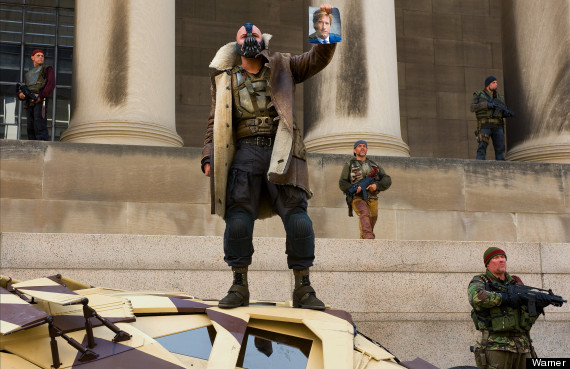
The Police State Rises. Oops, I Mean the Dark Knight Rises


I was a comic book aficionado before it was cool. Or "edgy" or "fly" or "pimp"or whatever it's called right now.  And the Batman was my favorite masked hero even before that 1988 Tim Burton movie rescued the Dark Knight's reputation from the awful legacy of the '60s TV show. Even before Frank Miller's "powerful reinterpretation" a few years before that.

I'm not a fair weather fan. And as a die-hard fan, I felt adequately qualified after seeing Batman Begins in the theater to proclaim it the best screen adaptation of Bob Kane's cowled vigilante.

The sequel, The Dark Knight, was a nice effort, but really two movies wadded together, trying to accomplish too much for one feature film...as so many superhero sequels do.

I just returned from opening night of Dark Knight Rises.

It's a crowd pleaser, and I have no doubt it will do great box office. The special effects were spectacular, of course. It was nicely plotted, in that it plucked at the emotions in the logical places, gratifying the audience with Pavlovian aplomb.

The script is based on a run in the comics which had the Batman severely injured after a battle with Bane, and a substitute (Dick Grayson/Robin/Nightwing for a while, maybe, but I had pretty much stopped following comics by that point and don't remember) dons the cape and cowl to continue the crusade against crime.

The film opens with the Batman retired and Bruce Wayne still crippled, not from a fight with Bane, but from injuries sustained battling the Joker and Two-Face eight years ago.

Hmm. He spent seven years abroad before becoming Batman. That would put him at about 27+ at the beginning of his career. Add however long he protected Gotham before retiring, then another eight years and he's over 35--pretty long-in-the-tooth for somebody who has to engage in unarmed combat with swarms of bad guys, and perform death-defying stunts on a regular basis. And if I heard Bruce's doctor right, he has no cartledge left in his knees or elbows. (I lost a little bit of cartledge in one knee and have not been up to half of the physical activities I used to engage in before that.)

When Bane comes to town, Bruce decides to come out of retirement. He straps on a knee brace, sets his cane aside and is right back in the saddle. No explanation is made of how the knee brace fits under his costume unnoticeably, or how it helps his other knee, or either elbow. Do we really need one? I guess not. So the Batman is back in action, with a new toy (a VTOL aircraft), and we are ready for him to kick some super-cundingy.

Jim Gordon, though already Gotham's police commissioner, still resembles the Year One Lieutenant Gordon--packing heat, personally leading SWAT teams and riot squads in heroic cop combat, and performing death-defying stunts of his own while disarming bombs and such. Okay... Maybe police commissioners do that in real life...in places like Sierra Leone, El Salvador or Mongolia.

Another cop character is introduced (Officer Blake), who I kept expecting to put on the bat-armor himself...but didn't.  Yet by the end of the film it is implied that he will be putting on a costume of some sort.

As with all cinematic Batman sequels, the creative think-tank, or production committee, obviously dictated that one villain (Bane) would not be enough for this film, and so we have R'as Al Ghul's daughter Talia show up, as well as Catwoman fulfilling the obligatory amazon superninja role, in a predictable "bad girl with a heart of gold" incarnation. (But at least she started out as a cat burglar, and I'll take whatever faithfulness to the comic canon I can get.)

That same circlejerk...er, creative think-tank, I mean... had a "raising the stakes" orgy during preproduction. Bane (who it turns out is also connected to the League of Shadows from Batman Begins) isn't content to just destroy Gotham as Al Ghul tried to do. Nope--he's gonna nuke it off the map. But not before utterly destroying Bruce Wayne financially--by movie's end Bruce will have lost Wayne Enterprises, his own fortune, Alfred...temporarily, and Wayne Manor (which includes the Batcave and all its goodies). Oh, and his secret identity. Again.

I don't completely understand this, but every film maker tasked with bringing a superhero to the screen is obsessed with exposing the identities of the masked heroes they depict. It's like a fetish or something. Not only does Bane, Catwoman, Talia Al Ghul, Commissioner Gordon and the aforementioned cop (Blake) join the ranks of those who know the Batman's "secret" identity, but the Wayne Foundation's secret research and development complex (the Bat-arsenal) is exposed for all of Gotham to see. In fact, Bane's mercenaries use (and destroy, of course) the spare Batmobiles stored there.

In his first tussle with Bane, Batman conveniently forgets how to fight. He telegraphs every punch, and can't get out of the way of equally telegraphed blows from his Sean Connery-sounding assailant. His spine is dislocated (if not broken) by the end of the struggle, to the point that vertebrae are protruding from his skin. But after some prison chiropractic techniques, a few push-ups, pull-ups and situps later he is in peak condition (at 35+ with no knee or elbow cartledge, scarring of the liver and accumulative brain concussions) to go kick Bane's mercenary butt this time. Because, you know, he's heard some motivational dialog, and he's learned how to manipulate fear and hope, and all that will give him the edge he needs. Oh yeah, maybe he'll cut back on the Western Union roundhouse punches, too.


The ending borrows from Miller's Dark Knight Returns in a couple ways...also Superman Returns and First Avenger in the hero-as-savior aspect. The writer(s?) and director go from rebooting the Batman canon to obliterating it with gleeful abandon. By the film's conclusion there is no possible way for the Batman to continue his war on crime in Gotham City according to the Bat-mythos we are familiar with. At least until the next reboot.

What annoys me most about the latest Bat-flick is what's going on under the surface. There is a message hammered into the audience, both visually and thematically, which goes beyond the law-and-order platitudes of most cop flicks.

Bane is a well-armed, shrewd, manipulative agitator who incites anarchy by taking the city captive while encouraging the populace to liberate themselves. Anarchy ensues, and Bane gives people guns! (Cringe, hiss!) Just in case you don't find armed citizens scary enough, he also breaks open a penitentiary (or was it Arkham Asylum?) and arms dangerous, hardened criminals, too.

Visually, director Nolan was careful to show that the heroic, altruistic Gotham Police were outgunned by the rabid mob. But this mattered little, as only a few shots were fired before the courageous guardians of order clashed with the freedom-crazed agents of chaos. Then the weapons disappeared and a hand-to-hand rumble ensued. Sure. I'd use fists instead of firearms when involved in a street war with thousands of combatants. Wouldn't you?

Bane, for all his revolutionary rhetoric, cares nothing for the army of gun-toting rebels he has mobilized, fully intending to destroy them along with the world order he so despises.

Irony abounds, here.

First you have a story lionizing an anonymous vigilante while simultaneously implanting establishment attitudes about "legitimate" authority (and its monopoly on coercive force). This is nothing new in Batman stories, but it's worth pointing out.

Then there's the sympathy for the "Occupy" movement woven into the plot, while qualifying it by showing the benevolent nature of super-billionaires like Wayne who are selflessly helping the proletariat, even though they suffer the scorn of classist critics like Selena Kyle/Catwoman. Kind of like how Michael Moore supports the Occupy movement and demonizes capitalism while getting fatter off the capitalist system. Or how George Soros, the international bankers and other super-billionaire insiders clandestinely support the leftist movements out to destroy the system they took advantage of to reach their lofty positions.

As mentioned, Bane is effective at stirring up revolutionary fervor among the weak-minded gun-toting masses, but he himself doesn't give a flying rat carcass about them or the cause he has seduced them with. He just wants to see the world (Gotham) burn. This betrays the Hollywood/media assumption that popular grass roots movements opposed to our national tailspin into socialist police statehood, at their core, are simply collections of brainless rednecks being manipulated by mercenary svengalis (Palin, Limbaugh and Beck, for instance, as the left-wing mind imagines it) whose only real motivation is personal gain. A compounded irony is their failure to recognize actual individuals who fit that svengali role, like Jesse Jackson, Al Sharpton and Michael Moore. (They would be out of jobs if race hatred or the machinations of Wall Street bankers ever came to an end.)

Bane and others pontificate on fear, and the importance of training yourself what to be scared of. Meanwhile the film makers are trying to train the audience what to be scared of: liberty (= anarchy); rule of the people, by the people and for the people (= mob rule and abolishment of due process); and a citizenry bearing arms (= uncontrolled violence on an epic scale).

Batman's "no guns" rule is overtly invoked, though Catwoman saves his life by using one such dreaded weapon. Officer Blake is horrified, at one point, that shooting two bad guys attacking him resulted in fatalities, and tosses his pistol away in remorse. Even so, he uses firearms later to save himself and others.

But the biggest irony is the propaganda victory of the shooting in Colorado. During a screening of this pro-police-state film, some whack-job with a protective mask, tear gas, and, of course, a firearm, murdered enough people to demonstrate just how dangerous it is when the state doesn't have a monopoly on coercive force. And what atrocities occur when people cling to liberty instead of sacrificing it for security and the greater good. The threat of chaos if law and order isn't enforced with an iron fist.

It is highly doubtful this crisis will be allowed to go to waste.

I would not be surprised if new "gun control" legislation, complete with provisions outlawing gas masks, was drafted before the smoke even cleared out of that Colorado theater. And more will be discovered about the shooter in days to come, too. Did he ever attend a Tea Party event? See, I told you those creeps were dangerous--better crack down on them. Did he ever voice criticism of Obama? See, I told you only racists and whack-jobs held those kind of opinions. Better outlaw "hate speech," too. Oh, wait...we're already working on that, aren't we?

(This just in: The murdering whack-job in question has been identified as James E. Holmes, someone involved in the Occupy movement, not the Tea Party as the Obama Administration and network news will want you to believe. Holy irony, Batman! If the press suddenly shuts up about his political affiliations, you'll know this is true.)

It's unrealistic to expect any film maker allowed to work in Hollywood to keep their left-wing globalist worldview from coloring their work. So, up to a point, I take it in stride and try to enjoy movies anyway. I didn't allow myself to consider the political untertones in the two Batman movies before this. I wanted to like this one. The Batman is a fantastic character and deserves fantastic adventures, whether on the big screen or the comic page. This story is fantastic when it comes to stunts, explosions, imagery and "what's at stake" plot-wise. It is not so fantastic in other ways; and offensive to me in a political context.

Batman Begins is still the best Bat-flick yet, in my opinion.

Friday, July 6, 2012

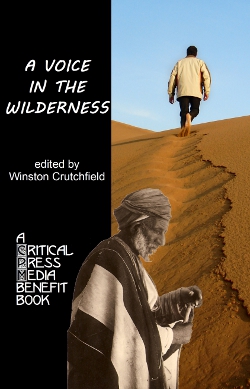
A Voice in the Wilderness: Fiction Shorts United By Theme


Blogger/podcaster and pulpnificent pontificator Winston Crutchfield has compiled a fiction anthology which is now published and ready for purchase.

Various writers contributed to this project, with a variety of genres including historical (set in biblical times), dystopian future, fantasy, science fiction and , as you might expect given the theme, contemporary Christian fiction.

Every purchase of a benefit book from Critical Press Media results in a charitable donation. Here's a little more about the anthology:


John the Baptist was a unique person in the history of God’s plan for redemption, and in the history of the world. He was the last of the Old Testament Prophets, and the first of the Apostles. He was sent before Christ to prepare the world to recognize and receive the Savior. Authors were challenged to fulfill the function of John the Baptist’s office in creative and visionary stories.

Luke 3 (NIV)
3 And he went into all the region around the Jordan, preaching a baptism of repentance for the remission of sins, 4 as it is written in the book of the words of Isaiah the prophet, saying: “The voice of one crying in the wilderness: Prepare the way of the LORD!”

This volume contains compelling fiction and thoughtful essays from Winston Crutchfield, Don Yarber, Henry Brown, David Crutchfield, Deborah Caligiuri, Justin Lowmaster, Nathan James Norman, Philip Carrol, and Ken Harmeyer.

A Voice in the Wilderness is now available directly from Critical Press Media in popular e-book formats and as a paperback printed copy from Lulu. E-book downloads contain a zip file with DRM-Free PDF, EPUB, and MobiPocket/Kindle PRC files, viewable on PCs, smart phones, PDAs, and dedicated e-book readers such as the Amazon Kindle. Support independent publishing and purchase a perfect-bound paperback from Lulu.

Saturday, June 9, 2012

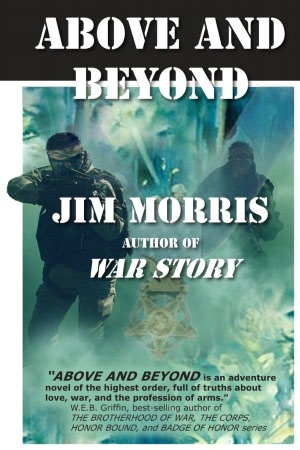
Above and Beyond by Jim Morris

icon
  icon

I was born during our nation's involvement in Vietnam, but by some strange combination of coincidences, I never learned what Vietnam was until I was 14 years old. Oh, I'd heard of the Green Berets (both the Special Forces soldiers and the movie made about them). I'd watched an episode of The Six Million Dollar Man with a scene depicting some wacked-out veteran's flashback of Vietcong chasing him through the jungle (though it didn't make sense to me until many years later..."Who are those people with the funny hats, Dad?"). And I'd listened to "Where Have All the Flowers Gone?" on the radio and even memorized the lyrics without understanding their specific reference.

It might be hard to imagine now, but not only that, I had also absorbed the anti-American sentiments that were en vogue ever since that ugly conflict.

I obviously overcame that, in time.

I was cured of my ignorance about Vietnam eventually, too. By the time I myself was a soldier, many of the senior NCOs and most of the field-grade officers were Vietnam veterans. Until Operation Urgent Fury (Grenada), the most recent combat American troops had experienced was in Southeast Asia. Some of the jargon I picked up dated back to American occupation of Germany or Korea. But most of the Airborne Creole I learned (and remains a component of my dialect, to the chagrin of my family) was of French-Vietnamese origin.

I once had the opportunity to meet General Westmoreland. He was retired, but in uniform. We shook hands. I was young and dumb…but not so dumb that I dared ask him what was on my mind: “Yo, General, how did it feel being Johnson’s stooge? Was it worth the cost of so many American lives over there to accomplish absolutely nothing?”

OK, it would be unfair to hold him solely responsible, I know. But I never met Johnson, Nixon or Kissinger, who should have been held responsible. I might have been dumb enough to ask them some tough questions.

When something causes me to think about Vietnam, depending on my disposition at the time, I either become depressed or infuriated. So I have to be in just the right mood before I'm willing to read a book or watch a movie about that historical debacle. Since I've been in that mood from time to time over the years, I've read a few Vietnam war novels. One of the best was one I reviewed here on the 2-Fisted Blog not long ago: The Return by Charles W. Sasser.

Even more recently, I've had the pleasure of meeting (via the Internet) a friend of Sasser's, and a renown writer in the military fiction AND nonfiction universes: Jim Morris. I was somewhat familiar with Jim Morris' work by reputation; also because I'd read some of his articles and a very fun semi-parody of men's fiction called Breeder. But now his books are being re-released digitally for E-readers, and I've just finished his Vietnam war novel Above and Beyond.

This is a novel Morris began writing in the hospital in Japan in 1968 while recovering from wounds that ended his military career. His right hand in traction, he wrote the first draft left-handed. It took 36 years before Above and Beyond saw print. (Geez, Hell and Gone took eight years from completion to published and that was maddening.)

Morris won three Purple Hearts before the first combat troops were deployed to Vietnam and before the first anti-war demonstration. There have been a lot of Vietnam veterans who became authors, but Morris was in the first wave. You could even say he blazed the trail for others to follow.

Above and Beyond’s protagonist, Neil Thompson, was a third-generation West-Pointer. He was booted from the then-prestigious military academy for failure to report a roommate who cheated on an exam. As the story opens he is a Special Forces “Green Beret” in Vietnam, having had to claw his way, tooth-and-nail, into a deployment that so many others wanted desperately to avoid. Now he wants to go to OCS and receive a commission before his former classmates get theirs and outrank him (enabling them to make his life a living hell, as small-minded officers can).

Thompson was born to be a soldier—or at least he’s convinced himself of such. He’s a likeable guy, with some perhaps heroic qualities, but Morris kept him real. He’s got some cognitive functions that are not quite as noble as an action-adventure hero’s. They’re more like what you’d find inside the brain of a real-life human being.

Thompson and his zany team leader Shoogie are part of Project Theta. Theta’s mission is similar to that of the LRRPS (Long Range Reconnaissance Patrols), and, later, SOG (Special Operations Group/Studies and Observation Group)—basically snooping and pooping inside the enemy’s back door. Like author Morris did, they work closely with the Montagnards—the ostracized hill people of Vietnam.
In an army of unwilling cannon fodder the only elite volunteers were the paratroops; in the airborne the most elite were the highly-trained, independent men of Special Forces; and within the Forces the absolute crazies inevitably gravitated to the reconnaissance projects.
While in-country, Thompson meets and falls for Juliana, an International Volunteer Service worker. ( IVS was kinda’ like the Peace Corps…only the Peace Corps wasn’t in Vietnam.) You would think a dope-smoking progressive and a minion of the military-industrial complex wouldn’t last long beyond a one-night stand, yet what drama they do suffer is rather typical of military families.
There is just enough combat depicted to show what this aspect of the “police action” in Vietnam was like. Any more might have mired the reader down in the minutia of a tragically futile conflict with no sensible strategic objective.

When a leg general arrives to take command in Project Theta’s Area of Operations, Morris’s storyline struck a chord. What followed was illustrative of, not Vietnam, really, but the US Army’s officer corps dating back possibly as far as the Civil War…or farther.
“Frenier never admitted to being wrong about anything in his life. He won’t stop the attack, or go up the reverse slope. He’d throw away his whole brigade first.”
Brigadier General Frenier just happens to be the same officer (a bird colonel, then) who kicked Thompson out of the Point, too. He’s an unimaginative, vain, pompous ass. He does show a couple redeeming qualities after sacrificing his troops on the altar of his self-importance; but there’s no mistaking what kind of commander he is. And as far as the novel goes, the joke’s ultimately on him: He berates the marines once or twice as sacrificing their men needlessly, and knowing no tactic other than the frontal assault. Can you spell H-Y-P-O-C-R-I-T-E? And in case you aren’t sure what kind of father this egotistical boob would be to his children, we find out later that his son eschewed West Point for Annapolis and branched USMC.

One more interesting point about Frenier: Another character described him as “trying to fight World War Two with helicopters,” or something very similar.

I’ve seen this sentiment a lot in fiction. And if you hang out with people interested in military science, you’ll eventually hear the old adage: “Generals spend their peacetime careers planning to fight the previous war.”

There was an attitude in many circles during the ‘80s that conventional forces were just about useless; and future wars would be won or lost solely by special operations. Frankly, I found that idea about as cockeyed as Billy Mitchell’s notion that, after WWII, air power alone could win conventional wars. Morris purports nothing so extreme in this novel, but his characters rightly hint that the conflict in Southeast Asia (at least with the limitations placed on US forces by Washington) required a whole different combat doctrine.

Shoogie pointed off in the distance. "Who burned that village over there?"
The driver glanced in that direction. "We did," he said. "The people was supposed to be Cong sympathizers."
Shoogie drawled, "If they weren't before they sure as shit are now."

Police actions, by definition, allow little room for victory in any reasonable sense. Whatever his faults, MacArthur was a commander willing to do what was necessary to achieve victory. You know: like the war he’d just helped win in 1945. But in 1950 he faced an enemy with many fellow travelers in Washington whose concept of victory had (and has) nothing to do with America (or any representative government) prevailing in any given struggle. The MacArthurs had to go. All hail the Westmorelands.

Ahem. I warned you what Vietnam does to my mood. I’m choking back my instincts to rant on about politics and military strategy.

By the time of Vietnam, the MacArthur/Patton-type officers (represented by McLeod in Above and Beyond) are a shrinking minority. Frenier is a picture of the new breed. Or, at least, the favored breed. And to win a war with the limitations the Johnson State Department imposed, it would have taken 30 years…or a couple more Tet Offensives until the NVA wiped itself out charging into the meatgrinder.

Despite my own political commentary, Above and Beyond is politically ambiguous. It’s poignant and almost ecclesiastical in its dichotomies: love and hate; war and peace; passion and indifference; loyalty and betrayal; selflessness and selfishness. Like the composer of a symphony, Morris weaves together a variety of notes, chords and tempos to give the audience (reader) an experience that engages the emotions, yet rings true.

To read my interview with the author about this book, visit Virtual Pulp Press.


Thursday, May 31, 2012

Primal Unleashed by Jack Silkstone


After months of frantic juggling, I finally found time on Memorial Day to sit down and dig into this primo piece of paramilitary fiction. And I can see why it's so popular.

PRIMAL is a Private Military Company that is, uniquely, privately funded. They don't fight for profit and they owe no allegiance to any particular government. If Bruce (Batman) Wayne's parents had been killed by terrorists instead of street criminals, and he wasn't comfortable wearing tights, he would run an organization like PRIMAL, righting wrongs around the world.

In the prequel, PRIMAL: Origins we learned how this organization came to be. American ex-CIA man Vance and his IT wizard, Chua, are the brains of the organization; but the real stars of this story are newcomers Bishop and Mirza.

It seems the Russians developed a nerve agent deadlier than any other biological/chemical warfare asset, and now a Ukrainian arms dealer is about to sell it into the wrong hands. There are 3 different interests struggling for possession of this weapon; PRIMAL wants control so neither of the others have the opportunity to use it.

During the course of the mission Bishop crosses paths with beautiful Iranian spy Saneh. She's a great character and brings sexual tension into the mix...and neither the good guys nor the reader are sure to what extent she can be trusted.

The novel really hits its stride about halfway through. The plotting is nicely done and the action is suspenseful. By the end, the main characters are beginning to shine. Primal: Unleashed isn't just set up for a sequel...it's set up to be a whole series.

Author Jack Silkstone takes advantage of the digital nature of the book by including links, for those who want to know more, to webpages about some of the specialty weapons, equipment, etc. his characters use. (Why didn't I think of that?) He also includes images of aircraft and such to better help the reader visualize. Some of his dialog is a little too on-the-nose in places, but the overall quality of the book is much higher than a lot of the men's adventure from yesteryear, and far above most of the indie-published e-fiction available today.

Friday, May 18, 2012

MEN'S FICTION AUTHOR FROM THE '80S GOING E-BOOK!

My introduction to men's adventure novels, and war fiction, was The Sergeant #4:The Liberation of Paris by Gordon Davis. Up until I cracked open that paperback, I had never read anything like it before. I turned pages in a stunned trance, eyeballs dilated, jaw slack, visions of bayonet duels dancing in my head.


The Sergeant #4

With this new literary universe to explore, I began collecting similar books. (It took me years, but I now have the entire Sergeant series in paperback.) Another series I collected was The Ratbastards by John Mackie. It was also a WWII series, but set in the Pacific rather than Europe.

ratbastards #1

At the time, I took the different author names at face value, but couldn't help noticing similarities in style, phrases in the dialog, and certain recurring sequences in different battle scenes.
The main protagonist in both series is a big, tough, battle-scarred Master Sergeant in the infantry--Clarence J. Mahoney in The Sergeant and John Butsko in The Ratbastards. Both have loyal junior NCO sidekicks that were once innocent all-American boys, but are now the best soldiers in any man's army.

For the rest of the article, visit Virtual Pulp Press!

Sunday, May 13, 2012

The Avengers have Assembled!


Please excuse my overly-intellectual critical response, but...GOOD LORD! HOLY CRAP! HELL'S BELLS!

I had high hopes for The Avengers movie and boy, did Hollywood deliver this time. There were so many ways they could have gotten it all wrong...but for the most part, they didn't. My inner comic book nerd has been seduced by the screenplay and the special effects.


Jeez, where do I start?

Director Joss Whedon has pulled off a refreshing effort to both stay somewhat loyal to the source material and make it palatable for the non-comic-savvy. See, I was a fan of The Avengers back when the only attempts at screen adaptations of Marvel Comics were laughable, and few but comic aficionados knew that "the Avengers" were something besides secret agents on a TV show. For me, Iron Man, Captain America and Thor were the core of the group; there was boocoup conflict among the characters, both hero and villain; and slugfests aplenty (in true Marvel fashion, often between the good guys due to misunderstandings). Whedon and his screenwriters delivered on all counts.

In a film adaptation of any sort of book--graphic or prose--certain characters usually need to be combined or deleted to save screen time. I think omitting characters like Moondragon and the Vision was a good call--they never added much to the Avengers, IMHO, anyway. Occasional members like Wonder Man and Captain Marvel/Miss Marvel were rightly passed over, too. Personally, I would have preferred She-Hulk to the Black Widow, but since the He-Hulk is a member in the screen version, that would have been redundant.


I haven't picked up a comic in many years, so I don't know what the Avengers are like right now...or have been like. But though I think the Hulk (the gray, intelligent version?) was a charter member in the '60s, he rarely appeared on the roster during the days when I read it. Like Thor, I never had an interest in following his solo exploits, but enjoyed his contribution to the team efforts. (BTW: it seemed the Marvel staff never completely decided whether the Hulk was more powerful than the immortal Thunder-God, and it's probably good that they didn't.) Both of them were assets to the team in the film version, and extremely fun to watch. The visuals of Thor calling lightning with his hammer were downright stunning--possibly the best comic-booky shots ever composed on the big screen (though one shot from The Rocketeer is still a strong contender as well as, believe it or not, a sequence from Superman Returns). And in a movie liberally seasoned with humor, the Hulk provided, hands-down, the most gratuitous laugh-out-loud moment. During said moment the theater erupted in belly laughter and I literally cheered and clapped. Let me assure you: I never do that during movies, no matter how much I enjoy them. At least I can't remember ever doing so before. It's a scene I could watch over and over and feel a rush every time. Whew!

Personally, I always liked it when former X-Men the Beast and (to a lesser extent) Cyclops were on the Avengers' roster. Also the Thing and the Human Torch from the Fantastic Four (I always liked the Thing better than the Hulk, but was in the minority in that respect). All of these have now appeared on the big screen, too. And my favorite Marvel superhero (followed closely by Iron Man), Spiderman, was not a member of the Avengers in the comics (though he was an occasional guest-star), but I thought he should have been. He will likely never be an Avenger in the movies, either. I always thought the Black Panther was cool, too...at least potentially, as an Avenger...as was Giant Man/Yellowjacket/Ant-Man. I won't complain that none of these heroes were cast. For one thing, it would be hard to manage so many extra characters correctly during a feature-length film--even a 2&1/2 hour feature.

Long-time Avengers stalwart Hawkeye was a solid choice for the cinematic superteam. The un-powered archer, as a member of this superteam, was always a small fish in a big pond. But the writers usually figured out how to make his contributions seem relevant. The Black Widow was an interesting choice to round out the team for the big screen. Like I said: I haven't followed the comic for a long time; so maybe she's not such an obscure minor-league character anymore. It's a given that the obligatory Hollywood feminist weltanshaung requires at least one amazon superninja in every action movie (and it doesn't bother me so much in a story about a team of superheroes) who asserts her physical superiority over a man in at least one scene. But it seems the Wasp, Scarlet Witch, Tigra or even the Black Cat would have been more logical choices. Still, it's hard to complain about seeing Scarlet Johansson in black spandex.

And speaking of costumes...the most faithful one in this movie was Captain America's. Surprising. I tend to be a purist, but wouldn't have minded if they kept the WWII version from his own movie. Well, I guess the Hulk was dressed pretty much exactly like he is in the comics. And Iron Man's armor is close and looks great. Hawkeye's looks nothing like his outfit in the comics. Maybe that's a good thing, given people's aversion to bright colors in real life. But no mask? Just seems wrong. He should at least have a helmet--like a modified chopper helmet with drop-down sunscreen and a Heads Up Display with targeting optics and so forth. Speaking of helmets: Why doesn't Thor have his?

I can probably answer these questions myself. Many superhero flicks discard the idea of "secret identity," partially justified by Marvel's Civil War series, which is probably the reason for Tony Stark's idiotic outing of himself as Iron Man at the conclusion of the first shell-head movie. Also, Hawkeye and Black Widow, in this universe, are government agents (of S.H.E.I.L.D.) and therefore not living double lives, with family or friends behind white picket fences that their enemies could go after. Same with Steve "Captain America" Rogers, which makes you wonder why he bothers with a mask.
But the main reason for mask-less superheroes on screen is the same reason you have cinematic Medieval knights who remove their helmets for battle while enemies are shooting arrows and swinging heavy melee` weapons at their heads: the actors can't bear to have their pretty faces covered. This is why Spiderman, who allegedly wants to keep his true identity a secret in the first 3 movies, removes his mask in public at every opportunity, when it's not conveniently ripped, burned or blasted off his head. (I just saw the preview for the next Spiderman flick and it looks like he keeps doing the same thing.)

So why does Thor eschew his helmet in the movie? I mean, it wouldn't obscure his face or his girly blond tresses either when fighting or delivering noble, nigh-Shakespearian dialog. Probably because the actor would feel silly wearing it. Why, then, does bad-guy Loki wear his far more conspicuous helmet for much of the film?

I don't understand all the costuming choices, but I can live with them. Especially with an action flick as well-written and well-executed as this one. It's impressive that suspension of disbelief can be maintained throughout a feature film with such incredible subject matter. And the chemistry of the cast is just about perfect.

We are treated to Marvelesque skirmishes between Thor and Iron Man; Thor and the Hulk; and all the Avengers against an evil alien invasion force that seems vaguely familiar from the comics (I didn't read Fantastic Four much, which is where I think they were lifted from). The special effects are really something--even without the gratuitous massive destruction in New York City and SHIELD headquarters.

Until now, I ranked Batman Begins the best superhero movie made, with Iron Man I in second place and Captain America somewhere up there, too. I think we have a new champion, folks.

With it's box office success, I'm sure there will be a sequel. Almost every time a film maker shoots a sequel, they attempt something even bigger and better than the first...and accomplish just the opposite. Since evidently the Avengers will be squaring off against Galactus (another Fantastic Four regular) in the next installment, the "bigger" plot looks like a done deal. Whether Whedon (or whoever) can make another Avengers flick as good as this one is something I will anxiously await to determine.

Monday, April 16, 2012

Sure as the Turnin' of the Earth, This Western Will Stand the Test of Time

icon

icon

It might be obvious I haven't had much time to blog lately...much less read, write, keep up with social networking...and certainly not to play videogames. I'm not complaining because I'm very grateful to be working in this economy. But lately I haven't even been able to watch movies with the family much.

So for this post, I'm taking a blog-stroll down Memory Lane.

I never cared much for westerns--either novels or movies--until I was 23 years old. Then I became something of a fanatic for a while making up for lost time by consuming everything I could about the Old West, both fact and fiction. What caused this radical change in interest was a single film. Please know that my tongue is nowhere near my cheek as I call this film a masterpiece.

I not only propose that The Searchers might be the greatest western ever filmed, but it was also probably the pinnacle of director John Ford's artistic achievements and the most memorable role/performance on the Duke's extensive filmography.

In a previous blog post I listed The Searchers as one of the few films that surpasses its prose source material. When I found a collector's edition DVD with extras, including interview segments with my favorite living director, John Milius, I just had to get it even though I'd seen the movie dozens of times already.


Most of the film's exterior scenes were shot in Monument Valley--director Ford's favorite location for epic tales of the West. Cinematically the imagery is more powerful than anything I've seen from CGI. There are more quotable lines of dialog than you can shake a rifle at, which could be laughable if the delivery wasn't so good. There's not only tragedy, but comedy, romance and sentiment, too. Sometimes the weight of the narrative shifts from light to heavy so fast you might feel guilty for laughing.

Like Alfred Hitchcock, John Ford began directing in the silent days, and developed a habit of telling as much of the story as possible visually, minimizing his use of intertitles...and of dialog, after the industry switched to talkies. His semiology may never have become the intricate code seasoned throughout some Hitchcock films, but there is a lot more going on in Ford films like this one than you could ever guess from the dialog alone.

After a haunting ballad over the opening credits, the narrative opens on a pioneer family living in the Texas frontier of 1868. The Edwards family emerges from their womb-like home to witness prodigal brother Ethan Edwards appearing out of the rugged wilderness he almost seems a part of.


Ford masterfully presents all the exposition we need within the first few minutes of screen time--most of it without use of words: Ethan left to fight on the Confederate side during the Civil War, but has been absent, location unknown, for the three years since war's end. He doesn't reveal his whereabouts or activities during the interim, but it likely included some ethically questionable business. There's a tangible degree of hostility between he and his brother Aaron, most likely due to an implied love triangle between the brothers and Martha, Aaron Edwards' wife. Ethan's strong, possibly heroic, side is revealed via his interactions with his nephew and nieces. Then the audience is slapped in the face with his bigotry, introduced with the arrival of Martin Pawley (Jeffery Hunter) who "a fellah could mistake... for a half-breed."


Ford used some of his faithful regulars for the supporting roles, including Ward Bond, Vera Miles and Harry Carey, Jr., plus brought in some newcomers to the troupe like Hunter and a young Natalie Wood. Hunter is cast as the straight-arrow, good-to-a-fault hero figure we would normally sympathize with most (despite some real aw-shucks corn pone moments and the fact that he fights like a girl). But the show is stolen by Ethan Edwards as played by the Duke. Next to his ill-advised casting as Ghengis Khan in The Conqueror, this is the darkest character I've ever seen John Wayne play...a noteworthy departure from the altruistic hero he built his career personifying. And despite all the knee-jerk snipes at his acting ability or "emotional range" by limpwristed fa-hiiiilmmm critics, big John nailed this role.

There are multiple elements that make The Searchers such an epic; but perhaps the most important of these is the Ethan Edwards character. Cliche` though it may be to say so, he is larger-than-life. His racism makes it hard to sympathize with him in a couple scenes, but it's even harder not to root for him through most of the film. His presence isn't just commanding as in other Duke roles; this character is so powerful, and so determined, you just know he's more than a match for the most formidable villain that could be thrown at him from either the historic West or Hollywood's mythical version. Imagine Clint Eastwood's Unforgiven character after he had that drink at the bar and that might give you an idea.


Ethan is nobody to trifle with. He can't be duped or cowed by any mortal. When he sets his mind on a target, he's going after it with guns blazing, oblivious to collateral damage. He's a lot like Col. Kilgore (Robert DuVall) in Apocalypse Now (actually, these two movies resemble each other in other ways, too)...despite the carnage and bullets flying all around him, he can walk upright through it or stand like a statue in its face and never get a scratch (the exception comes later at a crucial moment). He's a guy you want on your side when crap hits the fan.


Ward Bond is at his blustering, egotistical best as the "Reverend Captain Samuel Johnston Clayton" of the Texas Rangers, but for all his pomp and order-barking, his natural leadership is effortlessly outshined by Ethan's, who all characters, young and old, look to for answers, approval, and raw, pure strength when the going gets tough. Ford displays this Cold War of the Alpha Male for both dramatic and comic effect at different points in the film.

If you pay careful attention you'll discover the reason for Ethan's bigotry is the death of his parents at the hands of the Commanche. But he took Sun Tzu's advice to "know your enemy" quite seriously, judging by how well he knows the Commanche tongue, customs and belief system. On the featurette included on the two-disk collector's edition, John Milius points out that Edwards "ain't white, anymore" according to Ethan's own standards. His contempt for the etiquette and traditions of civilization is palpable. Polite society would label such a man a barbarian. Truly, Ethan is just as much a savage as any Commanche. But, as is the case in many a Ford western, it is exactly just such a man needed to tame the West...to transform the wilderness into a garden.


For all its brilliance, The Searchers is not without its flaws. Some of the humor and sentimentality is too sappy for modern viewers. There are continuity errors and some botched dialog. Not all of the acting is Oscar-caliber. There is a key Commanche character played by a non-Native American actor (the rule, rather than the exception, in older westerns). And there is enough bigotry from the characters (as well as hypocrisy worked into the script) to cause cringing if you're sensitive about such things. To be fair, though, John Ford loved  Swedish and Irish stereotypes just as much as he did any other ethnic stereotype. The most obnoxiously portrayed character in this film is Charly McRory, a moronic cowboy/Ranger with a High Colorado accent.

I could go on about this film at considerable length...in fact, I did exactly that before Blogger suddenly decided I needed to re-sign in, then obliterated 75% of my original post. (I Just don't think that I can take it; 'cause it took so long to make it. And I'll never find that recipe a-gaaaaaaaaain...) But you should really just watch it yourself, then tell me what you think in the comments. I can't recommend it highly enough.