Search This Blog

Showing posts with label Jim Morris. Show all posts

Saturday, July 6, 2013

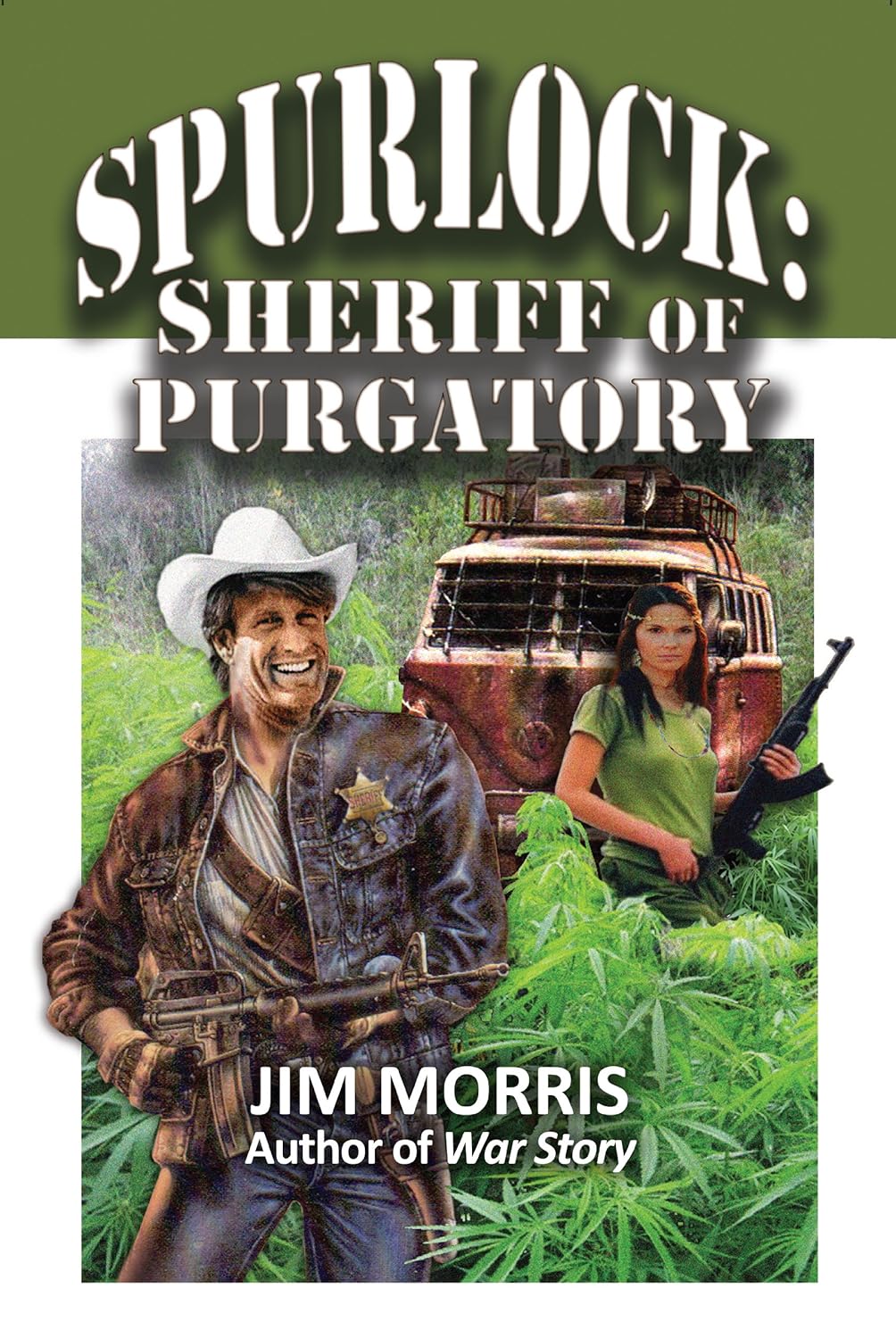
420 Friendly Adventure--Spurlock: Sheriff of Purgatory


I'm becoming quite well-acquainted with Jim Morris's work. That's how I know that this novel is off the beaten path for him. At least the beaten path so far. Like Bob Dylan, it is so free-wheeling that I'm inspired to wax poetic:

Spurlock is a shrewd dude who meditates in the nude, to put him in the mood to deal with the rude and the crude, who need adjustment of attitude. He lives in a time when the US is screwed. And he likes wacky tobaccy better than food. Though Morris is hardly a prude, his prose is a far cry from lewd.

I should have been a beatnik. Or a hip-hop gangsta.

Okay, let me expound a bit without putting it into rap lyrics. (Don't worry--there is no infantile rhyming in this book.)

Morris has set this tale in an alternate reality. I'm a bit fuzzy on the historic details that led to the scenario, but the gist of it is: 1. The Ruskies won a war with the USA, and now occupy the continent. 2. The occupational army runs the economy by proxy; and that proxy is the Mafia. And you get the idea that of the two organizations, the Mafia is the more powerful. 3. There was an armed resistance to the invasion. Most of them were assimilated back into the culture, like Spurlock. The "guerrillas" remain in rural areas, operating like a minor-league (and redneck) Mafia. They are murderers, rapists and borderline psychopaths who don't even understand what it is they think they're fighting for. 4. Purgatory is such a backwater that it has been left alone since the war was lost.

Sheriff Spurlock runs his county (and his personal life) with a mixture of streetwise savvy and a Zen-like quest for balance and harmony. He has an agreement with the local guerrilla leader which maintains the status quo, such as it is, with minimal conflict. That status quo is upset when a stuttering Mafia don comes to town with plans to absorb Purgatory into his fiefdom.

Shrewd dude that he is, Spurlock proposes a compromise with the Mafia that should keep everyone happy. But the don loses face during his visit, so Spurlock is screwed, clever compromises notwithstanding.

What follows is a road trip to the Big Apple by Spurlock and a practicing witch. There are some interesting misadventures along the way, then Spurlock locates and attempts to evacuate his estranged children from a New York very much like the one Snake Pliskin had to escape from.


This is an eccentric adventure tale laced with colorful characters, Eastern philosophy and social satire. There are some nice twists and detours along the way.

Personally, I've never experimented with marijuana, drugs or Eastern mysticism. Never had an interest in doing so even though I was born in the heyday of all that flower-power Summer of Love go-go stuff. But those who have lived a far less "straight edge" life than I have will probably feel right at home accompanying Sheriff Spurlock on this quest which is, at its core, pretty dang fun.


Friday, March 15, 2013

Jim Morris and Hank Brown Discuss Classic Men's Adventure Spoof "Breeder"

For anyone who loves to read, I’ve got a great story for you. Have you ever owned a book that you enjoyed so much, you read it all over again every few years? Have you ever wished you could meet the author and have a conversation with them about that book? Well, folks, that happened for me.

Most people discover Jim Morris’ writing through his most well-known book, the autobiographical War Story. Some come to his prose by way of The Devil’s Secret Name or Fighting Men, from watching Operation Dumbo Drop (based on one of his stories) or from reading some of his magazine articles. I was introduced to his work via a men’s adventure novel which was a breed apart (pun intended) from any military fiction I’d read before. Jim and I discuss what makes it unique below, but I should mention up front that he is a boombastic writer. His prose in this novel especially appeals to me because the style is so much like the way I think and speak and joke around. However it happened, he really locked in on my wavelength.

Breeder has just been re-released in both paperback and e-book formats, and the literary landscape is more picturesque now because of that, so far as I’m concerned. So here’s our dialog:
 
HANK: First of all, Jim, thanks very much for taking the time to discuss this with me. For me, Breeder is one of those books I dust off every few years when I want to escape for a while and recapture the fun I had the first time around. Should a Fahrenheit 451 scenario unfold and jackbooted thought cops came to burn up all my dangerous literature, they'd have to kill me before I let them torch that book. Re-reading it is like catching up with an old friend and snickering together at some of our familiar "in" jokes.

JIM: I had started Breeder in Oklahoma, and when (editor Mike) Seidman took Sheriff of Purgatory, which had been published in a shorter hardback version by Doubleday I figured he'd buy Breeder, so I finished it. They paid me $3500 for it, and if they ever got any fan mail they never forwarded it to me. I was always proud of it, but I had no idea anybody else ever got what I was doing with it. Your review was the first and only reaction I ever got from anybody about it. I have no idea how many books were sold, because I never got any royalties, and nobody ever told me. When I asked Cindy (Manning) to do the cover she told me she liked it a lot, but she never had mentioned it before. I didn't even know she'd read it. Same with my son Crews. When I told him it was coming out again he told me he liked it too, and liked that it was dedicated to him and his brother. So I'm liking this new way of doing business. There may or may not be as many sales, but God knows the royalties are better, and writers have a much more personal relationship with their readers, which makes me really happy.
Back cover--Breeder
HANK: I’ve never been traditionally published, but I suspect this new author-reader dynamic is far superior as well. Also, I’ve never been quoted for a back cover blurb on a paperback, as far as I know. So it’s a double honor that I’m quoted thusly on the latest edition of Breeder. And the fact that I get to grill the author of one of my favorite books is just too friggin’ awesome for words.
This is a little embarrassing: I remembered a story one of your characters (Lady Strange) told the hero about her father, but I forgot where I "heard" it in between readings. I figured it must have been one of my ex-girlfriends, but couldn't figure out which one. (Of all the things I've lost, it's my mind I miss the most. But that gives you an idea how much a part of my long-term memory this book became.)
I'll start with the generic question: What inspired Breeder? Where did it come from or what made you want to write it?

JIM: I read a piece in a newspaper Sunday Supplement section, oh, sometime about 1977. It was about a lab experiment which was basically the Breeder experiment. They bred sterile super-rats and those rats killed off the regular rats and took over their females. There was one breeder super-rat, and their fear was that it would escape the laboratory. I thought that would be a perfect setup for a satire about the exaggerated heroes in men’s fiction. It took a few years before I actually got around to writing it though. The first draft was titled SuperRat. Mike Seidman, my editor at TOR, convinced me that this title would not be a draw.

 HANK: I could second-guess that decision. “SuperRat” hints at the humor and outlandish nature of the novel, and might have drawn Harry Harrison fans thinking it was a spin-off of his Stainless Steel Rat—only to find out it was something even better…IMHO.

This book actually hit the shelves at the twilight of traditionally published men's adventure fiction. I didn't know the genre was being phased out at the time--being stationed at Bragg since the mid '80s there'd never been a shortage of the genre in the Fayetteville bookstores and I just took it for granted that it would always be available. In fact, a lot of that fiction had begun to grate on me. The invincible super-stud with the porn star endowment who could charm any nubile wench into the sack and then spring up post-coitus firing a 20mm cannon from the hip while espousing some sophomoric worldview to make Freud smirk...that had grown stale, striking me as too much like the grandiose self-image of some of the alcoholic Neanderthals I served with. So the way you poked fun at the conventions of the genre was one aspect of Breeder's appeal to me. And yet it was such a subtle spoof that plenty of readers would take it at face value.

I remember a college acquaintance once praising the "genius" of the Batman TV show in the 1960s, because the campy humor flew right over the heads of the kids who watched the show, but it slapped the adults in the face...letting both demographics enjoy it on a level where they were comfortable. While Breeder never approaches that ridiculous flavor of parody, you did walk a tightrope of sorts, crafting a narrative with appeal for both an audience that "gets it," and an audience that assumes this is just Ramsay Thorne's Renegade on steroids with some speculative fiction and social satire thrown in. I'd like to hear why you made that choice.

JIM: Basically I made it for fun. The kind of stuff I read as a kid was science-fiction, mostly. Later I graduated to a more elevated kind of men’s fiction. I was a big fan of Hemingway, James Jones, Vance Bourjaily, Joe Heller of Catch-22 fame... Then, later, in New York, I edited that kind of stuff, but also the men’s series adventure fiction. A lot of it I liked. Jerry Ahern was a good writer, and some others were terrific. My friend Hank Schlesinger wrote really good men’s fiction. But also a lot of it was the purest of crap. And I’ve never liked the formula of formula fiction. Anyway I thought it would be fun to exploit the genre and satirize it at the same time.

HANK: Somewhat related to this general topic, I guess, is the self-reflective comment on the genre early on in Breeder, made via Desmond, the hero's roommate. (How men's fiction protagonists are always uberstuds, never guys like Desmond.)

And I hadn't noticed Dale A. Dye's comment on the original cover until just now that Breeder is cliche'-free. Do you agree? Seems to me the whole point of Breeder is to highlight the cliche's of the genre, and amplify them to a nigh-ridiculous level while at it.

JIM: I’m not sure it’s still a cliché when you exaggerate it out of shape. You’d probably find English teachers who go either way on that. The idea was pretty much to laugh my ass off and keep the adrenalin up at the same time.

HANK: You were successful from where I sit. You had me snickering throughout, but certain parts made me laugh my ass off—like a scene after the recon of the local banks. Clendenning and Lady Strange are deciding which bank they want to rob first, cars they’ll have to steal for the getaway, guards they may have to kill, things that could go wrong resulting in their own deaths…stuff like that. During this discussion she glances at a bank brochure procured during their recon and remarks (and if she didn't make a tsking sound first, she should have), "My, these interest rates are just awful." I almost laughed myself into a stroke.

The way I shopped for reading material in those days went something like this: I drove to the bookstore, found the shelves with what I was in the mood for, and scanned for something that caught my eye. When something did, I'd pull it down, give the cover art the once-over, then read the back cover blurb. If the blurb intrigued me, I'd open it up and thumb through some random pages to determine if the author's style could hold my interest. Depending on my mood, if the book scored high in all criteria, I'd lay down my $3.95 for it (boy, those were the days!).

JIM: What’s neat about that to me is that, as an editor, that’s exactly how I tried to set my books up. I wanted a cover that would catch the eye from say the front door of a 7-11, or at a distance from a book rack in a store. The cover would draw you to the blurbs. The blurbs would draw you to the front matter, and the front matter would suck you into the story. You went the extra step of sampling the prose itself, which means you were an especially smart and dedicated reader. Actually I think you were the kind of reader I lived to reach, which is to say the same kind of reader I was before I got in the biz.

HANK: That is DA BOMM! I don’t think I’ve ever been so expertly baited before.

Breeder Original Cover As I mentioned earlier, I had dialed back a notch or two on my enthusiasm for men's adventure by then, so I was actually browsing the science fiction shelf when I found Breeder. It was a Tor book, with a southwestern landscape in the background of the cover art, and a firefight underway outside a small adobe village. In the foreground was a blond, bare-chested dude making out with what appears to be an Injun babe. Dominating the cover, though, was the hero brandishing an Uzi...inside a test tube.

JIM: So let’s pause a sec and give credit to Royo, the artist. He’s Spanish. I’d liked his covers I’d seen before and asked Mike to use him, which he did, and for which I’m glad. The current cover is by Cynthia Manning, the best commercial artist I’ve ever personally known, and who also has the added distinction of having been my second wife.

HANK: Now I understand how incomplete my own strategies have been. I should have married an illustrator, whose father is an ad executive/marketing genius and mother is a big wig at Amazon or something. (And then be very careful not to piss them off, of course.)

My attention so effectively caught with the cover art, I flipped it over to the back cover blurb, which read:

HE WAS A BREEDER...but he didn't know it. He only knew that America was torn by civil disobedience and strife and that his job was to help settle things down.

HE WAS A SOLDIER...Clendenning knew that, knew tactics, knew weapons. But he didn't know what he had been trained for, what he had been born for. If he had gone to the debriefing, things would have been very different. But Clendenning always did things his own way.

JIM: Another pause to give Mike Seidman credit for that copy. Mike and I had the odd distinction, at that time, of being the only action-adventure editors (I was working for DELL then) who were also veterans. Mike had been a leg MP in XVIII Airborne Corps at Bragg. We had another distinction in common. He had answered a call one morning and actually caught a rapist leaving the scene of the crime. The guy didn’t understand “Halthalthalt,” said very fast and low and so Mike blew his young ass smooth away. So he and I were the only action-adventurers who had ever actually killed somebody. Maybe that’s why he liked my stuff.

HANK: Breeder does have a rather morbid outlook, come to think of it. Maybe that’s another reason it appealed to me so much. I think it would have appealed to most of the grunts I knew at the time (those who were capable of reading/comprehending more than just a Bacardi or Everclear label, that is) as well.

After reading the blurb my eyebrows were definitely raised. So I thumbed through some random pages, and my eyes caught this phrase: "Hot rod Christian Indian Sorcerer." I probably did a double-take. I searched around and read the better part of a couple chapters right there in the store and found that one of the Geebees drove a badass Charger RT. Not one of these butt-ugly four door luxury sedans they call Chargers since the Daimler-Chrysler debacle. A REAL Charger. And another Geebee drove a hopped-up Corvette. That clinched it for me--there was no way I was leaving that store without buying the book. I'm still something of a gearhead but I was a flat-out fanatic in those days, and the only medium in which I could read about street machines was in the automotive enthusiast magazines (Hot Rod, Car Craft, etc.). For some reason, no author ever featured truly wicked machinery like that in novels. As it turned out, those cars played a very minor role in the story, but still I loved the fact that they were included at all. Was this a case of you merely fleshing out the stereotype of those you thought would constitute the corps of a Geebee movement?

JIM: Probably had to do with the fact that one of my favorite things to do in this world is to drive a beautiful, powerful car at a high rate of speed with loud stupid music in the background. I have very little mechanical knowledge, but, oh baby, I know what I like.

HANK (channeling the Big Bopper): Shantilly Lace, she had a purty face…

Now that’s what I’m talkin’ ‘bout. Beautiful, powerful cars ripping up the road in an orgy of high-octane mayhem—that’s freedom, baby!

There were several elements in Breeder that I knew something about. Aside from ROTC and the Rangers, you didn’t go into much detail on many of them, but what details you did include were spot-on (taking into account that this was speculative fiction, of course)—a piece of jargon or some other little nuance here or there—and I really appreciated that. The film makers behind the Fast and the Furious franchise are so blatantly ignorant about the subject matter of their movies that I refer to all their celluloid abominations as “The Lame and the Ludicrous.” Big respect to you as an author because, unlike those Hollywood hacks, you limited yourself to what you could present credibly.

The new cover looks cool. The infant brandishing the AK47 inside the test tube is great. But I still like the original cover, too.


JIM: All credit to Cindy on that. Like I said, she’s the best. But I did write the new cover copy.

HANK: Anyway, in the back cover blurb of the re-release, you now make it clear from the beginning that the breeder's entire upbringing was a charade with your Potemkin Village comment.

The first time I read it, you hadn't made it so slap-in-the-face obvious up front. I remember the first major clue for me was in Chapter One when Clendenning read his own article the paper, in which he opined that college football should be played between different schools instead of between frat houses. Hmm. Then he ambushes a sorority queen who is "glowing" and she utters narry a protest as he ravages her. Double hmm. (I must have forgotten the title of the book I was reading, and the blurb, and was anxious to get to the Charger RT.) Then when Clendenning kills his ROTC instructor in front of a class full of witnesses and there are absolutely no repercussions I did another double-take. I was active-duty enlisted and at the time had never been to college or involved in ROTC at all. Even so, I was fairly confident that this sort of thing just did not happen.

JIM: I wrote those first chapters when I was still in Oklahoma. Later, in the University of Arkansas writing program I put that stuff up for evaluation by the writer’s workshop. I did that with satirical intent too, because some of the people in the workshop were soooo politically correct that I knew the rape scene would give them the leaping fantods, especially one jerk who had no sense of irony whatsoever, and who wrote the most boring prose I’ve ever seen in print. It worked too. He went into high dudgeon mode and called me awful names. Oh, it was so distressing!

Jim Whitehead, who taught the workshop, had to point out that the rape was stylized, and obviously written with satirical intent. But I loved to watch that fool froth at the mouth and flail about.

HANK: One of many reasons I never shared this book with any of my friends in college. Besides, according to your protagonist he didn't commit rapes--they were just "extremely rapid seductions."

I had all sorts of theories swimming around about who was behind Jeff Clendenning’s carefully choreographed childhood, and why they went to such incredible lengths to infiltrate the US Defense forces with Manchurian Officer Candidates who were unaware of their true mission. For some reason I was leaning toward a malevolent extra-terrestrial entity (ironic, considering Jeff’s “Alpha Centauri” comment and your flirtation with the idea of re-writing Breeder that way), so when you revealed the Soviet Union as the culprit, it kinda surprised me. I mean, you almost spelled it out with that Ruskie professor and his experiment with rats, but still I wasn’t quite ready for it. Many readers might have seen it coming, but I still wonder about your choice to reveal more of your cards this time than with the first printing.

JIM: I never really thought of it as a secret. I just needed some cover copy so I ripped it out, and that came with it.

HANK: Maybe it’s an unfair comparison, but I can’t help thinking of Terminator II: Judgment Day. The way the film was put together, the audience had every reason to believe Schwarzenegger was sent to kill John Connor after his cyborg twin failed in the first movie, while the liquid metal Terminator was sent to protect the boy. It would have been a big surprise when Arnie says, “Come wit me if you vant to liff!” Then you realize the roles are reversed. But because of the theatrical trailers, the surprise was blown and everybody knew the deal from before they bought the popcorn. But I digress. Please continue.

JIM: My original intent was to make the controllers the space people out there, something like the Silver Surfer in uniform. In that first scene when Jeff is going for his morning run he was running under two moons. But Mike (Seidman) was the guy who bought it, and his area was not pure sci-fi, but adventure thrillers. He said for him to publish the book it had to be earthbound, so we made the villains the usual suspects for the day, the bad, bad USSR. Since who the bad guys were wasn’t the main point of the book I went with it.

HANK: One of your principle characters is fascinating, to say the least: Brother Fletcher, the Soul Mechanic. He’s a Choctaw/Cheyenne medicine man who’s also a stoner, gearhead, and revolutionary. After first meeting Jeff Clendenning (your protagonist), Brother Fletcher goes into a long diatribe on philosophy and religion, explaining his “Church of Is.” During the ride into town he lets on that he knows Jeff is AWOL (and disguised with his girlfriend’s wig while wearing her cutoff shorts, thong sandals and a Waylon Jennings T-shirt–an obscene get-up for an action hero if I’ve ever pictured one). Then as Jeff adjusts the disguise while getting out of the car, he asks how he looks.

“Like a muscular faggot,” Fletcher replies.

First of all, you slayed me with that line. I laughed so hard I almost blew snot bubbles. But aside from the humorous aspect (for me, anyway), with that scene you expertly nailed the character for the reader. No more introduction is necessary. He’s larger-than-life; flawed; eccentric; opinionated…and also endowed with a degree of legitimate clairvoyance.

Tell me about this character: is he based on a real person? Is he purely symbolic? Had you already begun researching Native American mysticism when you wrote him?

JIM: Well, I’m from Oklahoma, and I’ve met a few guys with some of Brother Fletcher’s characteristics. He’s not that great a jump from people I actually know. “The Church of Is” comes from a joke that I heard from my friend Zoltan Malocsay, that I won’t attempt to reproduce here. Also, I was getting into Castaneda at the time, and was fascinated with Indian medicine. Still am.

HANK: I’ve met guys who remind me of him in some ways—usually Vietnam vets who were curious about how the newfangled Army worked, but mostly wanted to share their own experience and philosophy.

There’s another character who is unforgettable, and who also inspired me into some self-education. When I first read this character’s name, “Littlejohn the Conqueroo,” I wondered what the author was smoking. Ironically, I was already a blues fan and had listened to Muddy Waters’ early stuff a lot; but I didn’t make the connection until I heard Steppenwolf’s cover of “Hoochie Coochie Man.” At that point I went on a researching spree (which was a bit more difficult then because the Internet was unknown outside a select circle of computer geeks) and I learned about “High John the Conqueror Root” as well as its miniature version, “Little John.” I wound up educating myself on hoodoo in general, including the medicine favored by hoodoo practitioners, partially because of what you named this character.

So why did you give him that name?

JIM: “Goin’ Back down (to) the candy sto’, bring back the second cousin, Little John the Conqueroo.” –Bo Diddley from “I’m a Man.”

(Note from former aspiring blues aficionado Hank “Cain’t Dance Worf a Damn” Brown: “I’m a Man” was a thinly-veiled rip-off of Muddy Waters’ “Hoochie-Coochie Man.” Muddy got his revenge by blatantly ripping off “I’m a Man” with his “Mannish Boy Blues.” Then a generation later George Thorogood’s “Bad to the Bone” was a thinly-veiled send-up of all of them. But any of the above testosterone-dripping tunes are highly appropriate soundtrack fodder for the sort of men’s fiction lampooned in Breeder.)

BTW, dig how Bo Diddley uses tactical radio procedure to clarify that “main” actually means “man”…

“I spell: M-A-N.”

Well, I guess he should have spelled it Mike-Alpha-November if he was going all the way, huh?

JIM: Gotta tell you: Bo Diddley was the first guy I ever thought was cool. I used to know a Blues drummer here in LA named Fou-Fou, a nickname he picked up in a Belgian whorehouse in the army. I was at Fou’s one day, and the conversation came around to Bo Diddley and I was telling him what I just wrote here. While I was telling him that he fiddled with his phone and then held it out and said, “Tell him yourself,” and I talked to Bo Diddley for a half hour.

So basically what I did (with Littlejohn the Conqueroo) was invent Mister T before he did. When that character came out in The A Team I cracked up. I dreamed you, Mister T.

HANK: I remember thinking one time as I read it: No way! This guy is like Mr. T!
“I don’t hate Jim Morris; I pity the fool! But I welcome the chance to haunt his dreams some mo’!”

But wait… My paperback bears a print date of 1988. Rocky III and The A-Team (starring Mr. T) were early 1980s. When was the book actually written?

JIM: That part was written maybe in 1977-78. Same with the helicopters playing Led Zeppelin’s “Communication Breakdown” during the attack. At least I think I left that in. I wrote it before Coppola used “Flight of the Valkyries” in Apocalypse Now, but the book came out after. But I used it anyway, because I thought of it first.

HANK: Hoowah! In your FACE, Coppola and Millius!

Ahem. In your near-future scenario, you had all branches of the US Military combined into the “US Defense Forces.” The uniform was black stretch-jumpsuits and nobody was referred to by rank, only by pay-grade. Talk a little about that choice, if you would.

JIM: Well, I’m old enough to remember when the Air Force became a separate branch, and the Departments of War and Navy were merged into the DOD. There was talk, at that time, of merging the forces, sort of like the way the Canadians and the Israelis do it. That and the habit in the army of people referring to others by their pay grade seemed like something it would be fun to satirize.

HANK: In 1993 and ’94 I met some real-life Geebees. They didn’t call themselves Geebees, maybe because CB radios didn’t play as big a role in their network as in your book, good buddy. And I didn’t meet the “doper” persuasion much–mostly the 2nd Amendment advocates (“gun nuts” to use 0-8 Percival Custer’s term). But I had many conversations with these people, broke bread with them, saw some of them train (I even wrote a character into my last novel, Tier Zero, lifted out of this counterculture­­­­­­)…and as I was introduced to their world I remember thinking to myself: “Jim Morris was some kind of prophet!” Not just about the Geebees, about a whole lot of things, but especially that.

In your book a second Civil War was underway. There were a lot of folks who feared that would become a reality in the mid ’90s. (It’s an even bigger fear right now, BTW.) Please tell me about the Geebees, Civil War II, and how you depicted them in Breeder.

JIM: Well, of course I’d had some contacts with the precursors of the militia movement. Edited Jerry Ahern’s The Survivalist, written for Bob Brown’s Survive magazine, and edited EAGLE magazine, and Harris Pub’s gun magazines. So I had a fair amount of experience with guys with military training who were frothing at the mouth at the way things were. Seemed like something a smart dedicated enemy could exploit to make us destroy ourselves without them having to get dirty.

HANK: Just wait, folks, until you read about the Jewish chapter of this quasi-fictional resistance movement.

If I lived in California, Jim, I’d consider it a privilege to buy you lunch and your fill of beers while we had this discussion face-to-face, with a recording device. But since that is not possible, I’ll stop with the questions now. I very much appreciate your willingness to humor me with this back-and-forth. And I want to thank you for writing Breeder. It’s probably obvious by now that I’m a big fan of this novel. Such a huge fan that I searched for years for other fiction by you, with no success until recently. I’ve read and reviewed your autobiography War Story and your serious war novel Above and Beyond. I have Silvernail on my Kindle already, and you can bet I will eventually find time to read Spurlock: Sheriff of Purgatory. Everything I’ve read from you has been good, and left a mark on me in some way or another.

Getting to finally meet you and converse about fiction, film, Special Forces…and everything else we’ve discussed…has been truly a joy. Thank-you very much.

JIM: You have to realize that everything I’ve done since I was six years old was to work myself into a situation where someone would say something like that to me. Thanks.

HANK: Jim now has his own website you should visit: www.jimmorriswarstory.com. Some great articles and other info there!


Saturday, December 8, 2012

SOLDIER OF FORTUNE, WITNESS OF FATE...


Yesterday was the anniversary of the attack on Pearl Harbor. I haven't read or watched any fresh material on the subject in quite some time, which is why I didn't blog about it. But that event was a turning point in history I doubt many people today appreciate.

The war with Japan was a catalyst which led to a change in warfare, and the world as a whole. Even after the Cold War ended, the paradigm shift has not yet been overturned. The major players on the global scene are still pushing their own agendas via proxy wars, when necessary. So I'm featuring a book written by someone who was there in the midst of some of those proxy wars: The Devil's Secret Name, now available as an e-book.

I've reviewed some of Morris's other books here on the Two-Fisted Blog before and, long story short, they are all good reads that just might educate you a bit if you're not careful.

A highly decorated Green Beret commander and acclaimed military writer, Jim Morris spent his post-Vietnam years as a journalist on assignment in the world’s most dangerous battle zones. Armed only with a reporter’s eye and a soldier’s heart, he covered the Third World conflicts that served to forge a post-Cold War world, shaping both lasting peace and sowing the seeds of global terrorism. An embedded journalist, years before the term was coined, he bore witness to the fierce realities and uncertain outcomes of guerrilla warfare.

From the jungles of Southeast Asia to the shattered peace of the Middle East and the violent twilight world of El Salvador, here are the frontline dispatches of a veteran reporter and seasoned solider. Inevitably the only reporter on the scene, Morris chronicles more than combat shrouded in the fog of war. Living among the soldiers, his remarkable battlefield reports capture the extraordinary courage, unwavering faith, and the dark humor common to all combat troops.

ABOUT THE AUTHOR

Jim Morris served three tours with Special Forces (The Green Berets) in Vietnam. The second and third were cut short by serious wounds. He retired of wounds as a major. He has maintained his interest in the mountain peoples of Vietnam with whom he fought, and has been, for many years, a refugee and civil rights activist on their behalf.

His Vietnam memoir War Story won the first Bernal Diaz Award for military non-fiction. Morris is author of the story from which the film Operation Dumbo Drop was made, and has produced numerous documentary television episodes about the Vietnam War. He is author of three books of non-fiction and four novels. He has appeared on MSNBC as a commentator on Special Operations.

Friday, October 12, 2012

SpecOps in Pre-Castro Cuba: Silvernail


Have I mentioned lately that the World Wide Web is what's up? One reason I say this is that it makes possible the interaction of bookworms like me with the authors of books they love. 

E-books and Print-on-Demand are what's up, too. Those make it possible for authors once pimp-slapped around by the New York Publishing Cartel to re-issue their backlist and make it available for a new generation of readers. I should say generations, plural, because there's no need for good books to go out of print anymore due to limited shelf space at brick-and-mortar bookstores.

Both of these phenomena (of internet-age coolness) come together in the person of Jim Morris. I've reviewed his Breeder, War Story and Above and Beyond here on the Two-Fisted Blog. With the help of Antenna Books, he is still re-releasing his earlier titles. One of the most recent to become available for the Amazon Kindle is Silvernail. Check it out:

The Green Berets' deadliest asset, he was chosen to do their most dangerous job...

The Green Berets sent Captain John Silvernail to San Sebastian to change the tide of history. His mission: to hook up with the rebel army that was whipping the pants off the U.S. backed dictator. His goal: to win its leader's confidence before Castro did.

But to get on Comachos's good side, Silvernail had to fight for him. And once the fighting had started, there was no telling where it would lead or when it would stop.

ABOUT THE AUTHOR

Jim Morris served three tours with Special Forces (The Green Berets) in Vietnam. The second and third were cut short by serious wounds. He retired of wounds as a major. He has maintained his interest in the mountain peoples of Vietnam with whom he fought, and has been, for many years, a refugee and civil rights activist on their behalf.

His Vietnam memoir War Story won the first Bernal Diaz Award for military non-fiction. Morris is author of the story from which the film Operation Dumbo Drop was made, and has produced numerous documentary television episodes about the Vietnam War. He is author of three books of non-fiction and four novels. He has appeared on MSNBC as a commentator on Special Operations.


Friday, August 31, 2012

War Story by Jim Morris

"Ever since Robin Moore wrote that book, we'd been green-bereting up a storm." --Jim Morris, War Story


Vietnam.

Just the mention of that geographic term is enough to spark controversy among  people my age and older. Pretty much every adult I knew growing up had some sort of strong emotion attached to it. My teachers had protested the American deployment there; my parents had feared it; and once in a while I ran into someone who had been directly involved in it.

I think most people would agree the whole mess we call Vietnam was tragic (though my teachers/professors undoubtedly believed it had a happy ending since the Communists conquered the South and Vietnam has joined the number of Socialist dictatorships that American jobs are being outsourced to).

American veterans of the conflict certainly suffered, whether from combat wounds, Agent Orange, being spit on when they returned home and called baby-killers. But nobody suffered as much as the natives of Vietnam. I mean the Vietnamese, of course; but also the Montagnards and Nungs.

Jim Morris was in-country from early on, before the first conventional troops were deployed, until after the Tet Offensive (more on that later). As an officer in Special Forces, he bounced around quite a bit in South Vietnam, able to put both the forest and the trees of that conflict into a perspective that  your average lowly grunt (or a REMF in Saigon, for that matter) could not--at least without years of investigative journalism afterwards, I'd bet.


From Lyndon Johnson on down, the prosecution of the Vietnam War was a confusing, convoluted, self-defeating debacle. But no more confusing or convoluted than politics, or life in general, for the people of Vietnam. In this autobiographical work, we get just enough of a snapshot of the situation over there to appreciate just how complex it was.

More than anything, though, War Story is about a man whose chief aspiration in life was to be a soldier. While other young men were dragged to Vietnam kicking and screaming, or dodged the draft altogether, Jim Morris and other members of the Special Forces volunteered for Vietnam. Against his wishes, Morris was assigned jobs either in the rear or on Okinawa--jobs other men would have killed for. Still, he clawed and scratched his way back to the periphery of the conflict. Sometimes right into the hot thick of it--you can be certain that, unlike some who've attempted to parlay their service into political success, Morris earned his Purple Hearts. In fact, Morris actually feared promotion beyond 0-3 (Captain), because it would nix his chances to command an A-Team.

In the author's own words: "I do not recall a moment in my life when I was not bored, before I got to Vietnam; very few since leaving there. Going to Nam was like trying on my first pair of glasses. Before the glasses I didn't know that other people could see clearly. Before going to Nam I didn't know that everyone wasn't paralyzed by boredom all the time. I suppose that in any well-ordered society people like us would be locked up or shot. But then you would have to get people like us to do the locking up and shooting."


Had there been more officers like this in my time, I might have held to my original plan of being a 30-Year-Man. Or at least 20. Morris was a soldier who cared about the mission, and wanted to make a difference, armed with ideas which could have done so. He worked within the system, but (and this is one thing I love about SF) wasn't obsessed with following counterproductive protocols, or eating cheese. He wanted to fight, and to win, while the average career officer just wants to kiss ass, shuffle paperwork, and admire rows of spit-shined boots and starched uniforms all perfectly dress-right-dressed.

But not only was victory not an objective for the US chain-of-command, the South Vietnamese weren't much interested in it, either. The ARVN (Army of the Republic of Vietnam) was infamous for its corruption and incompetence. It would be hard to name a military organization more rife with cowards, crooks, traitors and fools. Whatever good soldiers fought for the South were buried under bureaucratic BS.

Morris relates the story of how some loyal villagers reported six VC (Viet Cong) sighted in a certain ARVN officer's district. "Only one weapon between them." That ARVN commander could have captured them quickly and easily, possibly getting some valuable intelligence into the bargain. Instead, he sent the report up his ponderous chain of command. Three days after the VC left the village, an airstrike leveled it. That's how loyalty was rewarded. Any wonder why most of the Vietnamese citizens turned a blind eye to VC activity?

"All intelligence in Vietnam flowed up, and none flowed down to the people who could use it. But the maps in Saigon were gorgeous."

At one point, Morris compared two of the strategic maps available for MACV brass. One map showed the areas of VC/NVA (North Vietnamese Army) incursion from across the border(s), and the other showed the distribution of American base camps. In context, the latter made no military sense. Had nobody ever thought to make this comparison? Morris didn't like camps, but still, armed with this information, he came up with a plan to interdict a high-traffic stretch of the Ho Chi Minh trail. You would think there would be an outbreak of forehead-smacking among the high command, and a rush to act on this info and hurt the enemy in a big way.  Fortunately, Morris showed his discovery to Colonel Ludwig Faistenhammer--another officer who considered it his job to fight and win. Here's Morris' own words about this man:

'There weren't many like Ludwig. He was the character Fritz Scharne in Robin Moore's The Green Berets. It was the story of how he managed to ambush a VC battalion commanded by a Frenchman... It was such an improbable story that I asked him if it was true. He said it was. "I lay awake nights dreaming up ways to get that son of a bitch," he said. Part of how he set him up was by feeding him false information while playing tennis with him at the Cercle Sportif in Saigon.'

The next camp was, in fact, set up right in the notch Morris identified, though he never did get the command there.

As Morris hops around South Vietnam in War Story, you might want to follow along on a map. Having never been there myself, I was unfamiliar with the geography and sometimes grew confused about where he was and when he had been there before. The command structure on both the American and South Vietnamese sides were equally cumbersome. Heck, it was a convoluted mess by WWII and has only gotten worse every decade since then.

In Morris' war novel, Above and Beyond, he remarks upon some of the field-grade officers deployed in Vietnam that they were "trying to fight World War Two, but with helicopters." In my opinion, that would have been fine, had such sentiments gone straight to the top. After all, MacArthur conducted a successful jungle campaign some 20 years before, without helicopters. But then, victory was the objective at that time; the enemy wasn't allowed to hide behind "neutral" borders; and American commanders were not stifled with ridiculous rules of engagement. But, since kicking the enemy's ass back through North Vietnam and marching through Hanoi was not allowed, Johnson had shrunk the window for success to a very tiny aperture. This was the reality confronted by Morris and others who made an effort to win despite the limitations placed upon them.

"There is only one way to fight a guerilla war and that is to outguerilla the guerilla. You have to steal his political issues and his social issues and his tactics; and if you do that he has nothing left to sell and the war is won. It was so easy. Why couldn't the bastards see it? Maybe that was what made me not one of the boys: the fact that I moved around so much as a kid that I was highly sensitive to new social situations. That was what made me not one of the boys. Maybe I knew what I was doing and 'The Boys' didn't."

And Morris could certainly adapt to new social situations. He didn't just work with the 'Yards (Montagnards--ostracized mountain tribes of Vietnam), but made friends with them. He could make sense of their military and social network, and knew who could get the job done unclouded by the "all Dinks are the same" attitude held by some of the more condescending officers on our side of the fence. One such 'Yard comrade, nicknamed "Cowboy," is a fascinating enough character to warrant his own biography.


The author is not just a Special Forces officer who wants to do his part--he's a soldier, and likes being around other soldiers.

"One of the nice things about being around other soldiers is that they will suffer your bullshit gladly, knowing that sooner or later you will shut up and listen to theirs."

Amen.

I could go on at great length about this book and what I learned from it. I recommend that you just read it and let Morris' narrative speak for itself. Unlike some of my rants here, it is fairly devoid of politics. He mentions more than once his admiration for the VC he was fighting. But not because of what many assume--that the Cong were super-guerillas unparalleled in all history. Compared to the ARVN, any combatant would seem like a super-soldier. The Cong had their limitations, too (which were not exploited). The truth is, many factors worked in the VC's favor. And when Charlie bit off more than he could chew, the Press and the Johnson Administration came to his rescue, snatching defeat from the jaws of victory.

For the Tet holiday (Vietnamese New Year) in 1968, the Communists launched their most ambitious offensive of the war. They had conquered North Vietnam with a decisive victory over the French at Dien Bien Phu, and now they imagined themselves ready to graduate from their guerilla campaign in the South and do the same to the Americans.

After the Tet Offensive, the news media declared the war "unwinable." With the protest movement back in the US threatening to become a war on the streets, and a Commander-in-Chief who was never committed to victory in the first place, the US caved in to these pressures and began to pull the troops out. Prolonged defeat became the official policy. Tet was what put the final nail in the coffin for any hope of even securing a stalemate as in Korea.

Rather than me pontificate on how the "battle for hearts and minds" was affected by Tet, I'll quote somebody who knew, and saw, and experienced what myself and the "experts" did not:

"These are the facts about Tet: The ARVN found itself during Tet. Units that had never fought well before, or thought about fighting at all, did a creditable job. Public opinion was mobilized against the VC for daring to profane the Tet holiday, and the cities were alienated, when before they had been entirely indifferent to the war except as a profit-making venture. Just in our own little area there, when the Mike Force, which was Montagnard, came through to mop up and check the place out, Vietnamese housewives who, two days before, wouldn't have walked across the street to spit on a 'Yard came out of their houses with tea and cakes for them and hailed them as liberators. Vietnamese actually feeding Montagnards. Tet was such a bad fuckup for the VC that it is scarcely describable, but the Press reported it the other way, and people believed it."

In other words, early in 1968, we had won the battle for hearts and minds that the Johnson State Department had been so fixated on.


How about the strategic picture? Tet was a military disaster for the Communists. What few tactical successes they enjoyed were minor, short-lived and earned at tremendous cost. Even as inept as US and RVN leadership in-theater had been, the VC got their asses kicked all over the map and were in sad shape to continue fighting afterwards. Had the NVA gone toe-to-toe with American forces during or afterwards, we would have won the war despite ourselves.

Morris himself was assigned to a REMF unit at the time of Tet, but he and those under him set out to join in the nearest firefight as if they'd learned of a nearby kegger and were crashing the party. While journalists were screaming "we're doomed!" to the folks back home, American fighting men were ecstatic that the VC were coming out for a stand-up fight. All over the country, VC were getting spanked.

Morris continued marching to the sound of the guns well after Tet, and during another firefight, while helping some wounded GIs get out of harm's way, he received the wounds that would send him home.

War Story doesn't spend any time justifying US intervention in Vietnam, or much time defining what was at stake. At its core it is the story of a soldier who wants to fight, and does so, in the only war that happened to be available. Obviously he was more than just a soldier, but a (at that time) new breed of elite warrior, heartbroken when forced to park behind a desk when there was fighting to be done. In just that respect alone it stands apart from most of the memoirs on Vietnam you may come across.


Saturday, June 9, 2012

Above and Beyond by Jim Morris

icon
  icon

I was born during our nation's involvement in Vietnam, but by some strange combination of coincidences, I never learned what Vietnam was until I was 14 years old. Oh, I'd heard of the Green Berets (both the Special Forces soldiers and the movie made about them). I'd watched an episode of The Six Million Dollar Man with a scene depicting some wacked-out veteran's flashback of Vietcong chasing him through the jungle (though it didn't make sense to me until many years later..."Who are those people with the funny hats, Dad?"). And I'd listened to "Where Have All the Flowers Gone?" on the radio and even memorized the lyrics without understanding their specific reference.

It might be hard to imagine now, but not only that, I had also absorbed the anti-American sentiments that were en vogue ever since that ugly conflict.

I obviously overcame that, in time.

I was cured of my ignorance about Vietnam eventually, too. By the time I myself was a soldier, many of the senior NCOs and most of the field-grade officers were Vietnam veterans. Until Operation Urgent Fury (Grenada), the most recent combat American troops had experienced was in Southeast Asia. Some of the jargon I picked up dated back to American occupation of Germany or Korea. But most of the Airborne Creole I learned (and remains a component of my dialect, to the chagrin of my family) was of French-Vietnamese origin.

I once had the opportunity to meet General Westmoreland. He was retired, but in uniform. We shook hands. I was young and dumb…but not so dumb that I dared ask him what was on my mind: “Yo, General, how did it feel being Johnson’s stooge? Was it worth the cost of so many American lives over there to accomplish absolutely nothing?”

OK, it would be unfair to hold him solely responsible, I know. But I never met Johnson, Nixon or Kissinger, who should have been held responsible. I might have been dumb enough to ask them some tough questions.

When something causes me to think about Vietnam, depending on my disposition at the time, I either become depressed or infuriated. So I have to be in just the right mood before I'm willing to read a book or watch a movie about that historical debacle. Since I've been in that mood from time to time over the years, I've read a few Vietnam war novels. One of the best was one I reviewed here on the 2-Fisted Blog not long ago: The Return by Charles W. Sasser.

Even more recently, I've had the pleasure of meeting (via the Internet) a friend of Sasser's, and a renown writer in the military fiction AND nonfiction universes: Jim Morris. I was somewhat familiar with Jim Morris' work by reputation; also because I'd read some of his articles and a very fun semi-parody of men's fiction called Breeder. But now his books are being re-released digitally for E-readers, and I've just finished his Vietnam war novel Above and Beyond.

This is a novel Morris began writing in the hospital in Japan in 1968 while recovering from wounds that ended his military career. His right hand in traction, he wrote the first draft left-handed. It took 36 years before Above and Beyond saw print. (Geez, Hell and Gone took eight years from completion to published and that was maddening.)

Morris won three Purple Hearts before the first combat troops were deployed to Vietnam and before the first anti-war demonstration. There have been a lot of Vietnam veterans who became authors, but Morris was in the first wave. You could even say he blazed the trail for others to follow.

Above and Beyond’s protagonist, Neil Thompson, was a third-generation West-Pointer. He was booted from the then-prestigious military academy for failure to report a roommate who cheated on an exam. As the story opens he is a Special Forces “Green Beret” in Vietnam, having had to claw his way, tooth-and-nail, into a deployment that so many others wanted desperately to avoid. Now he wants to go to OCS and receive a commission before his former classmates get theirs and outrank him (enabling them to make his life a living hell, as small-minded officers can).

Thompson was born to be a soldier—or at least he’s convinced himself of such. He’s a likeable guy, with some perhaps heroic qualities, but Morris kept him real. He’s got some cognitive functions that are not quite as noble as an action-adventure hero’s. They’re more like what you’d find inside the brain of a real-life human being.

Thompson and his zany team leader Shoogie are part of Project Theta. Theta’s mission is similar to that of the LRRPS (Long Range Reconnaissance Patrols), and, later, SOG (Special Operations Group/Studies and Observation Group)—basically snooping and pooping inside the enemy’s back door. Like author Morris did, they work closely with the Montagnards—the ostracized hill people of Vietnam.
In an army of unwilling cannon fodder the only elite volunteers were the paratroops; in the airborne the most elite were the highly-trained, independent men of Special Forces; and within the Forces the absolute crazies inevitably gravitated to the reconnaissance projects.
While in-country, Thompson meets and falls for Juliana, an International Volunteer Service worker. ( IVS was kinda’ like the Peace Corps…only the Peace Corps wasn’t in Vietnam.) You would think a dope-smoking progressive and a minion of the military-industrial complex wouldn’t last long beyond a one-night stand, yet what drama they do suffer is rather typical of military families.
There is just enough combat depicted to show what this aspect of the “police action” in Vietnam was like. Any more might have mired the reader down in the minutia of a tragically futile conflict with no sensible strategic objective.

When a leg general arrives to take command in Project Theta’s Area of Operations, Morris’s storyline struck a chord. What followed was illustrative of, not Vietnam, really, but the US Army’s officer corps dating back possibly as far as the Civil War…or farther.
“Frenier never admitted to being wrong about anything in his life. He won’t stop the attack, or go up the reverse slope. He’d throw away his whole brigade first.”
Brigadier General Frenier just happens to be the same officer (a bird colonel, then) who kicked Thompson out of the Point, too. He’s an unimaginative, vain, pompous ass. He does show a couple redeeming qualities after sacrificing his troops on the altar of his self-importance; but there’s no mistaking what kind of commander he is. And as far as the novel goes, the joke’s ultimately on him: He berates the marines once or twice as sacrificing their men needlessly, and knowing no tactic other than the frontal assault. Can you spell H-Y-P-O-C-R-I-T-E? And in case you aren’t sure what kind of father this egotistical boob would be to his children, we find out later that his son eschewed West Point for Annapolis and branched USMC.

One more interesting point about Frenier: Another character described him as “trying to fight World War Two with helicopters,” or something very similar.

I’ve seen this sentiment a lot in fiction. And if you hang out with people interested in military science, you’ll eventually hear the old adage: “Generals spend their peacetime careers planning to fight the previous war.”

There was an attitude in many circles during the ‘80s that conventional forces were just about useless; and future wars would be won or lost solely by special operations. Frankly, I found that idea about as cockeyed as Billy Mitchell’s notion that, after WWII, air power alone could win conventional wars. Morris purports nothing so extreme in this novel, but his characters rightly hint that the conflict in Southeast Asia (at least with the limitations placed on US forces by Washington) required a whole different combat doctrine.

Shoogie pointed off in the distance. "Who burned that village over there?"
The driver glanced in that direction. "We did," he said. "The people was supposed to be Cong sympathizers."
Shoogie drawled, "If they weren't before they sure as shit are now."

Police actions, by definition, allow little room for victory in any reasonable sense. Whatever his faults, MacArthur was a commander willing to do what was necessary to achieve victory. You know: like the war he’d just helped win in 1945. But in 1950 he faced an enemy with many fellow travelers in Washington whose concept of victory had (and has) nothing to do with America (or any representative government) prevailing in any given struggle. The MacArthurs had to go. All hail the Westmorelands.

Ahem. I warned you what Vietnam does to my mood. I’m choking back my instincts to rant on about politics and military strategy.

By the time of Vietnam, the MacArthur/Patton-type officers (represented by McLeod in Above and Beyond) are a shrinking minority. Frenier is a picture of the new breed. Or, at least, the favored breed. And to win a war with the limitations the Johnson State Department imposed, it would have taken 30 years…or a couple more Tet Offensives until the NVA wiped itself out charging into the meatgrinder.

Despite my own political commentary, Above and Beyond is politically ambiguous. It’s poignant and almost ecclesiastical in its dichotomies: love and hate; war and peace; passion and indifference; loyalty and betrayal; selflessness and selfishness. Like the composer of a symphony, Morris weaves together a variety of notes, chords and tempos to give the audience (reader) an experience that engages the emotions, yet rings true.

To read my interview with the author about this book, visit Virtual Pulp Press.


Sunday, March 18, 2012

So This Guy Walks Into a Barsoom...


I don't go to the movies much, anymore. Two I really wanted to see so far this year were Act of Valor and the John Carter adaptation. Unfortunately, both came to theaters at roughly the same time. I saw the former, but don't know if I'll make it back in time to catch the latter.

Frankly, with the polarized opinions about the Edgar Rice Burroughs adaptation, I didn't know what to think. Well, it's good to have a network--Jim Morris came to my rescue. He watched it, and agreed to let me publish his report on the experience. Here it is:


My son Crews, named for my CO in Vietnam, called me last week. He said my six-year-old grandson Hayden had been totally psyched by the John Carter trailer that had been running on the OKC stations, and that he and my other son Ben were going to take Hayden to see it last Sunday.

All of that totally pumped me up as I had been a biiiiiiig fan of the John Carter on Mars books when I was maybe twelve. I flat loved those books, and was also psyched to see the flick. So the deal I made was that I would see them here in LA and Skype with Hayden afterward.

Called a couple of buds here to see if they wanted to go with me, and they did, but failed to figure on Spring Forward day and missed the gig. I'd be a bit snarky about that if I hadn't screwed up too. Went into the sixteen screen multiplex in Woodland Hills and strolled into the first theater I saw with John Carter on the sign. I was soon badly perplexed by the fact that I was in the middle of the movie and my 3D glasses didn't work. I watched it through to the end, gaining much eyestrain in the process, and then went and bitched to the ticket taker. 

She kindly did not call me an idiot and asked if I had gone into theater 10. Nope, theater 9. "Uh, your glasses don't work in theater 9."

Tell me about it. 

"Okay, you've only missed ten minutes in theater 10," so I zipped back upstairs and went in at the point that Carter was getting the hell kicked out of him in a Yankee jail. Gotta say I loved the flick. The art direction was fabulous, fully realizing Burroughs' vision. I doubt this was possible even five years ago.

The screenwriters dickered with the plot and characterizations a bit, but not enough to do any harm to the movie. One change that I liked was that the character of Dejah Thoris was more fully developed.

I don't think anyone has ever claimed that characterization was Burroughs' long suit. In the books her principle role is to get kidnapped and rescued by John Carter, a lot. In the movie she is no slouch with a longsword. I like a semi-naked woman swinging a sword. It just seems right somehow.


Another by-product of the movie is that I downloaded all five books on Kindle for $.99 and am now about halfway through book three.

Talked to Hayden last night. He was totally psyched by the film, loved it. I also bought him all five books in print from Amazon and he's read the first three chapters of A Princess of Mars. My grandson, six years old. How about that?


Purty dang cool, I say!

BTW, for those who don't know it (and missed my previous blog posts), Jim Morris is an accomplished and renown author of some doggone good fiction and non-fiction, available on Virtual Pulp Press, Antenna Books and any other bookstore worth its salt.

Wednesday, February 1, 2012

Another Triumph For Truth, Justice, and Automatic Weapons

Americans love a great comeback story, don't we? Whether it be John Elway, Sugar Ray Leonard, Frank Sinatra, Douglas MacArthur, Superman II or Rocky III, we're all suckers for heroes who suffer reversals but come back swinging. Heck, Arnold Swarzenegger's superstardom began the moment he uttered "I'll be back" from the silver screen.

icon
  icon
As a Special Forces officer in Vietnam, Jim Morris suffered a significant setback in the form of a  combat wound which forced his retirement. But that didn't keep him away from Indochina or from the Montagnards he'd lived, fought and trained with so extensively--he returned as a war correspondent. In fact, he covered several Third World hot spots after that.

And lucky for literate, red-blooded males, he began writing books, too. War Story, The Devil's Secret Name and Fighting Men earned him the respect of servicemen, veterans and lifelong civilians. He wrote some dang good fiction, too.

Time marched on. Books went out of print. Self-appointed soothsayers in the publishing industry decided for us what we were willing to read...and it wasn't the kind of books Jim Morris wrote. Oh yeah--there was also a movie called The Rookie which helped supplant the identity of the man associated with that name in the popular consciousness.

Time kept marching. As tends to happen, changes in technology and culture take place. First came POD publishing. Then e-publishing. Then the Two-Fisted Blog! Maybe not in that exact order, but the point is, some great books and great authors will be fighting their way back into the literary landscape.

I've already got some teasing tidbits on my Virtual Pulp Press site, while more and better morsels are in the works. Jim's got some great stories to share, both within and without his books, and I'll be passing some of them along in months to come.

Friday, June 10, 2011

Breeder by Jim Morris


One of the coolest things about blogging is when I'm able to play a part in helping other fans of men's fiction discover, or rediscover, some entertaining novels that have all but been forgotten.

Jim Morris spent 3 tours in Vietnam in the Special Forces. He has authored non-fiction titles on military topics, and for many years was a contributor at Soldier of Fortune Magazine. Until recently, I thought this title was the only proof that he had ever dabbled in fiction, but it looks like his other fiction is showing up on Amazon, finally.

Breeder is on the Guilty Pleasures shelf of my home library in between the Renegade Series, the Last Ranger, the Sergeant and the Ratbastards. It is in no danger of ever being recognized as important literature, but it sure gave me something to enjoy for a few hours.

Published in 1988, the novel takes place in the then-near future of 1991, and Morris makes some interesting predictions, to say the least. Not many of them have come true, yet, but I can see the same societal undercurrents Morris saw then. Either his prophecies were premature, or he was just having fun pulling my leg. For instance: there has long been an attitude among certain political circles that all our Armed Forces in the United States should be merged into one polyglot "Defense Force." The Marines would be combined with the Army to form the "Land Defense." All aircraft, whether stationed on carriers or air bases, would be consolidated for the "Air Defense" branch. And so on. This has happened as of 1991 in Morris' book.

But that's not all. The USA is fighting a second civil war. Not between the states, but against the "Geebees," an interesting anticipation of the citizen militias that would rise up between 1993-95.

Our hero, Jeff Clendenning, is, at first glance, a parody of every men's fiction super-stud you've ever read about. He's the model of physical perfection. He's stronger, faster, and a better fighter than anyone else. No woman can resist him and even the frigid ones are left satisfied. Unlike most authors in the genre, though, Morris has a reason why his protagonist is such a superman: genetic engineering. In fact, it's central to this deliberately cartoonish Cold-War adventure. Morris took the Sleeper Agent plot, combined it with the Master Race plot, gave them a twist, dressed it all up in pulpy action conventions, and out came Breeder.

Jeff Clendenning has one special ability beyond the usual action super-stud's: he can tell when a woman is ovulating. He is the "breeder" of the title, of course, so you can imagine how this super power would be essential to his mission.

Trouble is, the breeder doesn't know what he is--what he was designed to be. In fact, there's a lot about life and the world he doesn't know, due to the disinformation he's been fed and the elaborate "Truman Show" existence he's been raised in. But between deployments with the Rangers, kidnapping by the Geebees and a Patti Hearst-like bank-robbing spree, the breeder discovers the whole incredible story. If Morris' cheek wasn't dented out so far by his tongue, I might be tempted to suspect he was trying to get the reader to sympathize with the emotional side of his super-stud, because the breeder's story might be sad if it wasn't so doggone funny and gratuitously violent.

From the very first time I read this novel, I dismissed the Master Race aspect of the plot as silly, simple, and off-the-wall. After all, no tinkering with the American gene pool has been necessary to bring us to the brink of financial ruin (to name just one calamity that we now face). All it has required has been Pavlovian conditioning, softening, and dumbing-down of the electorate over a couple generations.

But then, Europe is rapidly transforming into a Muslim continent as I write this, and this paradigm shift is taking place in the womb.There is a political power base here in America that hopes to forge an ironclad monopoly over the three branches of our government, and one method they've been using to great effect (besides the aforementioned Pavlovian conditioning, softening and dumbing-down) includes tactics like refusal to enforce immigration laws, granting of amnesty to illegals, allowing illegals to vote, collect welfare, and the encouragement of "anchor babies" through redistribution of taxpayers' money. Again, the key to victory, for some, is considered to lie within the womb. And post-2012 election it appears to be working exactly as planned.

So maybe the whole Master Race plot is not as silly as I assumed. Certainly it's no sillier than some of the plot devices being used today.
In any event, I don't purport that this was Jim Morris' attempt at an Atlas Shrugged of his own. It's an action adventure/paramilitary thriller, or perhaps a deconstructive parody of the genre. It's a fast read with some crazy action and an appealing set of bookends to the story (has to do with his roomie's poster). I can't really call it subtle, but it's possible you could miss it. (Is anything subtle in this genre?)

If a professor of literature asked me to defend my recommendation of this book, I doubt if I could. Yet I recommend it nonetheless.