Search This Blog
Tuesday, August 27, 2013
Listen to This! (Two New Two-Fisted Audio Books)
Maybe you've noticed I haven't been blogging much lately. Or tweeting. Or facebooking. Or releasing my next novel. Well, it's not because I've just been chilling out, I promise you.
Because of my own appreciation for recorded books, I decided to have some of my titles produced this way. Hell and Gone was the one I got started on first, and had hoped to get released first. However, due to circumstances beyond my control, it is way, way, way overdue and still isn't even close to finished. I'm pleased to announce, however, that both Tier Zero and my Fight Card novella, Tomato Can Comeback, are now ready for download.
In case you couldn't tell, I love to read books. I just don't have time anymore for much recreational reading. But I do clock several hours at a time on a regular basis staring through a windshield on my way to various places for work. Up until a year or so ago, I took advantage of the recorded books available at the public library. I discovered authors this way I might never have read otherwise (like Wilbur Smith, who has become one of my go-to guys). Because the county I live in is mostly rural, we don't have any huge libraries, so I burned through the adventure fiction available fairly quickly. In my battle against boredom, I opened myself up to genres I probably would never have otherwise. Like romance. Yeah, a lot of it is hard to wade through...makes you feel like you're drowning in pancake syrup or something...but some of it is okay. And historical fiction--that's how I discovered Bernard Cornwall and his Sharpe series (I also checked out his one-off novel Agincourt).
Then along came Audible Audio for the Kindle. I can downloadrecorded books straight to my reader, just like ebooks, and the selection is not too shabby. I can usually find something in a genre that interests me. I've read the first several Ian Fleming 007 adventures this way, more Wilbur Smith of course, one of Len Levinson's RatBastard installments missing from my paperback collection, and Ghosts of Babylon by fellow indie author R.A. Matthis (a good read, BTW, and read by a good voice actor).
Other folks may drive a lot like I do, or do tedious work somewhere with nothing to occupy their mind while they go through the motions, or spend a lot of leisure time sunning themselves at the pool or beach. Maybe they'd like to read a book but can't afford to tie their eyes up for hours at a time.
In self-examination, I noted that after listening to one of Wilbur Smith's adventures, I began buying his books in paper and electronic form. Ka-ching! went my brain. And so I branched out. When Hell and Gone is finally finished, I'll blog it, too.
Now listen up!
Sunday, August 4, 2013
A Western That Cuts Against the Grain
In the history of the western genre (whether it be film or fiction), there have been a few basic plot skeletons used over and over again. One of these involves war with the natives; another pits lawmen against outlaws; and another features a range war.
Since the New Deal, the range war plot has been used extensively, and almost always cattlemen have been the villains, oppressing small ranchers and farmers on a greed-maddened quest for more grazing land. This theme is ubiquitous in western films, and western novels have mostly followed suit. Critics and theorists mostly agree that creative works with this theme are making a statement against Big Business.
Once in a while, though, there is a western tale using this plot template which marches to a different beat. One decent example is Louis L'Amour's Showdown at the Hogback. Then there is this novel, which shares many superficial aspects...but can't be confused with L'Amour's.
"Curly wolf" is Old West lingo for "bad mamma-jamma," and the title character certainly fits that description. Arizona (sometimes called the Arizona Kid) is an amoral gunfighter who hires out to the highest bidder. In this case, the highest bidder is a junta of crooked politicians and lawmen driving homesteaders (with both small and large ranches) off their claims in order to cash in on a lucrative railroad deal.
From what I've read, the quick-draw wasn't actually used in frontier days. Some historians say it wasn't even developed until the 1950s--a complete Hollywood fabrication. Whatever the truth may be, the quick-draw convention has been absorbed into western mythology. It's hard to find a western that does not incorporate it. This novel is no exception in that regard, but it is exceptional in that it handles all the gun play with a verisimilitude I haven't seen in any other western.
The Arizona Kid is deadly with a rifle, and a crack pistol shot either right or left-handed. He is hired to bully the homesteaders off their claims...or kill them if necessary.
Unfortunately for his employers, he begins to develop a conscience as the job unfolds. And that puts him between the proverbial rock and hard place. There are at least three sub-plots which are captivating in their own right. One is the struggle among the homesteaders to band together and fight, or pull stakes and take their family looking for some place they won't have to face death from "gun sharps" in addition to their battle with the elements, starvation, etc. (Life for frontier farmers and ranchers wasn't easy, even when unmolested by their fellow man.)
For fans of westerns, there is enough familiarity here to make you feel at home. There is also enough unorthodoxy to please those who don't normally dabble in the genre.
Monday, July 29, 2013
Bye-Bye to My Virtual Piece of the Pie
Thanks to a series of events, some of which I will be hard-pressed to forgive GoDaddy and HostGator for, Virtual Pulp Press has been wounded in action. I don't know how long it will be until I can perform the major surgery required. Maybe I never will, which would mean it is not just wounded but in fact dead.
Considering my schedule and all the irons I'm trying to juggle through the fire, my plans for VPP were probably too ambitious--especially given that I've been dealing with third parties who don't deliver on what they promise, after taking my money for that delivery. I think I'll get some of that money back, but certainly not the time or effort that's been converted to waste. Nor will I even get my domain back probably, since some parasite in the Ukraine took it when the ball was dropped. Not that the parasite likely has any similarly-named business--they just know it's important to someone else and therefore want to get paid for having it. Don't hold your breath, Sasha.
I still intend to use VPP as a defacto imprint. Whatever adventure stuff I publish will still bear the logo. And the 2-Fisted Blog will continue as normal, rather than being incorporated into the site. I'll continue to post links for books, movies, etc., here on the blog. Also, the clunky old outdated store is still active on www.virtualpulppress.kayser-watson.net, thanks to James Kayser, an all-around stand-up guy (and vice-prez of the company).
Who knows what the future holds. But for now, the cool online store I envisioned is an uphill battle I'll no longer be fighting.
Considering my schedule and all the irons I'm trying to juggle through the fire, my plans for VPP were probably too ambitious--especially given that I've been dealing with third parties who don't deliver on what they promise, after taking my money for that delivery. I think I'll get some of that money back, but certainly not the time or effort that's been converted to waste. Nor will I even get my domain back probably, since some parasite in the Ukraine took it when the ball was dropped. Not that the parasite likely has any similarly-named business--they just know it's important to someone else and therefore want to get paid for having it. Don't hold your breath, Sasha.
I still intend to use VPP as a defacto imprint. Whatever adventure stuff I publish will still bear the logo. And the 2-Fisted Blog will continue as normal, rather than being incorporated into the site. I'll continue to post links for books, movies, etc., here on the blog. Also, the clunky old outdated store is still active on www.virtualpulppress.kayser-watson.net, thanks to James Kayser, an all-around stand-up guy (and vice-prez of the company).
Who knows what the future holds. But for now, the cool online store I envisioned is an uphill battle I'll no longer be fighting.
Saturday, July 6, 2013
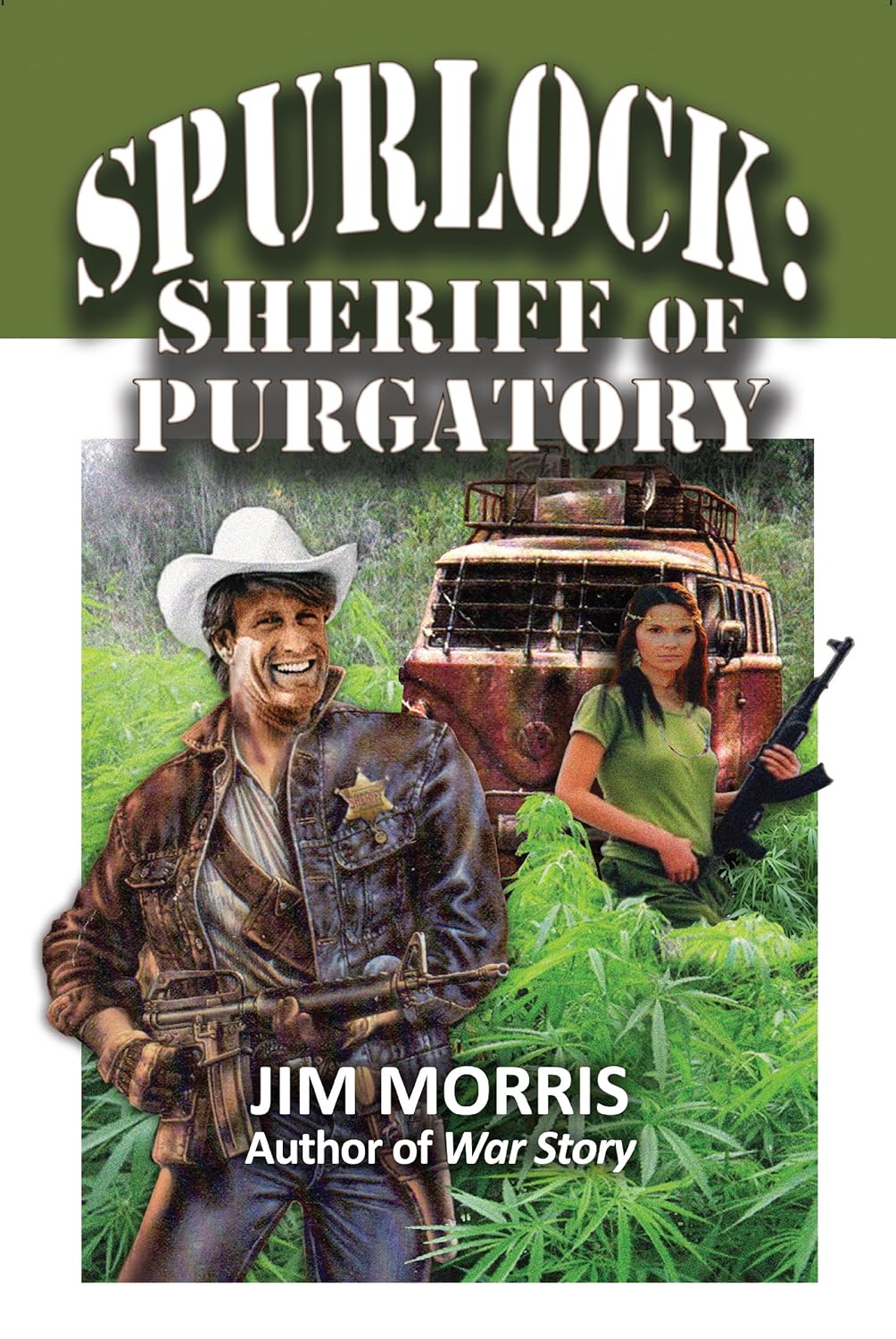
420 Friendly Adventure--Spurlock: Sheriff of Purgatory
I'm becoming quite well-acquainted with Jim Morris's work. That's how I know that this novel is off the beaten path for him. At least the beaten path so far. Like Bob Dylan, it is so free-wheeling that I'm inspired to wax poetic:
Spurlock is a shrewd dude who meditates in the nude, to put him in the mood to deal with the rude and the crude, who need adjustment of attitude. He lives in a time when the US is screwed. And he likes wacky tobaccy better than food. Though Morris is hardly a prude, his prose is a far cry from lewd.
I should have been a beatnik. Or a hip-hop gangsta.
Okay, let me expound a bit without putting it into rap lyrics. (Don't worry--there is no infantile rhyming in this book.)
Morris has set this tale in an alternate reality. I'm a bit fuzzy on the historic details that led to the scenario, but the gist of it is: 1. The Ruskies won a war with the USA, and now occupy the continent. 2. The occupational army runs the economy by proxy; and that proxy is the Mafia. And you get the idea that of the two organizations, the Mafia is the more powerful. 3. There was an armed resistance to the invasion. Most of them were assimilated back into the culture, like Spurlock. The "guerrillas" remain in rural areas, operating like a minor-league (and redneck) Mafia. They are murderers, rapists and borderline psychopaths who don't even understand what it is they think they're fighting for. 4. Purgatory is such a backwater that it has been left alone since the war was lost.
Sheriff Spurlock runs his county (and his personal life) with a mixture of streetwise savvy and a Zen-like quest for balance and harmony. He has an agreement with the local guerrilla leader which maintains the status quo, such as it is, with minimal conflict. That status quo is upset when a stuttering Mafia don comes to town with plans to absorb Purgatory into his fiefdom.
Shrewd dude that he is, Spurlock proposes a compromise with the Mafia that should keep everyone happy. But the don loses face during his visit, so Spurlock is screwed, clever compromises notwithstanding.
What follows is a road trip to the Big Apple by Spurlock and a practicing witch. There are some interesting misadventures along the way, then Spurlock locates and attempts to evacuate his estranged children from a New York very much like the one Snake Pliskin had to escape from.
This is an eccentric adventure tale laced with colorful characters, Eastern philosophy and social satire. There are some nice twists and detours along the way.
Personally, I've never experimented with marijuana, drugs or Eastern mysticism. Never had an interest in doing so even though I was born in the heyday of all that flower-power Summer of Love go-go stuff. But those who have lived a far less "straight edge" life than I have will probably feel right at home accompanying Sheriff Spurlock on this quest which is, at its core, pretty dang fun.
Wednesday, June 26, 2013
Assagai by Wilbur Smith
Whether he's on his game or not, Wilbur Smith is a novelist who tells a good adventure story nine times out of ten.
This one begins a few years prior to the outbreak of WWI and features early aviation, espionage, romance, and big game hunting in Africa.
Leon Courtney is a junior officer in the British Army in East Africa, with a lousy commanding officer. He makes a career change early on and finds himself on an epic hunting safari for Teddy Roosevelt and his son, Kermit. Ultimately he finds himself in a dangerous love triangle and some colonial chess-playing between the British and German empires prior to the opening guns of the First World War.
Smith's research is usually solid, but in this work he has some anachronisms--like German purpose-built bombers years before the war even began. (Even well after the war started, and bogged down into trench combat, planes were not used for fighting, but observation. The armies involved considered the military potential of "aeroplanes" dubious at best. Purpose-built combat aircraft didn't start rolling off the assembly lines for a while.)
Where Smith really shines is in his descriptions of Africa. In particular I appreciated his breakdown of the complex ecosystem which provides early warning (and hygiene) for elephants. And though I'm an unashamed carnivore, have enjoyed hunting in my day (and would again if it were feasible with my schedule, etc.), Smith's depictions of hunted animals are so poignant that I often can't help a pang of sadness when the humans prevail. This is true in a lot of his novels.
I couldn't help wondering if this novel is setting up what happens in The Power of the Sword which I read a year or two ago. Anyway, it's a pretty good read.
Wednesday, June 19, 2013
Switchblade Fiction: The Vandals by John A. Vikara
No offense to Nuyockas, but you couldn't pay me enough to live anywhere near youze guys. I've visited the Big Apple and enjoyed seeing it up close. I've read about it, watched documentaries on the city, and am fascinated by the history of it, etc. When I was younger and not nearly the cantankerous curmudgeon I am now, I even managed to sit through West Side Story--dance scenes and all.
Vikara's novel is the best book I've read so far about street gang turf wars, fiction or non-fiction.
It follows the episodic structure of The Wanderers, which has its pros and cons. On the plus side, it covers the rise and fall of the gang inside the decade in a cumulatively objective manner, getting inside the heads of a handful of the key members. It also allows for realism, while still moving the plot forward. On the negative side, the format is a bit jarring, abandoning some characters just as you're starting to root for them.
The author was a youth gang member himself, and I appreciate his insights. I've never lived in Gotham and was not alive to experience the era portrayed here. Still, I've developed a prejudice: I unconsciously assume all the turf wars took place in Brookyln, the Bronx or the rougher parts of Manhattan, and wouldn't ordinarily associate Queens with street gangs. Yet there it is, and the deaths are no less fatal because they occurred in Queens.
The story ends on a bittersweet note. You could call it a depressing note, but some Vandals and their friendships survive. There are a couple guys who die by a cruel twist of coincidence and fate, which has all the morbid hopelessness of a story from one of the horror comics read by some of the gang members. I didn't see the point of that, but the novel as a whole is still a good one and was impossible for me to put down.
At 99 cents for your Kindle, you can't go wrong.
Monday, June 10, 2013
Have You seen Your Mother, Baby, Hunting in the Shadows?
Sorry, but the title makes me want to modify and sing Rolling Stones lyrics. Like a good Patient Zero, I have spread this virus as far as I could, in hopes that it's contagious enough that others will be afflicted with this compulsion.
Peter Nealen is a former Recon Marine and a recently-debuted author of military fiction, starting with his Task Force Desperate, and now followed up by Hunting in the Shadows, about a private military company operating after the economic collapse in our near future.
In the paramilitary adventures being published now (including my own), I can't think of any protagonists I'd be comfortable calling "mercenaries," though technically that is what they are. Money is a secondary motive for these "soldiers of fortune." Bringing some semblance of justice to a given situation is the primary driving force, and there are interests they won't fight for (or take money from). Today we have the option of calling mercs "contractors" or "PMCs," thus outflanking the stigma associated with that dreaded M-word. So be it.
If there's anything that even remotely resembles a plot device in Nealen's military fiction, it is what Pentagon brass refer to as "mission creep." His novels unfold the same way unconventional warfare does. The mission parameters in effect yesterday may not be what you're guided by today. The roster on your side and the enemy's side keeps changing as guys die, just as in "normal" warfare, but nothing else is constant, either. Those who thrive in this kind of existence adapt quickly and often, constantly considering various contingencies, variables and caveats. We know this because, as in Task Force Desperate, the tale is told in first person--so we are right there inside Jeff's head as he navigates more dangerous turf and an intricate, complex (if not convoluted) political/military minefield in the Middle East.
Jeff
is a Team Leader in Praetorian Security now. The shooters waxed in the
last mission have been replaced, and Praetorian is on a headhunting
crusade this time--taking out known terrorist leaders during a
near-future conflict involving Iraqis, Kurds, Iranians...and a rogue's
gallery of terror organizations (some of which you've heard of, others
maybe not).
For the last couple years the Clancy-esque millitary thrillers and techno-thrillers have acquired some competition in the form of a "second wave" of military fiction. In the Second Wave, authors (many of them veterans of Iraq and/or Afghanistan) are combining adrenalin-pumping action with a degree of authenticy sadly lacking in much of the First Wave. I'm glad to have been involved in this renaissance and I recommend Hunting in the Shadows as a fine representative of it.
Thursday, June 6, 2013
D-Day Anniversary 2013
I neglected this anniversary last year. Can't remember why. June 6, 1944 was not only a turning point in world history, but it ultimately altered my life course forever, as well (when I learned about it). Few films have captured the carnage and desperate struggle for Omaha Beach like Saving Private Ryan, so enjoy these clips and remember that freedom isn't free.
And I may have shown this one before, but because of my Airborne heritage I'm showing it again: the jump into Normandy the night before the invasion, as depicted in Band of Brothers.
Finally, here's a scene from The Longest Day about the poor devils who were dropped over St. Mere Eglise right into the Germans' laps. I couldn't find an unedited clip--somebody superimposed snapshots of some of the real paratroopers from the time.
Labels:
D-Day,
ETO,
GIs at war,
WWII
Sunday, June 2, 2013
Drive Angry
Welcome to Schlock Theater 2013. Looks like Nicholas Cage signed up for a variation on Ghost Rider. Unfortunately there's no Eva Mendez this time, but the film makers compensated by replacing the flaming motorcycle with some (sometimes aflame) Detroit muscle.
The title comes from a license plate, BTW, not from what happens on the screen. Aside from a few burnouts there's no angry driving. For the highway shots, the cars usually move at a rip-snorting 40 mph.
There are some choices made by the film makers that I applaud, yet there's plenty of stupid crap to negate them. Best line in the movie: "I never disrobe before a gunfight."
Best watched with buddies while consuming mass quantities of beer.
Tuesday, May 14, 2013
Destroyer #3: Chinese Puzzle by Warren Murphy and Richard Sapir
I never saw the big screen adaptation of the Destroyer. From what I've heard, that's no big loss. In any event, I'm a late arrival to this action-comedy series by Warren Murphy and Richard Sapir. But after reading just this one installment, I understand why the series is so popular.
The plot is rife with Cold War intrigue, with a few twists to keep you guessing. It concerns a kidnapped general from the People's Army, and his attractive concubine. Remo and Chiu are dispatched to resolve this international incident.
Remo Williams is a regular guy. No, make that an exceptional guy. He's an old-school adventurer who happens to be learning a deadly martial art from a wizened master. Chiu isn't just exceptional--he's pretty much superhuman. We get some background on him in this book, concerning his native village in Korea, and the art he has mastered. He's also a hilarious smartass, who kept me snickering periodically.
There is an affection between these two heroes--that of a teacher for his gifted student, and the student for his incomparable master. And yet, we learn Chiu is prepared to kill Remo if ordered to by those they work for. Lucky for both Remo and the reader, this doesn't happen.
So whether you like action or humor, but especially if you like both, this book gets a strong recommendation from me.
Tuesday, May 7, 2013
Military Intrigue With Hints of the Supernatural: Ghosts of Babylon
Yet another veteran-turned-author has joined our ranks. With Ghosts of Babylon, R. A. Mathis has not just earned a place for himself, he’s carved out a rather unique niche as well.
The novel takes place during the occupation of Iraq. Stuart Knight, a professor of archaeology, has volunteered to be a translator for American forces (since he speaks some Arabic) with an ulterior motive: he wants access to the priceless archaeological finds he is sure are waiting to be discovered in the Sandbox. He is attached to a battalion-level command which includes Regular Army soldiers and National Guard, so there’s conflict to be found everywhere—not just between Kurds and Iraqis.
It doesn’t take that conflict long to heat up, either. A local terrorist known as Al-Khayal is developing more and more sophisticated improvised munitions to use against occupation troops. Captain Allen, an intelligence officer (not an oxymoronic title in this case) has an old score to settle with the phantom killer, so finding Al-Khayal is a personal obsession for him. Fellow captain Crumm and their C.O., Colonel Thorne, have their own agenda in-country, and it doesn’t line up with Allen’s.
Then there’s Hadi, the young Kurdish boy who likes to explore. He finds just the sort of archaeological treasure that Stuart Knight is looking for, and that puts his and his family’s lives in jeopardy. There are some adults willing to kill for the artifact, and Hadi eventually runs afoul of Al-Khayal himself.
To read the rest of this review, follow the link to Hot Extract.
Monday, April 29, 2013
One Second After by William R Forstchen
I've been meaning to read this one for a while. I like some of the TEOTWAWKI fiction/film that's been produced, and hearing the raves about this from "mainstream" readers, I figured it would be hard to go wrong.
I remember looking at a cover of Popular Science or Popular Mechanics back in the 1980s, showing a nuclear blast in the atmosphere above Kansas. The blurb said such an explosion could knock out electronic devices all over the United States. It was over a decade later before "Electro-Magnetic Pulse," or EMP, became a familiar term in our lexicon. With the Cold War over, most everyone assumed it would never be used as a weapon. But rumors were widespread that EMP devices were being planted under the highways as a means of ending high-speed chases.
Forstchen has written a novel which assumes there are still nations and organizations around the world with ill will toward the USA, and they cripple us with just the sort of EMP attack theorized by that magazine in the '80s. He speculates how things go in the first year after such an attack in one small town near Asheville, North Carolina. It's not really a survivalist novel, though it does document the community's efforts to survive.
The protagonist, John, has a few things in his favor. He's a retired Bird Colonel, and a professor of history, which enables him to plan and execute the defense of Black Mountain. His mother-in-law owns a couple functional pre-electronic ignition vehicles (not dependent on microcircuitry--therefore EMP-resistant). And he lives up in the hills where there is plenty of game to hunt...at first.
John also has some disadvantages. Primarily, one of his daughters is a diabetic, and dependent on insulin.
Forstchen concentrates on the medical side of such a scenario--with food availability being a related health factor. And it would be every bit the nightmare he describes.
An EMP wouldn't just knock us back to the 1960s or '70s (before our entire society became so dependent on electronics). It wouldn't just knock us back to WWII, or even the 1800s. Because of our ignorance of how things were done before the pervasive technology we now take for granted, it would be more like the Middle Ages. How many of us know how to farm? How many know how to turn wheat into bread (assuming you live within range of where wheat is grown)? How many can fix stuff when it breaks (without power tools)? You can hunt for food if you have firearms, or are knowledgeable enough to build your own traps or weapons (which you probably aren't). OK. But how will you prevent most of the meat from spoiling before you can eat it? How many even know how to start a fire? How would you transport the tons of crops from the west and midwest to the starving masses in the rest of the country before it rots where it sits?
Forstchen grazes these subjects while spinning this yarn. Again: this is not a survival story. And it sure isn't escapist entertainment. It's a warning. On a few occasions John wonders at why no precautions were ever taken against this very real threat.
(WARNING: political screed follows. Colored text.)
"Our" government is about 17 trillion dollars in debt last I had the stomach to check, and putting us millions deeper in debt with every passing second. What are we spending the money on? Bailing OTHER countries out of their problems, for one thing. Our tax dollars have already turned Red China into a superpower, and transferred our industrial capacity to them. And we're borrowing billions from them so we can give it right back to them in the form of foreign aid. (I dare anyone to justify that. It cannot be justified, so it is ignored.) Part of that astronomical debt has been accumulated by bailing out Wall Street, of course, and other institutions, at the expense of the middle class. It's being used to form, fund, train, equip and arm various organizations (standing armies, is what the founding fathers would call them) to infringe and eradicate our individual rights protected by the Constitution which every politician swears to uphold. The money's used to make those same politicians filthy rich on our dime, as they immunize themselves from the "laws" they pass for the rest of us. The money is heaped upon illegal aliens and the Parasite Class to bribe them into loyalty to the Democrat Machine and to continue to steal our elections. It's used to arm and feed our enemies in the Middle East and around the world, to topple existing regimes and replace them with even more anti-American despots. It's used to fund undeclared wars. It's used to prop up the hopelessly corrupt, incompetent, anti-American, anti-Christian and anti-Semitic would-be world government called the United Nations. It's used to fund an untold number of frivolous studies and "works of art;" to pay for infanticide, condoms and untold multitudes of political pork. It's used to cover up the unending crimes perpetrated by the present administration while funding their exorbitant vacations, concerts and shopping sprees even as those of us trying to earn an honest living (if we're fortunate enough to still be employed) have to deal with higher and higher cost of living as the wages we earn plummet in buying power.
That's just a glimpse of where this money is being flushed, as the government refuses to fulfill its legitimate functions (like securing the borders). Meanwhile not one dime of this astronomical spending is directed toward strategic missile defense, a civil defense infrastructure, or protecting our power grids from EMP. "Homeland Security" is all about planning for an offensive war against American citizens, evidently, and has nothing to do with protecting the homeland from attack.
And while this goes on, the nations that hate us (but are all too willing to accept our handouts) are acquiring the capability to knock us into Medieval times with relative ease.
Forstchen slips a few pointed questions into the narrative about why nothing was done before it was too late, but never questions the priorities of those holding the purse strings, as I just did. Understandable, for a number of reasons. What I've just done is considered "preachy." And "preaching" is only tolerated when hardcore leftists are doing it. Also, as obvious by an introduction written by Newt Gingrich this is a neocon novel. My definition of neocon: a socialist who wants a strong military and espouses lower taxation.
In the Newspeak we're being trained to use, Marxists are called "liberals" and neocons are called "conservatives." I've just about quit using the term "conservative" (at least without quotation marks) because the term is constantly used to describe anyone not as devoutly left-wing as those who control the mainstream media. Don't let all the misnomers confuse you. Neocons split from the Democrats basically during the Cold War because Stalin and Mao were a bit excessive in pursuing Marx's utopia, and neocons prefer a more subtle and gradual, less violent means toward the same ends (as long as taxes are dialed down a bit while military strength is dialed up) while the "liberals" adore the likes of Fidel Castro and Hugo Chavez...Until/unless knowledge of their own despotism becomes too common.
The neocon disposition is evident in some of the solutions and policies conceived by the good guys in One Second After. But it's all plausible enough, and even though I would be classified as a dangerous kook in a TEOTWAWKI community presided over by the Forstchens or Gingriches of the world, One Second After was still a decent read for me. Enough attention was paid to character and conflict to keep me turning pages, and caring what happened next.

Subscribe to:
Posts (Atom)