Search This Blog

Showing posts with label cultural icon. Show all posts

Monday, April 15, 2013

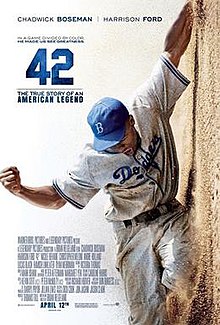
42: Another By-the-Numbers Black History Jock Movie


I used to be a sucker for these movies. From Louis Gossett Jr. playing Satchel Paige to The Express: the Ernie Davis Story not too long ago, I ate this stuff up. But my enthusiasm has waned in recent years.

One reason this movie has a strike against it (pun intended) from the opening pitch is because the story has been told so many times already. It's difficult enough scraping up some originality for ANY jock flick, much less the Black History subgenre of jock flicks.

Most people still love to watch a silver screen depiction of an athlete overcoming adversity, beating the odds and earning some kind of great victory. Not easy to do without becoming predictable. Throw in the "color barrier" aspect from the Jim Crow days and not only is the outcome predictable, so is most of the conflict on the way to it. We know the hero is going to be persecuted by rednecks in the bleachers, on the opposing teams and in their own locker room. Bigots will deny them hotel rooms, seats on planes and buses, and rob them of good plays on the field with blatantly crooked officiating. There will be a gratifying scene or two of those bigots getting some measure of commuppance; a touching instance of a teammate overcoming his own bigotry to help the hero at a critical juncture; and of course the big Victorious Moment when the hero scores the big home run/touchdown/goal/knockout/three-pointer/whatever.

I don't know that much about baseball and have never followed it (though I played in Little League and plenty of sand lot games as a kid), but according to some quick Internet research, 42 is surprisingly factual (if chronologically tweaked). And yet while watching it, I couldn't help feeling that it wasn't about Jackie Robinson the man--Jackie Robinson's name was merely stuffed into the Hollywood Black History Jock Flick cookie cutter.

The film makers combined visuals, dialog and mood music at all the Big Moments for the desired effect, but to me this was just faithful adherence to a well-worn formula. It's hard to tell if there was much, or any, passion for the subject matter.

This lack of passion trickled down into the performance of most of the actors. The best I can score most of them is "near miss." I can't fault the players, who certainly seem talented enough. In the case of Robinson's wife, reporter Wendell Smith and both managers of the Brooklyn Dodgers, they just didn't have much to work with. They were given just enough screen time and dialog to mark off a box on the formula checklist, but not enough to contribute anything significant to the story. Nicole Beharie as Rachel Robinson, for instance, could have been instrumental in helping her husband temper the rage building in him from the injustice he suffered. It almost seemed like that's what we were about to see once or twice. But if the scenes were ever shot, they must have wound up on the cutting room floor. So the passionate embraces and expressions of concern which were included amounted to nothing more than boxes checked off. Successful stamps of the cookie cutter.

Even the lead actor Chadwick Boseman wasn't given sufficient opportunity to define the Jackie Robinson character beyond type. Harrison Ford, however, hogged the camera from beginning to end, mugging and hamming as owner Branch Rickey. So much so that the flick was more about him than about Robinson. There's no doubt in my mind that Ford used his clout as a big name movie star to amp-up his part, to the detriment of the film itself and the other actors in it. And critics may even praise him for "stealing the show."

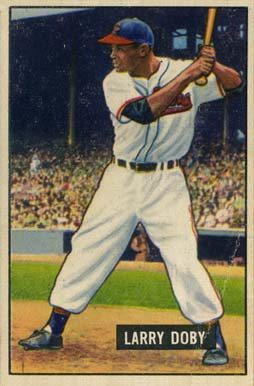
Robinson (as well as American League counterpart Larry Doby, and trailblazers Satchel Paige and Josh Gibson) were exceptional athletes and remarkable men. Unfortunately, there's nothing exceptional or remarkable about this movie.

In addition to the formula being so overused, maybe Hollywood film makers are equally hindered, subconsciously by their own worldview, from crafting a noteworthy film on this topic. After all, to tell the story with any modicum of historical reality they must depict an individual who, through hard work, diligence, determination and a measure of God-given talent, fights his way up from obscurity, rejects mediocrity, pursues excellence and achieves it despite the many forms of adversity in his path--usually an offshoot of institutionalized group identity. And the individual's exceptional accomplishments did not come by way of entitlement programs or government handouts.

That's not a message Hollywood likes to deliver.

Saturday, July 21, 2012

The Police State Rises. Oops, I Mean the Dark Knight Rises


I was a comic book aficionado before it was cool. Or "edgy" or "fly" or "pimp"or whatever it's called right now.  And the Batman was my favorite masked hero even before that 1988 Tim Burton movie rescued the Dark Knight's reputation from the awful legacy of the '60s TV show. Even before Frank Miller's "powerful reinterpretation" a few years before that.

I'm not a fair weather fan. And as a die-hard fan, I felt adequately qualified after seeing Batman Begins in the theater to proclaim it the best screen adaptation of Bob Kane's cowled vigilante.

The sequel, The Dark Knight, was a nice effort, but really two movies wadded together, trying to accomplish too much for one feature film...as so many superhero sequels do.

I just returned from opening night of Dark Knight Rises.

It's a crowd pleaser, and I have no doubt it will do great box office. The special effects were spectacular, of course. It was nicely plotted, in that it plucked at the emotions in the logical places, gratifying the audience with Pavlovian aplomb.

The script is based on a run in the comics which had the Batman severely injured after a battle with Bane, and a substitute (Dick Grayson/Robin/Nightwing for a while, maybe, but I had pretty much stopped following comics by that point and don't remember) dons the cape and cowl to continue the crusade against crime.

The film opens with the Batman retired and Bruce Wayne still crippled, not from a fight with Bane, but from injuries sustained battling the Joker and Two-Face eight years ago.

Hmm. He spent seven years abroad before becoming Batman. That would put him at about 27+ at the beginning of his career. Add however long he protected Gotham before retiring, then another eight years and he's over 35--pretty long-in-the-tooth for somebody who has to engage in unarmed combat with swarms of bad guys, and perform death-defying stunts on a regular basis. And if I heard Bruce's doctor right, he has no cartledge left in his knees or elbows. (I lost a little bit of cartledge in one knee and have not been up to half of the physical activities I used to engage in before that.)

When Bane comes to town, Bruce decides to come out of retirement. He straps on a knee brace, sets his cane aside and is right back in the saddle. No explanation is made of how the knee brace fits under his costume unnoticeably, or how it helps his other knee, or either elbow. Do we really need one? I guess not. So the Batman is back in action, with a new toy (a VTOL aircraft), and we are ready for him to kick some super-cundingy.

Jim Gordon, though already Gotham's police commissioner, still resembles the Year One Lieutenant Gordon--packing heat, personally leading SWAT teams and riot squads in heroic cop combat, and performing death-defying stunts of his own while disarming bombs and such. Okay... Maybe police commissioners do that in real life...in places like Sierra Leone, El Salvador or Mongolia.

Another cop character is introduced (Officer Blake), who I kept expecting to put on the bat-armor himself...but didn't.  Yet by the end of the film it is implied that he will be putting on a costume of some sort.

As with all cinematic Batman sequels, the creative think-tank, or production committee, obviously dictated that one villain (Bane) would not be enough for this film, and so we have R'as Al Ghul's daughter Talia show up, as well as Catwoman fulfilling the obligatory amazon superninja role, in a predictable "bad girl with a heart of gold" incarnation. (But at least she started out as a cat burglar, and I'll take whatever faithfulness to the comic canon I can get.)

That same circlejerk...er, creative think-tank, I mean... had a "raising the stakes" orgy during preproduction. Bane (who it turns out is also connected to the League of Shadows from Batman Begins) isn't content to just destroy Gotham as Al Ghul tried to do. Nope--he's gonna nuke it off the map. But not before utterly destroying Bruce Wayne financially--by movie's end Bruce will have lost Wayne Enterprises, his own fortune, Alfred...temporarily, and Wayne Manor (which includes the Batcave and all its goodies). Oh, and his secret identity. Again.

I don't completely understand this, but every film maker tasked with bringing a superhero to the screen is obsessed with exposing the identities of the masked heroes they depict. It's like a fetish or something. Not only does Bane, Catwoman, Talia Al Ghul, Commissioner Gordon and the aforementioned cop (Blake) join the ranks of those who know the Batman's "secret" identity, but the Wayne Foundation's secret research and development complex (the Bat-arsenal) is exposed for all of Gotham to see. In fact, Bane's mercenaries use (and destroy, of course) the spare Batmobiles stored there.

In his first tussle with Bane, Batman conveniently forgets how to fight. He telegraphs every punch, and can't get out of the way of equally telegraphed blows from his Sean Connery-sounding assailant. His spine is dislocated (if not broken) by the end of the struggle, to the point that vertebrae are protruding from his skin. But after some prison chiropractic techniques, a few push-ups, pull-ups and situps later he is in peak condition (at 35+ with no knee or elbow cartledge, scarring of the liver and accumulative brain concussions) to go kick Bane's mercenary butt this time. Because, you know, he's heard some motivational dialog, and he's learned how to manipulate fear and hope, and all that will give him the edge he needs. Oh yeah, maybe he'll cut back on the Western Union roundhouse punches, too.


The ending borrows from Miller's Dark Knight Returns in a couple ways...also Superman Returns and First Avenger in the hero-as-savior aspect. The writer(s?) and director go from rebooting the Batman canon to obliterating it with gleeful abandon. By the film's conclusion there is no possible way for the Batman to continue his war on crime in Gotham City according to the Bat-mythos we are familiar with. At least until the next reboot.

What annoys me most about the latest Bat-flick is what's going on under the surface. There is a message hammered into the audience, both visually and thematically, which goes beyond the law-and-order platitudes of most cop flicks.

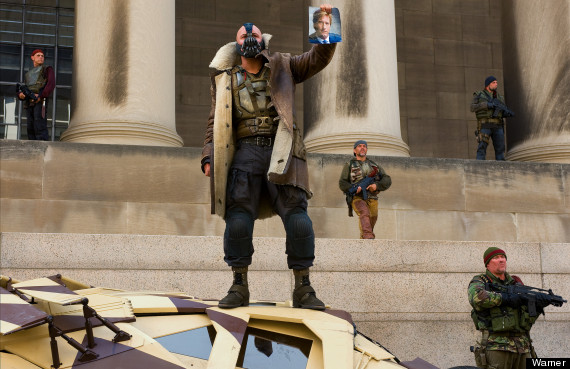
Bane is a well-armed, shrewd, manipulative agitator who incites anarchy by taking the city captive while encouraging the populace to liberate themselves. Anarchy ensues, and Bane gives people guns! (Cringe, hiss!) Just in case you don't find armed citizens scary enough, he also breaks open a penitentiary (or was it Arkham Asylum?) and arms dangerous, hardened criminals, too.

Visually, director Nolan was careful to show that the heroic, altruistic Gotham Police were outgunned by the rabid mob. But this mattered little, as only a few shots were fired before the courageous guardians of order clashed with the freedom-crazed agents of chaos. Then the weapons disappeared and a hand-to-hand rumble ensued. Sure. I'd use fists instead of firearms when involved in a street war with thousands of combatants. Wouldn't you?

Bane, for all his revolutionary rhetoric, cares nothing for the army of gun-toting rebels he has mobilized, fully intending to destroy them along with the world order he so despises.

Irony abounds, here.

First you have a story lionizing an anonymous vigilante while simultaneously implanting establishment attitudes about "legitimate" authority (and its monopoly on coercive force). This is nothing new in Batman stories, but it's worth pointing out.

Then there's the sympathy for the "Occupy" movement woven into the plot, while qualifying it by showing the benevolent nature of super-billionaires like Wayne who are selflessly helping the proletariat, even though they suffer the scorn of classist critics like Selena Kyle/Catwoman. Kind of like how Michael Moore supports the Occupy movement and demonizes capitalism while getting fatter off the capitalist system. Or how George Soros, the international bankers and other super-billionaire insiders clandestinely support the leftist movements out to destroy the system they took advantage of to reach their lofty positions.

As mentioned, Bane is effective at stirring up revolutionary fervor among the weak-minded gun-toting masses, but he himself doesn't give a flying rat carcass about them or the cause he has seduced them with. He just wants to see the world (Gotham) burn. This betrays the Hollywood/media assumption that popular grass roots movements opposed to our national tailspin into socialist police statehood, at their core, are simply collections of brainless rednecks being manipulated by mercenary svengalis (Palin, Limbaugh and Beck, for instance, as the left-wing mind imagines it) whose only real motivation is personal gain. A compounded irony is their failure to recognize actual individuals who fit that svengali role, like Jesse Jackson, Al Sharpton and Michael Moore. (They would be out of jobs if race hatred or the machinations of Wall Street bankers ever came to an end.)

Bane and others pontificate on fear, and the importance of training yourself what to be scared of. Meanwhile the film makers are trying to train the audience what to be scared of: liberty (= anarchy); rule of the people, by the people and for the people (= mob rule and abolishment of due process); and a citizenry bearing arms (= uncontrolled violence on an epic scale).

Batman's "no guns" rule is overtly invoked, though Catwoman saves his life by using one such dreaded weapon. Officer Blake is horrified, at one point, that shooting two bad guys attacking him resulted in fatalities, and tosses his pistol away in remorse. Even so, he uses firearms later to save himself and others.

But the biggest irony is the propaganda victory of the shooting in Colorado. During a screening of this pro-police-state film, some whack-job with a protective mask, tear gas, and, of course, a firearm, murdered enough people to demonstrate just how dangerous it is when the state doesn't have a monopoly on coercive force. And what atrocities occur when people cling to liberty instead of sacrificing it for security and the greater good. The threat of chaos if law and order isn't enforced with an iron fist.

It is highly doubtful this crisis will be allowed to go to waste.

I would not be surprised if new "gun control" legislation, complete with provisions outlawing gas masks, was drafted before the smoke even cleared out of that Colorado theater. And more will be discovered about the shooter in days to come, too. Did he ever attend a Tea Party event? See, I told you those creeps were dangerous--better crack down on them. Did he ever voice criticism of Obama? See, I told you only racists and whack-jobs held those kind of opinions. Better outlaw "hate speech," too. Oh, wait...we're already working on that, aren't we?

(This just in: The murdering whack-job in question has been identified as James E. Holmes, someone involved in the Occupy movement, not the Tea Party as the Obama Administration and network news will want you to believe. Holy irony, Batman! If the press suddenly shuts up about his political affiliations, you'll know this is true.)

It's unrealistic to expect any film maker allowed to work in Hollywood to keep their left-wing globalist worldview from coloring their work. So, up to a point, I take it in stride and try to enjoy movies anyway. I didn't allow myself to consider the political untertones in the two Batman movies before this. I wanted to like this one. The Batman is a fantastic character and deserves fantastic adventures, whether on the big screen or the comic page. This story is fantastic when it comes to stunts, explosions, imagery and "what's at stake" plot-wise. It is not so fantastic in other ways; and offensive to me in a political context.

Batman Begins is still the best Bat-flick yet, in my opinion.
Thursday, June 30, 2011

GI Joe: The Complete Story of America's Favorite Man of Action


My experience with GI Joe goes back to the age of five. Somebody bought me one for Christmas or a birthday--a 12 inch plastic dude with a scar and a beard in an orange jumpsuit. The box he came in told me he was a smoke jumper, but a picture on the box showed him in a different uniform carrying a medical bag next to a toy ambulance, so I knew he was a paramedic, too. Having no knowledge of word or phrase origins at the time, I simply accepted that "GI Joe" meant a scarred, bearded, smoke-jumping paramedic.

When my big brother explained what smoke-jumping was, I decided to make a parachute for Joe out of some of my mother's yarn and plastic from a bread wrapper. As a feat of engineering, my effort was a bust. That brilliantly designed parachute just wouldn't deploy, no matter how many times I chucked Joe into the air . And that's how I lost him. I found him again later, but the dogs had found him first. Joe was a hideously mutilated wad of peach-colored plastic. So ended my hands-on experience with GI Joe.

About 10 years later I still hadn't quite become fascinated with word and phrase origins, but I did have a keen interest in history and popular culture from bygone ages. I was also on my way to becoming a World War II buff. So I was starting to read the term "GI," always in military contexts, and accepted it as just linguistic coincidence. But then, when reading about war movies, I came across a review of one titled "The Story of GI Joe." The review (with some production stills) convinced me that this was a film set in WWII about the rigors of combat. I couldn't, for the life of me, imagine how that scarred, bearded, smoke-jumping paramedic in orange coveralls could be the star of such a film.

My epiphany came while reading a Silver Age DC comic from the days of Batmania. I encountered a full-page ad about GI Joe, who, in those black & white days of yesteryear, was a real, honest-to-gosh GI! My first reaction was, "Aha! No wonder he's called GI--that's what he was before he grew a beard, put on an orange jumpsuit and became a smoke-jumping paramedic." My next reaction was, "Cool! Why couldn't he have been a real GI back when I still played with toys?"

The ad photo showed Joe in uniforms from every branch of service, and I thought they were all nifty. The soldier and marine were decked out for combat (the marine had a camo cover for his helmet while the soldier did not--WWII was still THE conflict that came to mind when the subject of war came up back then, I guess) with rifles and web gear; the sailor had his snazzy crackerjack outfit on, and the Air Force Joe had a flight suit on, oxygen mask, etc, and was climbing into a scale model fighter plane. Man, all the imaginary heroics I missed out on!

Many years later Hasbro released some throwback Joes--not the little two-inch (or whatever) fantasy characters Hollywood recently made a movie about, but 12-inch, fully articulated fighting men from specific units...some were even specific servicemen (like Dorrie Miller, complete with anti-aircraft gun at Pearl Harbor, on his way to earning the Navy Cross). Try as I might, though, I couldn't justify to myself spending money on any of that. What I did spend my money on, though, was this book that tells Joe's story.

One of the guys at Hasbro got to reading an encyclopedia, and his son became fascinated at all the different medals listed therein. That's where the seed was planted. Toy soldiers have been around probably as long as real soldiers have, and now at Hasbro, plans went forward to develop a toy soldier for the 20th Century.

One of the toy Moguls involved in the Barbie line lent them some business advice that stuck: "First you sell them the razor, then they have to keep buying the blades." Or something like that. With Barbie, little girls got the doll one time, but turned Mattel into a toy empire buying accessories for it (different clothes, purses, doll houses, etc.). This was a perfect strategy for Hasbro, too, since Joe could be any flavor of GI a boy wanted him to be: deep-sea diver; scuba diver; pilot; astronaut; grunt with rifle; submachinegun; flamethrower... And speaking of Barbie, Hasbro was adamant that their new toy was for boys, and should never be called a doll. This is when, where and how the term "action figure" sprang into the American vocabulary.

I chuckled when I read how Hasbro settled on his name. There were only three TV stations to choose from in any given city back in the early 1960s, and it turns out that during the period when they were agonizing over a name for their serviceman, one night, with no planned coordination among them, the members of the Hasbro think-tank all wound up watching the same movie: The Story of GI Joe. The next morning, they unanimously decided to adopt Ernie Pyle's (the movie was based on his war correspondence) catchy euphemism for their entire "action figure" line. In a cockeyed way, this part of the tale gave me a sort of personal connection, having read about that film years before and pondered the title.

There are many interesting tidbits revealed in this book, like how Joe's backward thumbnail came to be and why they kept it; how they designed his face; and how they staged that picture of the fighter plane I mentioned above. The reason behind Joe's transformation from a GI into a smoke-jumping paramedic in the 1970s is explained in the book, though hardly a mystery to anyone who knows anything of those times. It can be summed up in one geographical name: Viet Nam. (And had Joe not burned his draft card, grown a beard and put on an orange jump suit, my mother probably never would have allowed me to own such a toy. So Hasbro's demilitarization was a wise move, I suppose. Sigh. Pragmatism...)

The book takes Joe up into the fantasy paramilitary organization of the 1980s, complete with cartoons and comic books, and it's all an interesting read if you have an interest in toys, business marketing, or pop-culture.

In many ways the evolution of GI Joe mirrors the mental journey of the boys who first played with him. Their fathers and uncles had saved the world from the Axis in "the war" (WWII), and as children they idolized fighting men, and thought it great fun to simulate war in their bedrooms or back yards. Then they saw their big brothers drafted and sent overseas to kill and die for a cause nobody could, or would, define. When big brother came home, it wasn't to tickertape parades and universal gratitude from the folks on the home front, but to Marxist protestors spitting on them, calling them war criminals, baby-killers, murderers. Often big brother came home in a wheelchair or a body bag.

I won't go into all the cultural conditioning undergone by the baby boomers. There was a lot of it. But between that and the natural process of maturation that transforms men in every culture, war ceased to be an opportunity for unlimited adventure, and became a gruesome, smelly nightmare. The military went from an being an honorable profession and a patriotic duty to a brutally half-witted dictatorship dedicated to crushing personal liberty. (I suppose there's some truth in all those perceptions.)

GI Joe probably came on the scene a decade too late for his own good. Yet his is a household name, connoting different images to different people and different generations. To Ernie Pyle, GI Joe was an everyman in uniform, a regular Joe (pun intended) thrown into the trenches to fight for his life. To the young boys of the 1960s, GI Joe was a cool, heroic warrior, fighting in noble conflicts of whatever scale their imaginations dictated (and whatever accessories their parents could bankroll). To my generation, he was a smoke-jumping paramedic with a beard, an orange jumpsuit, and Kung Fu Grip. To later generations he was a member of a secret paramilitary government organization thwarting COBRA's quest for world domination. In my opinion, the later incarnations merely hijacked the brand name, and bear little resemblance to what GI Joe was intended to be.

There's a whole lot of cultural commentary Joe could make after studying America through his plastic, painted eyeballs, too.

Some men remember  the true GI Joe fondly. Some despise him because of what they feel he represents. But wind the clock back far enough and he was a loyal comrade, indefatiguable personification of their own warrior spirit, or an imaginary friend, to almost all of them.

Thanks, Joe.