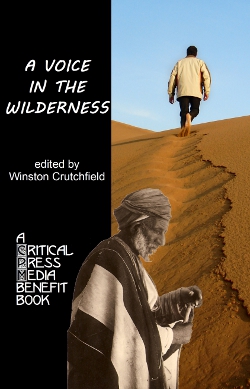
Blogger/podcaster and pulpnificent pontificator Winston Crutchfield has compiled a fiction anthology which is now published and ready for purchase.
Various writers contributed to this project, with a variety of genres including historical (set in biblical times), dystopian future, fantasy, science fiction and , as you might expect given the theme, contemporary Christian fiction.
Every purchase of a benefit book from Critical Press Media results in a charitable donation. Here's a little more about the anthology:
John
the Baptist was a unique person in the history of God’s plan for
redemption, and in the history of the world. He was the last of the Old
Testament Prophets, and the first of the Apostles. He was sent before
Christ to prepare the world to recognize and receive the Savior. Authors
were challenged to fulfill the function of John the Baptist’s office in
creative and visionary stories.
Luke 3 (NIV)
3 And he went into all the region around the Jordan, preaching a baptism
of repentance for the remission of sins, 4 as it is written in the book
of the words of Isaiah the prophet, saying: “The voice of one crying in
the wilderness: Prepare the way of the LORD!”
This volume contains compelling fiction and thoughtful essays from
Winston Crutchfield, Don Yarber, Henry Brown, David Crutchfield, Deborah
Caligiuri, Justin Lowmaster, Nathan James Norman, Philip Carrol, and
Ken Harmeyer.
A Voice in the Wilderness is
now available directly from Critical Press Media in popular e-book
formats and as a paperback printed copy from Lulu. E-book downloads
contain a zip file with DRM-Free PDF, EPUB, and MobiPocket/Kindle PRC
files, viewable on PCs, smart phones, PDAs, and dedicated e-book readers
such as the Amazon Kindle. Support independent publishing and purchase a
perfect-bound paperback from Lulu.
I was born during our nation's involvement in Vietnam, but by some strange combination of coincidences, I never learned what Vietnam was until I was 14 years old. Oh, I'd heard of the Green Berets (both the Special Forces soldiers and the movie made about them). I'd watched an episode of The Six Million Dollar Man with a scene depicting some wacked-out veteran's flashback of Vietcong chasing him through the jungle (though it didn't make sense to me until many years later..."Who are those people with the funny hats, Dad?"). And I'd listened to "Where Have All the Flowers Gone?" on the radio and even memorized the lyrics without understanding their specific reference.
It might be hard to imagine now, but not only that, I had also absorbed the anti-American sentiments that were en vogue ever since that ugly conflict.
I obviously overcame that, in time.
I was cured of my ignorance about Vietnam eventually, too. By the time I myself was a soldier, many of the senior NCOs and most of the field-grade officers were Vietnam veterans. Until Operation Urgent Fury (Grenada), the most recent combat American troops had experienced was in Southeast Asia. Some of the jargon I picked up dated back to American occupation of Germany or Korea. But most of the Airborne Creole I learned (and remains a component of my dialect, to the chagrin of my family) was of French-Vietnamese origin.
I once had the opportunity to meet General Westmoreland. He was retired, but in uniform. We shook hands. I was young and dumb…but not so dumb that I dared ask him what was on my mind: “Yo, General, how did it feel being Johnson’s stooge? Was it worth the cost of so many American lives over there to accomplish absolutely nothing?”
OK, it would be unfair to hold him solely responsible, I know. But I never met Johnson, Nixon or Kissinger, who should have been held responsible. I might have been dumb enough to ask them some tough questions.
When something causes me to think about Vietnam, depending on my disposition at the time, I either become depressed or infuriated. So I have to be in just the right mood before I'm willing to read a book or watch a movie about that historical debacle. Since I've been in that mood from time to time over the years, I've read a few Vietnam war novels. One of the best was one I reviewed here on the 2-Fisted Blog not long ago: The Return by Charles W. Sasser.
Even more recently, I've had the pleasure of meeting (via the Internet) a friend of Sasser's, and a renown writer in the military fiction AND nonfiction universes: Jim Morris. I was somewhat familiar with Jim Morris' work by reputation; also because I'd read some of his articles and a very fun semi-parody of men's fiction called Breeder. But now his books are being re-released digitally for E-readers, and I've just finished his Vietnam war novel Above and Beyond.
This is a novel Morris began writing in the hospital in Japan in 1968 while recovering from wounds that ended his military career. His right hand in traction, he wrote the first draft left-handed. It took 36 years before Above and Beyond saw print. (Geez, Hell and Gone took eight years from completion to published and that was maddening.)
Morris won three Purple Hearts before the first combat troops were deployed to Vietnam and before the first anti-war demonstration. There have been a lot of Vietnam veterans who became authors, but Morris was in the first wave. You could even say he blazed the trail for others to follow.
Above and Beyond’s protagonist, Neil Thompson, was a third-generation West-Pointer. He was booted from the then-prestigious military academy for failure to report a roommate who cheated on an exam. As the story opens he is a Special Forces “Green Beret” in Vietnam, having had to claw his way, tooth-and-nail, into a deployment that so many others wanted desperately to avoid. Now he wants to go to OCS and receive a commission before his former classmates get theirs and outrank him (enabling them to make his life a living hell, as small-minded officers can).
Thompson was born to be a soldier—or at least he’s convinced himself of such. He’s a likeable guy, with some perhaps heroic qualities, but Morris kept him real. He’s got some cognitive functions that are not quite as noble as an action-adventure hero’s. They’re more like what you’d find inside the brain of a real-life human being.
Thompson and his zany team leader Shoogie are part of Project Theta. Theta’s mission is similar to that of the LRRPS (Long Range Reconnaissance Patrols), and, later, SOG (Special Operations Group/Studies and Observation Group)—basically snooping and pooping inside the enemy’s back door. Like author Morris did, they work closely with the Montagnards—the ostracized hill people of Vietnam.
In an army of unwilling cannon fodder the only elite volunteers were the paratroops; in the airborne the most elite were the highly-trained, independent men of Special Forces; and within the Forces the absolute crazies inevitably gravitated to the reconnaissance projects.
While in-country, Thompson meets and falls for Juliana, an International Volunteer Service worker. ( IVS was kinda’ like the Peace Corps…only the Peace Corps wasn’t in Vietnam.) You would think a dope-smoking progressive and a minion of the military-industrial complex wouldn’t last long beyond a one-night stand, yet what drama they do suffer is rather typical of military families.
There is just enough combat depicted to show what this aspect of the “police action” in Vietnam was like. Any more might have mired the reader down in the minutia of a tragically futile conflict with no sensible strategic objective.
When a leg general arrives to take command in Project Theta’s Area of Operations, Morris’s storyline struck a chord. What followed was illustrative of, not Vietnam, really, but the US Army’s officer corps dating back possibly as far as the Civil War…or farther.
“Frenier never admitted to being wrong about anything in his life. He won’t stop the attack, or go up the reverse slope. He’d throw away his whole brigade first.”
Brigadier General Frenier just happens to be the same officer (a bird colonel, then) who kicked Thompson out of the Point, too. He’s an unimaginative, vain, pompous ass. He does show a couple redeeming qualities after sacrificing his troops on the altar of his self-importance; but there’s no mistaking what kind of commander he is. And as far as the novel goes, the joke’s ultimately on him: He berates the marines once or twice as sacrificing their men needlessly, and knowing no tactic other than the frontal assault. Can you spell H-Y-P-O-C-R-I-T-E? And in case you aren’t sure what kind of father this egotistical boob would be to his children, we find out later that his son eschewed West Point for Annapolis and branched USMC.
One more interesting point about Frenier: Another character described him as “trying to fight World War Two with helicopters,” or something very similar.
I’ve seen this sentiment a lot in fiction. And if you hang out with people interested in military science, you’ll eventually hear the old adage: “Generals spend their peacetime careers planning to fight the previous war.”
There was an attitude in many circles during the ‘80s that conventional forces were just about useless; and future wars would be won or lost solely by special operations. Frankly, I found that idea about as cockeyed as Billy Mitchell’s notion that, after WWII, air power alone could win conventional wars. Morris purports nothing so extreme in this novel, but his characters rightly hint that the conflict in Southeast Asia (at least with the limitations placed on US forces by Washington) required a whole different combat doctrine.
Shoogie pointed off in the distance. "Who burned that village over there?" The driver glanced in that direction. "We did," he said. "The people was supposed to be Cong sympathizers." Shoogie drawled, "If they weren't before they sure as shit are now."
Police actions, by definition, allow little room for victory in any reasonable sense. Whatever his faults, MacArthur was a commander willing to do what was necessary to achieve victory. You know: like the war he’d just helped win in 1945. But in 1950 he faced an enemy with many fellow travelers in Washington whose concept of victory had (and has) nothing to do with America (or any representative government) prevailing in any given struggle. The MacArthurs had to go. All hail the Westmorelands.
Ahem. I warned you what Vietnam does to my mood. I’m choking back my instincts to rant on about politics and military strategy.
By the time of Vietnam, the MacArthur/Patton-type officers (represented by McLeod in Above and Beyond) are a shrinking minority. Frenier is a picture of the new breed. Or, at least, the favored breed. And to win a war with the limitations the Johnson State Department imposed, it would have taken 30 years…or a couple more Tet Offensives until the NVA wiped itself out charging into the meatgrinder.
Despite my own political commentary, Above and Beyond is politically ambiguous. It’s poignant and almost ecclesiastical in its dichotomies: love and hate; war and peace; passion and indifference; loyalty and betrayal; selflessness and selfishness. Like the composer of a symphony, Morris weaves together a variety of notes, chords and tempos to give the audience (reader) an experience that engages the emotions, yet rings true.
To read my interview with the author about this book, visit Virtual Pulp Press.
After months of frantic juggling, I finally found time on Memorial Day to sit down and dig into this primo piece of paramilitary fiction. And I can see why it's so popular.
PRIMAL is a Private Military Company that is, uniquely, privately funded. They don't fight for profit and they owe no allegiance to any particular government. If Bruce (Batman) Wayne's parents had been killed by terrorists instead of street criminals, and he wasn't comfortable wearing tights, he would run an organization like PRIMAL, righting wrongs around the world.
In the prequel, PRIMAL: Origins we learned how this organization came to be. American ex-CIA man Vance and his IT wizard, Chua, are the brains of the organization; but the real stars of this story are newcomers Bishop and Mirza.
It seems the Russians developed a nerve agent deadlier than any other biological/chemical warfare asset, and now a Ukrainian arms dealer is about to sell it into the wrong hands. There are 3 different interests struggling for possession of this weapon; PRIMAL wants control so neither of the others have the opportunity to use it.
During the course of the mission Bishop crosses paths with beautiful Iranian spy Saneh. She's a great character and brings sexual tension into the mix...and neither the good guys nor the reader are sure to what extent she can be trusted.
The novel really hits its stride about halfway through. The plotting is nicely done and the action is suspenseful. By the end, the main characters are beginning to shine. Primal: Unleashed isn't just set up for a sequel...it's set up to be a whole series.
Author Jack Silkstone takes advantage of the digital nature of the book by including links, for those who want to know more, to webpages about some of the specialty weapons, equipment, etc. his characters use. (Why didn't I think of that?) He also includes images of aircraft and such to better help the reader visualize. Some of his dialog is a little too on-the-nose in places, but the overall quality of the book is much higher than a lot of the men's adventure from yesteryear, and far above most of the indie-published e-fiction available today.
My introduction to men's adventure novels, and war fiction, was The Sergeant #4:The Liberation of Paris by Gordon Davis. Up until I cracked open that paperback, I had never read anything like it before. I turned pages in a stunned trance, eyeballs dilated, jaw slack, visions of bayonet duels dancing in my head.
With this new literary universe to explore, I began collecting similar books. (It took me years, but I now have the entire Sergeant series in paperback.) Another series I collected was The Ratbastards by John Mackie. It was also a WWII series, but set in the Pacific rather than Europe.
At the time, I took the different author names at face value, but couldn't help noticing similarities in style, phrases in the dialog, and certain recurring sequences in different battle scenes.
The main protagonist in both series is a big, tough, battle-scarred Master Sergeant in the infantry--Clarence J. Mahoney in The Sergeant and John Butsko in The Ratbastards. Both have loyal junior NCO sidekicks that were once innocent all-American boys, but are now the best soldiers in any man's army.
I had high hopes for The Avengers movie and boy, did Hollywood deliver this time. There were so many ways they could have gotten it all wrong...but for the most part, they didn't. My inner comic book nerd has been seduced by the screenplay and the special effects.
Jeez, where do I start?
Director Joss Whedon has pulled off a refreshing effort to both stay somewhat loyal to the source material and make it palatable for the non-comic-savvy. See, I was a fan of The Avengers back when the only attempts at screen adaptations of Marvel Comics were laughable, and few but comic aficionados knew that "the Avengers" were something besides secret agents on a TV show. For me, Iron Man, Captain America and Thor were the core of the group; there was boocoup conflict among the characters, both hero and villain; and slugfests aplenty (in true Marvel fashion, often between the good guys due to misunderstandings). Whedon and his screenwriters delivered on all counts.
In a film adaptation of any sort of book--graphic or prose--certain characters usually need to be combined or deleted to save screen time. I think omitting characters like Moondragon and the Vision was a good call--they never added much to the Avengers, IMHO, anyway. Occasional members like Wonder Man and Captain Marvel/Miss Marvel were rightly passed over, too. Personally, I would have preferred She-Hulk to the Black Widow, but since the He-Hulk is a member in the screen version, that would have been redundant.
I haven't picked up a comic in many years, so I don't know what the Avengers are like right now...or have been like. But though I think the Hulk (the gray, intelligent version?) was a charter member in the '60s, he rarely appeared on the roster during the days when I read it. Like Thor, I never had an interest in following his solo exploits, but enjoyed his contribution to the team efforts. (BTW: it seemed the Marvel staff never completely decided whether the Hulk was more powerful than the immortal Thunder-God, and it's probably good that they didn't.) Both of them were assets to the team in the film version, and extremely fun to watch. The visuals of Thor calling lightning with his hammer were downright stunning--possibly the best comic-booky shots ever composed on the big screen (though one shot from The Rocketeer is still a strong contender as well as, believe it or not, a sequence from Superman Returns). And in a movie liberally seasoned with humor, the Hulk provided, hands-down, the most gratuitous laugh-out-loud moment. During said moment the theater erupted in belly laughter and I literally cheered and clapped. Let me assure you: I never do that during movies, no matter how much I enjoy them. At least I can't remember ever doing so before. It's a scene I could watch over and over and feel a rush every time. Whew!
Personally, I always liked it when former X-Men the Beast and (to a lesser extent) Cyclops were on the Avengers' roster. Also the Thing and the Human Torch from the Fantastic Four (I always liked the Thing better than the Hulk, but was in the minority in that respect). All of these have now appeared on the big screen, too. And my favorite Marvel superhero (followed closely by Iron Man), Spiderman, was not a member of the Avengers in the comics (though he was an occasional guest-star), but I thought he should have been. He will likely never be an Avenger in the movies, either. I always thought the Black Panther was cool, too...at least potentially, as an Avenger...as was Giant Man/Yellowjacket/Ant-Man. I won't complain that none of these heroes were cast. For one thing, it would be hard to manage so many extra characters correctly during a feature-length film--even a 2&1/2 hour feature.
Long-time Avengers stalwart Hawkeye was a solid choice for the cinematic superteam. The un-powered archer, as a member of this superteam, was always a small fish in a big pond. But the writers usually figured out how to make his contributions seem relevant. The Black Widow was an interesting choice to round out the team for the big screen. Like I said: I haven't followed the comic for a long time; so maybe she's not such an obscure minor-league character anymore. It's a given that the obligatory Hollywood feminist weltanshaung requires at least one amazon superninja in every action movie (and it doesn't bother me so much in a story about a team of superheroes) who asserts her physical superiority over a man in at least one scene. But it seems the Wasp, Scarlet Witch, Tigra or even the Black Cat would have been more logical choices. Still, it's hard to complain about seeing Scarlet Johansson in black spandex.
And speaking of costumes...the most faithful one in this movie was Captain America's. Surprising. I tend to be a purist, but wouldn't have minded if they kept the WWII version from his own movie. Well, I guess the Hulk was dressed pretty much exactly like he is in the comics. And Iron Man's armor is close and looks great. Hawkeye's looks nothing like his outfit in the comics. Maybe that's a good thing, given people's aversion to bright colors in real life. But no mask? Just seems wrong. He should at least have a helmet--like a modified chopper helmet with drop-down sunscreen and a Heads Up Display with targeting optics and so forth. Speaking of helmets: Why doesn't Thor have his?
I can probably answer these questions myself. Many superhero flicks discard the idea of "secret identity," partially justified by Marvel's Civil War series, which is probably the reason for Tony Stark's idiotic outing of himself as Iron Man at the conclusion of the first shell-head movie. Also, Hawkeye and Black Widow, in this universe, are government agents (of S.H.E.I.L.D.) and therefore not living double lives, with family or friends behind white picket fences that their enemies could go after. Same with Steve "Captain America" Rogers, which makes you wonder why he bothers with a mask.
But the main reason for mask-less superheroes on screen is the same reason you have cinematic Medieval knights who remove their helmets for battle while enemies are shooting arrows and swinging heavy melee` weapons at their heads: the actors can't bear to have their pretty faces covered. This is why Spiderman, who allegedly wants to keep his true identity a secret in the first 3 movies, removes his mask in public at every opportunity, when it's not conveniently ripped, burned or blasted off his head. (I just saw the preview for the next Spiderman flick and it looks like he keeps doing the same thing.)
So why does Thor eschew his helmet in the movie? I mean, it wouldn't obscure his face or his girly blond tresses either when fighting or delivering noble, nigh-Shakespearian dialog. Probably because the actor would feel silly wearing it. Why, then, does bad-guy Loki wear his far more conspicuous helmet for much of the film?
I don't understand all the costuming choices, but I can live with them. Especially with an action flick as well-written and well-executed as this one. It's impressive that suspension of disbelief can be maintained throughout a feature film with such incredible subject matter. And the chemistry of the cast is just about perfect.
We are treated to Marvelesque skirmishes between Thor and Iron Man; Thor and the Hulk; and all the Avengers against an evil alien invasion force that seems vaguely familiar from the comics (I didn't read Fantastic Four much, which is where I think they were lifted from). The special effects are really something--even without the gratuitous massive destruction in New York City and SHIELD headquarters.
Until now, I ranked Batman Begins the best superhero movie made, with Iron Man I in second place and Captain America somewhere up there, too. I think we have a new champion, folks.
With it's box office success, I'm sure there will be a sequel. Almost every time a film maker shoots a sequel, they attempt something even bigger and better than the first...and accomplish just the opposite. Since evidently the Avengers will be squaring off against Galactus (another Fantastic Four regular) in the next installment, the "bigger" plot looks like a done deal. Whether Whedon (or whoever) can make another Avengers flick as good as this one is something I will anxiously await to determine.
It might be obvious I haven't had much time to blog lately...much less read, write, keep up with social networking...and certainly not to play videogames. I'm not complaining because I'm very grateful to be working in this economy. But lately I haven't even been able to watch movies with the family much.
So for this post, I'm taking a blog-stroll down Memory Lane.
I never cared much for westerns--either novels or movies--until I was 23 years old. Then I became something of a fanatic for a while making up for lost time by consuming everything I could about the Old West, both fact and fiction. What caused this radical change in interest was a single film. Please know that my tongue is nowhere near my cheek as I call this film a masterpiece.
I not only propose that The Searchers might be the greatest western ever filmed, but it was also probably the pinnacle of director John Ford's artistic achievements and the most memorable role/performance on the Duke's extensive filmography.
In a previous blog post I listed The Searchers as one of the few films that surpasses its prose source material. When I found a collector's edition DVD with extras, including interview segments with my favorite living director, John Milius, I just had to get it even though I'd seen the movie dozens of times already.
Most of the film's exterior scenes were shot in Monument Valley--director Ford's favorite location for epic tales of the West. Cinematically the imagery is more powerful than anything I've seen from CGI. There are more quotable lines of dialog than you can shake a rifle at, which could be laughable if the delivery wasn't so good. There's not only tragedy, but comedy, romance and sentiment, too. Sometimes the weight of the narrative shifts from light to heavy so fast you might feel guilty for laughing.
Like Alfred Hitchcock, John Ford began directing in the silent days, and developed a habit of telling as much of the story as possible visually, minimizing his use of intertitles...and of dialog, after the industry switched to talkies. His semiology may never have become the intricate code seasoned throughout some Hitchcock films, but there is a lot more going on in Ford films like this one than you could ever guess from the dialog alone.
After a haunting ballad over the opening credits, the narrative opens on a pioneer family living in the Texas frontier of 1868. The Edwards family emerges from their womb-like home to witness prodigal brother Ethan Edwards appearing out of the rugged wilderness he almost seems a part of.
Ford masterfully presents all the exposition we need within the first few minutes of screen time--most of it without use of words: Ethan left to fight on the Confederate side during the Civil War, but has been absent, location unknown, for the three years since war's end. He doesn't reveal his whereabouts or activities during the interim, but it likely included some ethically questionable business. There's a tangible degree of hostility between he and his brother Aaron, most likely due to an implied love triangle between the brothers and Martha, Aaron Edwards' wife. Ethan's strong, possibly heroic, side is revealed via his interactions with his nephew and nieces. Then the audience is slapped in the face with his bigotry, introduced with the arrival of Martin Pawley (Jeffery Hunter) who "a fellah could mistake... for a half-breed."
Ford used some of his faithful regulars for the supporting roles, including Ward Bond, Vera Miles and Harry Carey, Jr., plus brought in some newcomers to the troupe like Hunter and a young Natalie Wood. Hunter is cast as the straight-arrow, good-to-a-fault hero figure we would normally sympathize with most (despite some real aw-shucks corn pone moments and the fact that he fights like a girl). But the show is stolen by Ethan Edwards as played by the Duke. Next to his ill-advised casting as Ghengis Khan in The Conqueror, this is the darkest character I've ever seen John Wayne play...a noteworthy departure from the altruistic hero he built his career personifying. And despite all the knee-jerk snipes at his acting ability or "emotional range" by limpwristed fa-hiiiilmmm critics, big John nailed this role.
There are multiple elements that make The Searchers such an epic; but perhaps the most important of these is the Ethan Edwards character. Cliche` though it may be to say so, he is larger-than-life. His racism makes it hard to sympathize with him in a couple scenes, but it's even harder not to root for him through most of the film. His presence isn't just commanding as in other Duke roles; this character is so powerful, and so determined, you just know he's more than a match for the most formidable villain that could be thrown at him from either the historic West or Hollywood's mythical version. Imagine Clint Eastwood's Unforgiven character after he had that drink at the bar and that might give you an idea.
Ethan is nobody to trifle with. He can't be duped or cowed by any mortal. When he sets his mind on a target, he's going after it with guns blazing, oblivious to collateral damage. He's a lot like Col. Kilgore (Robert DuVall) in Apocalypse Now (actually, these two movies resemble each other in other ways, too)...despite the carnage and bullets flying all around him, he can walk upright through it or stand like a statue in its face and never get a scratch (the exception comes later at a crucial moment). He's a guy you want on your side when crap hits the fan.
Ward Bond is at his blustering, egotistical best as the "Reverend Captain Samuel Johnston Clayton" of the Texas Rangers, but for all his pomp and order-barking, his natural leadership is effortlessly outshined by Ethan's, who all characters, young and old, look to for answers, approval, and raw, pure strength when the going gets tough. Ford displays this Cold War of the Alpha Male for both dramatic and comic effect at different points in the film.
If you pay careful attention you'll discover the reason for Ethan's bigotry is the death of his parents at the hands of the Commanche. But he took Sun Tzu's advice to "know your enemy" quite seriously, judging by how well he knows the Commanche tongue, customs and belief system. On the featurette included on the two-disk collector's edition, John Milius points out that Edwards "ain't white, anymore" according to Ethan's own standards. His contempt for the etiquette and traditions of civilization is palpable. Polite society would label such a man a barbarian. Truly, Ethan is just as much a savage as any Commanche. But, as is the case in many a Ford western, it is exactly just such a man needed to tame the West...to transform the wilderness into a garden.
For all its brilliance, The Searchers is not without its flaws. Some of the humor and sentimentality is too sappy for modern viewers. There are continuity errors and some botched dialog. Not all of the acting is Oscar-caliber. There is a key Commanche character played by a non-Native American actor (the rule, rather than the exception, in older westerns). And there is enough bigotry from the characters (as well as hypocrisy worked into the script) to cause cringing if you're sensitive about such things. To be fair, though, John Ford loved Swedish and Irish stereotypes just as much as he did any other ethnic stereotype. The most obnoxiously portrayed character in this film is Charly McRory, a moronic cowboy/Ranger with a High Colorado accent.
I could go on about this film at considerable length...in fact, I did exactly that before Blogger suddenly decided I needed to re-sign in, then obliterated 75% of my original post. (I Just don't think that I can take it; 'cause it took so long to make it. And I'll never find that recipe a-gaaaaaaaaain...) But you should really just watch it yourself, then tell me what you think in the comments. I can't recommend it highly enough.
Welcome back to Redbox Theater, my Two-Fisted Blogees. It's not often a blurb from a recent book or movie grabs me, but I'm gonna cut-and-paste one that did:
A lone-wolf Hollywood stunt driver (Ryan Gosling) moonlights as a freelance getaway wheelman, and he finds his solitary existence taking on new meaning after befriending Irene (Carey Mulligan), the lonely wife of convicted felon Standard (Oscar Isaac), and her young son Benicio (Kaden Leos). When Standard gets released from prison and is strong-armed into committing a bold daytime robbery, the Driver offers his services in an effort to help the repentant ex-con cut his ties to the criminal underworld. Things get complicated, however, when the robbery goes unexpectedly awry, and the Driver just barely manages to escape alive. When the take from the job proves to be stratospherically higher than the Driver was led to believe, it quickly becomes apparent that they were set up. Later, thugs threaten to kill Irene and Benicio, and all evidence points to transplanted New York crime boss Bernie Rose (Albert Brooks) and his hot-headed partner Nino (Ron Perlman) as the masterminds. As the Driver attempts to turn the tables on them, it becomes clear that the chain of command goes much higher than he could have ever anticipated. ~ Jason Buchanan, Rovi All Movie Guide
So in my wishful-thinking imagination, this sounded like a movie that had it all--juicy plot; likeable hero; high-yet-believable stakes...and some tire-melting, gear-jamming action.
My hopes continued to build during the first few scenes. Before accepting a gig as a getaway driver, our (anti)hero informs his passengers of his terms. (They've got him for 5 minutes only and after that they're on their own. He won't carry a gun or get involved in any shooting...etc.) And then he sticks to his plan. OK, it's only the beginning of the movie and he has another 90 minutes or so to metamorphasis into an idiot, but we're off to a good start.
When the getaway scene gets underway, it's quite suspenseful. The action is understated--no typical Hollywood car chase BS (even though I like watching some of that when it's done well). The driver has wisely chosen a plain-Jane nondescript sedan, but with plenty mo' under the hood, but only unleashes the beast once, really, and then briefly. More realistic than expected.
I also might add that the soundtrack during this scene was unusual and quite effective at boosting the suspense. From a young age I've been an avid observer of how cinematic scores can either enhance or spoil the action on screen. It always interests me when a director chooses to eschew music in favor of just drums. Kurosawa's Throne of Blood used a lone drum to memorable effect. The Longest Day really built up tension with its use of the military snare during the first act, I thought...not to mention the ominous toms beating out Beetoven's Fifth/the morse code "V" for victory at the beginning of the film.
In Drive's getaway scene the director opted for some sort of rhythmic throbbing sound that forces me to re-use some of the adjectives above: tense; ominous; understated...in some primordial way it was signalling me to ready myself for battle. To maintain an even strain right now, but be ready for some explosive action soon.
If that was the intended subliminal message, then the promise was broken by most of the film. It wasn't a bad movie, please understand. It was well-executed in most respects. What hinders it from greatness, I suspect, is that the film makers shot for a fusion of action flick and art film.
For all I know, the art house crowd may love it as much as they love, say, Taxi Driver. For me, though, I felt a bit cheated after reading the synopsis pasted above. Two other cult car flicks come to mind: Vanishing Point (the original) and Two-Lane Blacktop. Both were low-budget counterculture films that happened to have flashes of high-octane action in them (the former less disappointing than the latter). This was even less of a car flick, and the production values were higher than either of the other two, but it fits pretty well with Two-Lane Blacktop in that the style might be a turn-off to those attracted by the subject matter.
I do appreciate the disciplined adherence to realism, if that was the director's priority. And don't get me wrong--I'm sick of all the unexplained fiery explosions and needless, gratuitous destruction of fine machinery in 99% of Tinseltown car chases. I'm not suggesting they follow the cheesy formula at all. I'm just saying, by the way this film was marketed, I was expecting a bit more of a thrill ride.
Please excuse me while I chew on a toothpick for an extended period of moody silence.
I don't go to the movies much, anymore. Two I really wanted to see so far this year were Act of Valor and the John Carter adaptation. Unfortunately, both came to theaters at roughly the same time. I saw the former, but don't know if I'll make it back in time to catch the latter.
Frankly, with the polarized opinions about the Edgar Rice Burroughs adaptation, I didn't know what to think. Well, it's good to have a network--Jim Morris came to my rescue. He watched it, and agreed to let me publish his report on the experience. Here it is:
My son Crews, named for my CO in Vietnam, called me last week. He said my six-year-old grandson Hayden had been totally psyched by the John Carter trailer that had been running on the OKC stations, and that he and my other son Ben were going to take Hayden to see it last Sunday.
All of that totally pumped me up as I had been a biiiiiiig fan of the John Carter on Mars books when I was maybe twelve. I flat loved those books, and was also psyched to see the flick. So the deal I made was that I would see them here in LA and Skype with Hayden afterward.
Called a couple of buds here to see if they wanted to go with me, and they did, but failed to figure on Spring Forward day and missed the gig. I'd be a bit snarky about that if I hadn't screwed up too. Went into the sixteen screen multiplex in Woodland Hills and strolled into the first theater I saw with John Carter on the sign. I was soon badly perplexed by the fact that I was in the middle of the movie and my 3D glasses didn't work. I watched it through to the end, gaining much eyestrain in the process, and then went and bitched to the ticket taker.
She kindly did not call me an idiot and asked if I had gone into theater 10. Nope, theater 9. "Uh, your glasses don't work in theater 9."
Tell me about it.
"Okay, you've only missed ten minutes in theater 10," so I zipped back upstairs and went in at the point that Carter was getting the hell kicked out of him in a Yankee jail. Gotta say I loved the flick. The art direction was fabulous, fully realizing Burroughs' vision. I doubt this was possible even five years ago.
The screenwriters dickered with the plot and characterizations a bit, but not enough to do any harm to the movie. One change that I liked was that the character of Dejah Thoris was more fully developed.
I don't think anyone has ever claimed that characterization was Burroughs' long suit. In the books her principle role is to get kidnapped and rescued by John Carter, a lot. In the movie she is no slouch with a longsword. I like a semi-naked woman swinging a sword. It just seems right somehow.
Another by-product of the movie is that I downloaded all five books on Kindle for $.99 and am now about halfway through book three.
Talked to Hayden last night. He was totally psyched by the film, loved it. I also bought him all five books in print from Amazon and he's read the first three chapters of A Princess of Mars. My grandson, six years old. How about that?
Purty dang cool, I say!
BTW, for those who don't know it (and missed my previous blog posts), Jim Morris is an accomplished and renown author of some doggone good fiction and non-fiction, available on Virtual Pulp Press, Antenna Books and any other bookstore worth its salt.
Some new old-fashioned hack-and-slash fantasy fiction is out there and it's CHEEEEEEEEEEEAP!!!!!!
All I mean by "serious swords, silly sorcery" is that some of it takes a straightforward approach, like the first two installments of Tales of the Honor Triad (The Bloodstained Defile and The Gryphon of Tirshal); and others poke fun at the genre in a respectful way (like Chris J. Randolph's Vengar and Jack Badelaire's NANOK). Vengar the Barbarian is a not-so-subtle parody of another savage sword-wielding bronze giant from a forgotten age.
NANOK is, to quote the author:
"...a pastiche fantasy adventure short story written as a humorous, light-hearted homage to many of the Sword & Sorcery creations from the 60's and 70's: The Kyrik and Kothar novels of Gardner F. Fox, the Thongor stories of Lin Carter, John Jake's Brak the Barbarian, Karl Edward Wagner's Kane adventures, and much more.
Blend in a healthy mix of cheesy barbarian movies from the 80's, Dungeons & Dragons-esque fantasy tropes, inspiration from heavy metal album covers, Frank Frazetta paintings, comic books, wargames, gratuitously violent adult cartoons, and a pigpile of other influences. What you get is a story that'll have you laughing out loud one minute and fist-pumping the air in victory the next"
I don't know about you, but I sure could use some fist-pumping.
Hmm...I'm almost positive that last statement could be interpreted in some rather embarrassing ways.
Oh, well. Moving on...
Tales of the Honor Triad are heroic fantasy more than sword & sorcery. There's plenty of sword, but only a little sorcery in the two titles published so far.
The author says:
"Tolkien and his legion of imitators have not influenced me much. You can lay the blame squarely on the heads of Robert E. Howard, Edgar Rice Burroughs, and Poul Anderson."
Ain't this a great tagline?
A great storm, an epic battle, and three dangerous warriors...all on a collision course for a narrow mountain pass that is already a bloodstained defile.
And here's a teaser about Gryphon, now with a snazzy new cover:
The Honor Triad have journeyed to Javo's native country shortly after its transition from a free republic to a monarchy. The first king of Cemar has hired the three mercenaries to rid the land of the legendary supernatural beast that lives high on Mount Tirshal, outside the city. Neither the bowlegged little horse-archer Turgar, nor the furry giant Krag the Wrecker feel comfortable with the mystical forces surrounding Tirshal, but their lust for gold outweighs their fear. Still, the horrifying truth awaiting they and Javo at the gryphon's perch is more chilling than the legion of reptilian predators they'll have to fight through to reach it.
Use your battleaxe to chop open a keg of mead, ale or Red Bull, throw a few logs on the fire and download some of this gratuitous violence onto your e-reader for some good, clean fun.
Last time I sacrificed a small fortune at the theater, it was to see Red Tails. I got burned on that one. But I march to the beat of a completely different drum than the lock-stepped mass media, so the hate spewing forth against this flick helped me decide to give it a chance on the big screen.
I'm glad I did.
Not that I've read all the knee-jerk criticisms of Act of Valor, but I'm sure the acting was panned. Okay, I'll admit that the performances were not Oscar caliber, but considering that the SEALs on-screen were portrayed by real life active duty SEALs, it wasn't that bad. Better, in fact, than in many films I've seen. Let's not forget this is an action movie, either.
Much of this movie was shot in something like cinema verite` (reminded me of how John Milius and George Lucas originally planned to shoot Apocalypse Now...in 16mm on location in Vietnam). In general, this worked pretty well, but did cause occasional confusion during the action sequences. Otherwise, they were fantastic.
It was nice that the Special Boat Squadrons got a little bit of cowboy time, and pretty cool to watch, too. As with all war/military flicks, I took issue with some of the tactics depicted. For instance: I've never been a SEAL, nor do I watch the reality shows about BUDS, but I should hope that on a mission requiring surprise, SEALs would know better than to silhouette themselves in front of a bright, low moon. But cinematicly, it makes for a pretty shot. Directors like to cram multiple characters into the frame, too, in tactical scenes--which causes combat formations to shrink to tactically unwise intervals. But I can nitpick pretty much any shoot-'em-up movie with those kind of observations.
The language was actually a shade tamer than in real life military units. The technical details seemed to be solid. The action was violent, but not gratuitously so; and was necessitated by the plot. In short, this was a humdinger of an action flick.
And as I suspected, Act of Valor did no political soapboxing. But the very fact that a conflict was portrayed in which there was a clear deliniation between right and wrong--and American fighting men happened to be in the right--has infuriated the Hollywood establishment. See, American GIs should be ignorant rapists, racists, murderers, exploiters of harmless Third World Paradise-Dwellers, dangerous immature loose cannons committing a Mai Lai Massacre every time the military industrial complex gives them live rounds and a plane ride over the pond. Act of Valor has committed Hollywood heresy.
It's a mystery how they avoid choking on their own hypocrisy when they call this movie "propaganda."
It's a good movie, and probably one of the least propagandistic you're going to see in theaters OR on TV this year.
Today we have a guest blogger: C. S. Splitter, who has a couple noir-esque ebooks out that are gaining significant traction on Amazon. I welcome yet another member of our growing fraternity and encourage all Two-Fisted Blogees to check out his books; as well as follow him on the remainder of the blog tour. Warning: Drooling excessively over the books' cover art may cause damage to your keyboard.
Please believe me when I say that this blog approaches “unique” status.
When you write a book these days, one thing you seemingly MUST do is a blogtour. A blogtour is nothing more than a promotion where the author does guest posts, interviews, and reviews, in a finite period of time on various sites. Yes, it is exhausting.
So, when my
second book
came out, my little team decided I needed to do such a tour. The first thing I did was research on Action/Adventure blogs because, nowadays, bloggers matter. Let me tell you, there are not many! I checked GoodReads for groups dedicated to Action/Adventure and found exactly one. One! The “Two Fisted” site was one of the stops that I simply had to make. I turned my marketing person loose to make it happen and am happy to be here today. I feel at home here and that is something I cannot say for many other blogs.
Action/Adventure movies draw large audiences but the books market is dominated by a few well known authors. The reason for that, I think, is simply audience size. I am not knocking other genres, but it is pretty clear that sparkly vampires and magical romances where no one actually has sex, have huge audiences.
Maybe a smart author would look at the statistics and decide to write to the largest audience they can find. No one had ever accused me of being terribly gifted in the brain department so I never looked at statistics or researched fiction reading habits until AFTER I wrote “The Reluctant” and began the “Crayder Chronicles.”
When the idea hit me for the series, I decided that I just wanted to write a good story with believable characters. I have this undying belief that “regular people” can be heroes too. Not that all of my characters are heroes...as a matter of fact, they do some pretty questionable things. But, I longed for the “good ole days” when I, as a reader, could just lose myself in a book and that is what I blindly chose to attempt to write.
I am glad I went about it without foreknowledge of the market.
I have been exceedingly lucky. Amazon made
The Reluctant
free and it hit number two in Action/Adventure. The second time it climbed back to the same spot, I guess they took notice and put the minimum price back on it. Business is business to a corporation like that. I was using the first book as a sample, sort of like a drug dealer would do, to get people hooked on the series and buy the second book (“The Willing”) and subsequent releases. It is entirely possible that Amazon was smarter than me.
Then, a strange things happened: people started to care.
Once you put out a couple books, they start thinking you are smarter than you really might be. They ask your opinions on subjects like: What makes a good Action/Adventure book? It is awful when you have to confess that you do not really know. Authors are supposed to be smart, right?
There really is no single answer except that characters and stories still matter. A movie might get away with one action scene after another, but a good book cannot. People have to be able to identify with and care about the characters. They need plot twists and surprises. And, of course, Action/Adventure readers want some pulse pounding scenes (which are a BLAST to write, too).
The good news for those of us who write such books is that, while the audience for Action/Adventure might not be as large as that of paranormal, romance, or fantasy, the readers are dedicated and actually do some research to seek out good books in the genre.
There is an additional good piece of news for everyone: People are buying more books. Ebook sales are more than making up for the drop in print sales. That means that the audience for Action/Adventure is growing too.
The publishing world is in a huge state of flux. Traditional publishers are being replaced in some measure by independents and self published authors. That is great for readers, especially in genres like Action/Adventure that have had limited releases in the past. Now, there is choice even though you might have to dig a little bit to get to the good stuff.
The present state of Action/Adventure books might not be the brightest, but no one knows what the next trend might be. Today, it is vampires and paranormal romance, but tomorrow could see a return to the kick-butt, high adrenaline rush of a good action story.
Because...don't we all want a good escape every now and then?
Take heart. There are a bunch of new Action/Adventure authors out there and some of the books are as good as you will find anywhere. More choice has to be good.
Splitter
Many thanks, Splitter, for taking the time to share your thoughts.
Below are the jacket blurbs for his two published books, plus a brief bio:
The Reluctant:
Action, adventure, suspense, and thriller in one story told with a liberal dose of humor.
Tom’s problems are not unique. His business is failing and his wife has to work too many hours to make ends meet. He is under some rather large financial pressures and wants more from his marriage and his life.
He finds his respite in the air as a private pilot. Unfortunately for Tom, he is behind on payments for his plane and is forced to take odd jobs from a local crime boss. Tom is no criminal, but the errands he is running are just slightly on the wrong side of the law and the money is almost good enough to allow him to make his plane payments.
Just as things begin to come under some semblance of control, he meets a woman who just might represent the adventure he seeks. He soon discovers that appearances, and beautiful women, can sometimes be deceiving.
“The Reluctant” is the first in the Crayder Chronicles series and yet is a stand alone story with a satisfying conclusion of its own.
The Willing:
Book Two in "The Crayder Chronicles"
How far would you go to protect your friends and family?
Tom Crayder is the All-American guy next door with a business, a wife, a son, a mortgage, and an expensive hobby. He is also a politically incorrect, wisecracking operative working for a shadowy organization dedicated to administering justice outside of a broken system. Not even his wife knows of his other life when she finds herself unwittingly involved in a drug war.
Strap in with Tom as he navigates his way through the strata of a drug cartel. Lock and load with Lorena, a hard-hearted assassin, as she lends her deadly skills to Tom’s fight for his family. Sit back to watch Tom and Lorena figure out how to work together without killing each other.
Join the rest of the cast from "The Reluctant (Crayder Chronicles)" as they pitch in to track down the hitmen that threaten their associate.
Some mysteries are solved. Some questions are answered. Some live. Some die.
C.S. Splitter is a business man, author, and stand-up philosopher living in rural Maryland with his beautiful wife, small dog, and astonishingly large cat. He is an avid shooter and loves being 5000 feet above the ground, upside down, in an open cockpit.
He will never again jump out of a perfectly good airplane and feels the need to color outside of the lines.
So how is it that a movie with so little Hollywood hype (that I never heard of it until after it opened) blast enough profit in the first three days to earn back its investment X2?
Judging by the industry's silence about the film, you gotta wonder if they were hoping it would flop. By all accounts, it is not the typical leftist portrayal of American fighting men as savage raping racist warmongers, which probably explains why Hollywood didn't invest nearly the marketing into it as they did for, say, Brokeback Mountain. Whatever the reason, I'm proud of moviegoers who thought for themselves this time and spent their voting dollars on something different.
And boy, does it sound different--active duty SEALs as actors, reenacting real missions? I didn't even know that was legal. This goes a step beyond those classic war flicks that show a credit to the US Armed Forces during the opening music. You know, back before schools and movie studios began conditioning citizens to be ashamed of being American and insisting on how unexceptional our country is.
I've read that the film itself really doesn't get political. By Hollywood standards I guess that makes it "conservative" or "right-wing."


 I couldn't resist the title, folks.
 Vengar the Barbarian is a not-so-subtle parody of another savage sword-wielding bronze giant from a forgotten age.

 Oh, well. Moving on...
 Ain't this a great tagline?


 Action/Adventure movies draw large audiences but the books market is dominated by a few well known authors. The reason for that, I think, is simply audience size. I am not knocking other genres, but it is pretty clear that sparkly vampires and magical romances where no one actually has sex, have huge audiences.
 Then, a strange things happened: people started to care.